
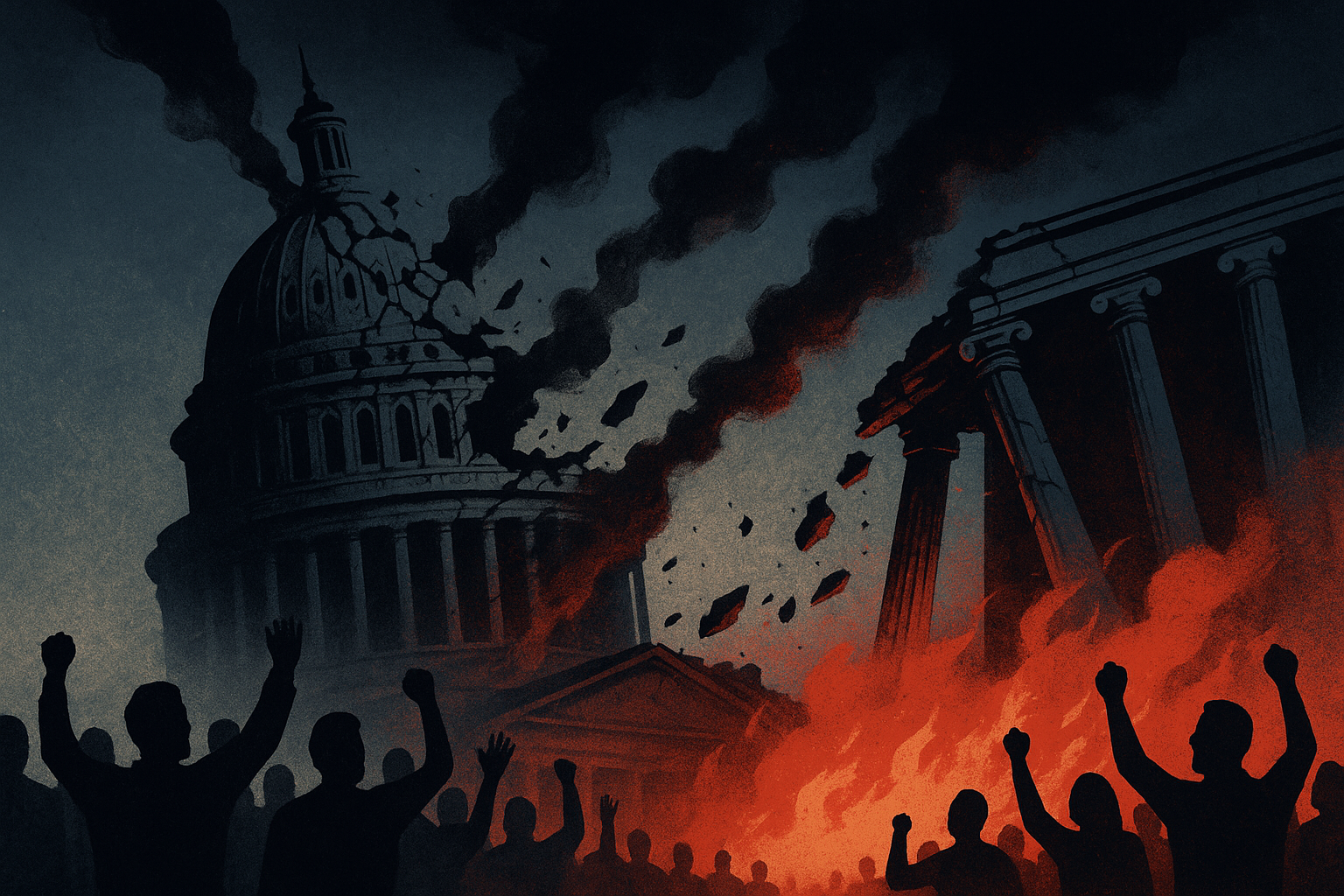
PART I — Crisis of Democracy, Explanatory Gaps in the Models
After 1989, the expectation took hold in the West—popularized by Francis Fukuyama’s talk of the “end of history”—that liberal democracy would have no serious alternative in the long run. What was meant was not the end of historical events but the end of the great ideological opponents of liberalism. Three decades later, however, the best long-term indicators show a different picture: The V-Dem Report 2025 notes that the democracy level for the “average world citizen” has fallen back to the level of 1985; moreover, for the first time in over 20 years there are more autocracies (91) than democracies (88), and around 72% of the world’s population lives in autocracies. Freedom House speaks in its 2025 report of the 19th consecutive decline in global freedom—a persistently negative trend that rules out random fluctuations. These macro data correspond to a shift in mood: In surveys, trust in institutions is declining while willingness to accept “hard” leadership figures is rising; PRRI found in 2023 that 38% of Americans “want a leader who, if necessary, breaks some rules to get things back in order.” Together this produces a syndrome of institutional erosion, erosive freedom practices, and affective polarization that purely economic or purely cultural explanations capture only partially.
This is precisely where the psychoanalytic approach of the article begins: It asks not only why people are dissatisfied but how this dissatisfaction is psychologically processed—and why the answer is so often not sober problem-solving but regression, splitting, projection, and passionate attachment to a strong leader. The guiding thesis is: The current authoritarian conjuncture feeds on a toxic resonance between leadership styles that instrumentalize primitive defense mechanisms and a late-modern subject condition marked by narcissistic injury and the search for excessive enjoyment (jouissance).
PART II — The Psychoanalytic Toolkit in Brief
The text unfolds four interlocking mechanisms. First, Freud describes mass attachment as a libidinal relationship: In the group, one’s own ego ideal is externalized onto the leader; criticism of him then feels like self-criticism. This explains the intensity and irrationality of some forms of followership. Second, Fromm resolves the paradox of “freedom”: Modern autonomy also produces isolation and anxiety; authoritarianism offers a sado-masochistic “escape from freedom” that promises security but costs autonomy. Third, Melanie Klein shows how splitting (good/evil) and projection (the unbearable is attributed to others) are reactivated in crises and produce the “architecture of enmity.” Fourth, Bion extends this with the leadership function of containment: Mature leadership “holds” collective anxiety, organizes it, and makes it thinkable and manageable; populist leadership perverts this, amplifies affects, and injects them back into the group as enemy images. Additionally, Lacan’s jouissance explains the euphoric, sometimes schadenfreude-laden pleasure in transgression that affectively charges authoritarian politics and defies rational objections.
PART III — The Unconscious in Action: Rhetoric, Cases, Data
In the case of Trumpism, “perverted containment” becomes particularly clear. Trump’s inaugural address painted a picture of “American carnage”—not an ordering translation of real problems but an emotional injection of apocalyptic images that produces dependence on the savior. As early as 2016, he staged omnipotence (“I alone can fix it”). He declared media opponents “enemies of the American people,” and on January 6 he called out “We fight like hell” before the march on the Capitol. This rhetoric bundles splitting, projection, and the license for transgression—precisely the affective grammar the article describes.
In Germany, the AfD shows how memory-political injuries are politicized: Alexander Gauland’s trivialization of the Nazi era as a “bird dropping” and Björn Höcke’s attack on the Holocaust Memorial as a “monument of shame” mark the symbolic splitting off of the “bad” part of history in favor of a narcissistically cleansed self-image; the resentment gained from this is projected onto new scapegoats (such as Muslims).
Putinism channels the trauma of imperial loss into a permanent paranoia of the “besieged fortress.” In speeches, Putin defames internal dissent as “scum and traitors” whom “the people will spit out”—a classic attempt to vent internal aggression outward and affectively close the group.
Bolsonarism organizes jouissance as physical-aggressive transgression. Bolsonaro trivialized COVID-19 as a “little flu,” and he publicly praised the torturer Ustra—a demonstrative identification with the aggressor that offers vicarious strength to the powerless audience.
And Modi’s Hindutva project encodes splitting legally: The Citizenship Amendment Act (CAA) explicitly privileges non-Muslim immigrants and thus nourishes a majority resentment aimed at the exclusion of a large minority.
In bridging to measurement instruments of political psychology, this depth logic corresponds to affective polarization (hostility rather than substantive difference), RWA patterns (submission/aggression/conventionalism), and the Need for Chaos, which measures the pleasure in destabilizing the system—the measurable shadow of the described jouissance. The named scales make visible the empirical surface that the psychoanalytic part explains as unconscious dynamic; PRRI’s 38% figure on rule-breaking readiness locates these dispositions in the mainstream.
PART IV — The Breeding Ground: “Aggrieved Freedom” in Late Modernity
Sociologically, the article bundles the resonance space of affects in the diagnosis of aggrieved freedom: A cultural imperative toward self-optimization (“be autonomous, flexible, unique”) collides with everyday experiences of powerlessness through precarity, global complexity, and epistemic overload. From the discrepancy between grandiose ego ideal and experienced dependency arises shame; from shame becomes resentment—a moralized grudge that claims simple opponents and “stolen” jouissance. Libertarian authoritarianism responds to this paradoxically: in the name of limitless individual freedom, it turns authoritarianly against solidarity, complexity, and ambivalent reality—a “rebellion against reality” that couples conspiracy thinking, splitting logic, and rejection of dependency. Into this gap steps the populist leader with a destructive-symbiotic fit: He validates injuries, delivers culprits, offers himself as an externalized ego ideal—and organizes collective pleasure in transgression.
PART V — Consequences: Democratic Resilience Beyond Pure Rationality
From the diagnosis follows not a moral appeal to “reason” but a threefold work on the affective infrastructure of democracy. First, there is need for political containment: leadership that acknowledges fear without instrumentalizing it; that organizes complexity without denying it; and that returns agency rather than breeding dependency. Second, there is need for institutionalized resentment work: protected spaces in which injuries can be expressed, structurally reinterpreted, and translated into fair, concrete policy—recognition plus material justice. Third, there is need for the cultivation of psychological competencies such as tolerance of ambiguity and mentalization in education and public discourse. This is not psychologizing political conflicts but rather the insight that democracy presupposes psychological capacities: to tolerate reality, to understand opposition, to work through differences without annihilating them.
In short: The text deciphers an affective grammar of authoritarianism—attachment, enmity, perverted containment, jouissance—and anchors it in a late-modern subject condition of aggrieved freedom. Those who want to strengthen democratic resilience must not banish emotions from politics but change the way we deal with them: holding rather than inciting, processing rather than projecting, pleasure-aware rather than pleasure-obsessed. The empirical situation makes the urgency visible; the case studies show how the mechanisms work in practice; and the psychoanalytic perspective explains why they are so irresistible.
Sources (Selection, matching the central findings and quotations):
V-Dem, Democracy Report 2025 (Executive summary with LDI decline; Autocracies>Democracies; 72% in autocracies).
Freedom House, Freedom in the World 2025 (“19th consecutive year of decline”).
PRRI, Threats to American Democracy (2023): 38% support “a leader who breaks some rules.”
Trump quotes: “American carnage” (Inaugural Address 2017); “I alone can fix it” (RNC 2016); Tweet “enemy of the American people”; January 6 “We fight like hell.”
AfD quotes: Gauland “bird dropping” [Vogelschiss]; Höcke “monument of shame.”
Putin “scum and traitors.”
Bolsonaro “little flu”; praise for Ustra.
On the context “end of history” (contextualization of the expectation after 1989).
What is this about?
This text explains the new success of strong leaders.
It shows: Politics today is strongly determined by emotions.
Not only facts count. Emotions guide decisions.
Why is this important?
Many democracies are coming under pressure.
People are losing trust in politics and media.
Then simple answers and hard words have a particularly strong effect.
Those who understand the emotions can better protect democracy.
Core statements in brief
First: People often bind themselves emotionally to leaders.
This means: The leader becomes an inner role model. Criticism then hurts.
Second: Groups hold together internally when they paint enemies externally.
This means: One’s own problems are attributed to others.
Third: Some leaders do not calm fear but stoke it.
Fourth: Breaking taboos creates pleasure. This is called jouissance.
Fifth: Behind it all often lies an aggrieved freedom.
This means: High demands for independence, but much powerlessness in everyday life.
PART I — The Crisis of Democracy and the Explanatory Gap
After 1989, many thought: Liberal democracy will prevail worldwide.
Today, however, major reports show setbacks.
Elections take place, but rules are being hollowed out.
Many people distrust parliaments, courts, and media.
Some wish for a strong leader “who just gets things done.”
Economic reasons only partially explain this.
Cultural conflicts also only partially explain it.
Neither says much about the intensity of the emotions.
This is exactly where the gap lies.
PART II — The Tools: How Emotions Shape Politics
Attachment to the leader:
People seek support. A leader becomes an ideal image.
This means: “He knows what is right.” This creates deep loyalty.
Splitting and projection:
In crises, many see the world only as good or evil.
They then push their own fear and anger onto others.
This creates clear enemy images and strong internal cohesion.
Leadership and containment:
Good leadership takes up fear, organizes it, and explains paths forward.
Bad, populist leadership does the opposite.
It amplifies fear, points to culprits, and keeps the crowd on alert.
Jouissance (pleasure in breaking taboos):
Crossing boundaries feels exciting.
Laughing together at opponents creates bonds.
This is how politics becomes an emotional event.
PART III — How This Shows Up in Reality
In the USA, Donald Trump often spoke of doom and betrayal.
He presented himself as the only savior.
In Germany, the AfD attacks the culture of remembrance.
This lowers shame and directs anger toward migrants.
In Russia, Putin tells of the threatened fatherland.
Internal criticism quickly counts as betrayal.
In Brazil, Bolsonaro celebrated toughness and humiliation.
In India, Modi strengthens a religious majority nationalism.
The forms are different. The emotional logic is similar.
Researchers measure hostile feelings between camps.
They also measure pleasure in the defeats of the other side.
Some even wish for “chaos.” This shows the pleasure in destruction.
PART IV — The Breeding Ground: “Aggrieved Freedom”
Our time demands much independence and success.
But many experience precarity, complexity, and loss of control.
Between expectation and reality, a wound develops.
The feeling behind it is often shame.
Shame easily turns into resentment.
This means: Persistent grudge against “those at the top” or “the others.”
From this grows a hard attitude:
“Total freedom for me, strict rules for others.”
One rejects complexity, dependency, and ambivalence.
Populist leadership fits perfectly with this.
It confirms the injury, delivers culprits, and promises enjoyment.
PART V — What Helps? Democratic Resilience with Emotion
Facts alone are not enough. Emotions need support.
First: Good leadership calms and explains.
It honestly says what is uncertain.
It shows what citizens can do themselves.
Second: Society needs spaces for recognition.
People tell their anger there.
Moderators organize causes without scapegoats.
Participation gives self-efficacy back.
Third: Education practices ambiguity and perspective-taking.
This means: Tolerating ambiguities.
Understanding the opponent’s view without agreeing.
Also important: no pure psychologization.
Structural problems must be solved politically.
What you take away
Authoritarian politics works through emotions: attachment, enemy images, fear, pleasure.
Our time makes people vulnerable: high pressure, little control.
Populists exploit this. They deliver simple enemies and strong enjoyment.
Democracy remains stable when fears are held, resentments are worked through,
and complexity is made understandable.
You can pay attention to:
Who really calms? Who stokes fear?
Who explains paths? Who only points to culprits?
This is how you recognize whether politics leads maturely or seduces regressively.
The Explanatory Gap – The Crisis of Liberal Democracy and the Limits of Rational Models
The Democratic Recession
With the end of the Cold War, liberal democracy seemed to have emerged as the unchallenged, universal model of political organization. Francis Fukuyama (1992) coined the term “end of history” for this perception in his influential thesis, thereby articulating the dominant expectation of an entire epoch: The combination of market economy and liberal-democratic institutions had proven to be the evolutionarily superior, final model. At the beginning of the 21st century, however, this certainty has given way to a deep and troubling disillusionment. Liberal democracy is not on an unstoppable march of triumph, but rather in a profound, global crisis. Phenomena that many in the West considered historical relics—authoritarian nationalism, personality cults, open contempt for rule-of-law procedures and minority rights—have returned to the world political stage with new, virulent force.
The diagnosis of a global democratic crisis is not a polemical claim, but the consistent finding of the most important, methodologically diverse long-term projects measuring democracy quality worldwide. The findings from institutions such as Freedom House and the V-Dem Institute converge on an alarming conclusion: The wave of democratic expansion observed since the end of the Cold War has not only come to a halt but has reversed itself.
The “Varieties of Democracy” (V-Dem) project, based at the University of Gothenburg, paints perhaps the most dramatic picture of this development in its Democracy Report 2025. The average level of liberal democracy in the world, as measured by the Liberal Democracy Index (LDI), has fallen back to 1985 levels. This means the democratic gains of nearly forty years have been nullified at the global level. The picture becomes even more drastic when weighted by population: The average world citizen today experiences a level of democracy last observed in 1985. This development manifests in a fundamental shift in the global balance of power. In 2024, the number of autocracies (91) exceeded the number of democracies (88) for the first time since 2002, with 72% of the world’s population now living in autocracies. This rise is not primarily due to classic military coups, but to the ascent of so-called electoral autocracies. These are regimes that hold elections but systematically hollow out rule-of-law and liberal institutions—free media, independent judiciary, protection of minority rights—until the electoral act itself becomes a façade without genuine competition. Large, populous states like India under Modi or Turkey under Erdoğan are prime examples of this creeping process of “autocratization without coup.” The crisis affects not only young or fragile democracies. V-Dem also measures significant declines in established Western democracies, and EU member states like Hungary in particular have completely lost their status as liberal democracies.
This picture is impressively confirmed by Freedom House’s analyses. The Freedom in the World 2025 report marks the 19th consecutive year in which the number of countries with setbacks in political rights and civil liberties exceeds those with advances. This unprecedented continuity over nearly two decades rules out random fluctuations and documents a persistent negative trend. The global balance has shifted: The number of countries classified as “Free” has steadily declined, while the number of “Not Free” and “Partly Free” has increased. The titles of Freedom House reports themselves tell the story of an escalating crisis, from “Democracy in Crisis” (2018) to “The Uphill Battle to Safeguard Rights” (2025), reflecting growing urgency. The methodological convergence of findings from V-Dem and Freedom House is significant. Although the projects use different definitions and indicators, they paint the same picture, lending the diagnosis of “democratic recession” extraordinary robustness.
This institutional decay observed at the macro level finds its subjective echo in an equally profound shift in public opinion. Data from major international survey projects such as the World Values Survey (WVS) or global studies by the Pew Research Center document a progressive erosion of trust in the core institutions of liberal democracy. In many countries, trust in parliaments, governments, the judiciary, and political parties is declining. However, this loss of trust does not necessarily lead to calls for more democratic participation, but often to its opposite: the longing for authoritarian solutions. WVS data show significant agreement with statements like: “We need a strong leader who doesn’t have to bother with parliament and elections.” A particularly alarming study by the Public Religion Research Institute (PRRI) in 2024 found that four in ten Americans are susceptible to authoritarian tendencies; 38% of respondents agreed they needed a leader willing to “break some rules” to set things right. At the same time, the crisis of trust manifests in extreme affective polarization. This is no longer just about different political opinions, but about deep emotional resentment in which the political opponent is no longer perceived as a legitimate competitor but as an immoral and existential enemy.
A first look at the landscape of contemporary democracies thus yields a clear, threefold crisis syndrome: progressive institutional decay, a palpable erosion of freedom rights, and a profound loss of citizen trust that manifests in authoritarian longings and affective polarization. This empirical reality raises an urgent question: What driving forces underlie this global authoritarian turn, and why do established explanatory models seem to reach their limits in the face of its affective force?
The Puzzle of Affective Attachment: Why Rational Explanations Fall Short
Political and social sciences have developed two dominant explanatory strands for the democratic recession, which can be roughly summarized as economic and cultural theses. Both approaches undeniably provide important insights and capture essential correlations. Nevertheless, they reach a critical limit when it comes to explaining the specific affective quality and the often paradoxical, irrational logic that constitute the core of today’s authoritarianism. They describe the symptoms of the crisis but do not always penetrate to the deeper psychological mechanisms that produce these symptoms in the first place.
The economic explanation, often discussed under the heading of “economic anxiety,” postulates that globalization, deindustrialization, and growing inequality have created a class of “modernization losers.” These population groups, threatened by economic precarity and status loss, turn in their desperation to populist actors who promise simple solutions, protectionism, and the identification of clear scapegoats—whether migrants, free trade agreements, or a detached global elite. This approach is plausible and supported by the fact that populist electoral successes are often particularly pronounced in regions with high unemployment and structural change. Nevertheless, crucial anomalies remain. On the one hand, supporters of authoritarian movements are by no means recruited only from the economically marginalized; often wealthy middle classes or even elites belong to their most loyal base, whose motivation can hardly lie in material need. On the other hand, voting behavior often contradicts direct economic self-interest, as when workers vote for politicians whose programs include tax cuts for the rich and cuts to social benefits. Above all, however, the economic model explains the occasion for anger and frustration, but not the specific form and intensity of the political reaction: the quasi-religious veneration of a leader figure, the almost loving devotion to a movement, or the deep, pleasurable satisfaction derived from humiliating the political opponent.
The second major explanatory approach, known as the “cultural backlash” thesis (Inglehart & Norris, 2019), shifts focus from economic to cultural factors. It argues that the rapid social change of recent decades—the increasing acceptance of LGBTQ+ rights, the strengthening of women’s rights, demographic shifts through migration, and the establishment of cosmopolitan values—has triggered a reactionary counter-movement among population groups with traditional values. These groups perceive the change as an existential threat to their way of life, their identity, and their social status. Populism here becomes the voice of those who feel culturally marginalized and long for a return to a supposedly more orderly, more homogeneous past. This approach is also strongly empirically supported, as cultural attitudes are often a better predictor of populist voting behavior than income situation alone. But here too an explanatory gap remains. The model explains that there is a values conflict, but not why this conflict takes such a radical, Manichaean form in which the opponent becomes an existential enemy. Nor does it explain the paradox of why defenders of traditional values often rally behind leadership figures who themselves trample on all traditional morality. The attraction of the transgressive, norm-breaking leader cannot be explained solely by the desire to preserve tradition.
Both explanatory models are thus necessary but not sufficient. What tends to remain unilluminated in their analyses is the psychological process that transforms objective social and economic burdens into a specific, highly affectively charged political subjectivity. What is missing is a theory that captures the inner, affective logic of this transformation. This is precisely where the necessity of a psychoanalytic perspective comes in. It does not ask whether people are dissatisfied, but how they psychologically process this dissatisfaction. Why is the reaction to fear and loss of control not rational problem-solving, but often a regression to primitive defense mechanisms like splitting and projection? Why is the attachment to a leader so intense and unshakeable that it resembles a libidinal bond rather than a political agreement? And why, perhaps most provocatively, does collective aggression and transgression seem to involve an unmistakable, pleasurable enjoyment? These questions about the psychic “energy” that drives these movements can only be answered through a depth perspective. Psychoanalysis, with its vocabulary, offers the crucial concepts for analyzing this politicized unconscious and decoding the hidden grammar of the seemingly irrational passions that shape contemporary politics.
Thesis and Structure of the Article: The Politicized Unconscious as Key
It is precisely at this point, at the limit of the purely rationally explicable, that the perspective of this article begins. It argues that the current conjuncture of authoritarian politics cannot be understood without illuminating the unconscious, affective foundations that underlie it. A psychoanalytic model of the political subject and the group is proposed that focuses on the unconscious management of anxiety, the regulation of grievances, the logic of narcissistic needs, and the paradoxical search for an excessive enjoyment, a jouissance. This perspective makes it possible to decode the hidden affective grammar that structures the seemingly irrational in the political field. The goal is to analyze the phenomenon of the “politicized unconscious”—that sphere in which private anxieties and unconscious fantasies become collective political energy.
The central thesis of this article is therefore that the authoritarian turn is driven by a psycho-social syndrome based on a toxic resonance between two poles: on the one hand, destructive leadership styles that deliberately instrumentalize primitive defense mechanisms such as splitting, projection, and a “perverted containing”; and on the other hand, a specific psychological disposition in parts of late-modern society that feeds on a deep narcissistic injury—”aggrieved freedom.” The populist leader thus offers a pathological but affectively highly effective solution to a real psychological emergency. A “destructive-symbiotic fit” emerges in which the leader does not calm his followers’ fears but instrumentalizes them to establish an unshakeable, libidinal bond.
To develop this thesis, the article follows a systematic structure. Part II will first lay out the psychoanalytic toolkit and define the central mechanisms—from Freud’s theory of mass bonding through Klein’s concepts of splitting and projection, Bion’s model of containment to Lacan’s concept of jouissance—in their political application. Part III will then demonstrate the empirical evidence for these mechanisms in the political field. Using qualitative discourse analyses of exemplary case vignettes (including Trumpism, AfD, Putinism), it will demonstrate the affective grammar of authoritarianism in practice and bridge to quantitative correlates from political social psychology (including RWA, affective polarization). Part IV analyzes the specific sociological breeding ground of this development and introduces the concept of “aggrieved freedom” as the core diagnosis of late-modern subjectivity. Finally, Part V will draw conclusions from this diagnosis and discuss implications for strengthening democratic resilience that must go beyond purely rational appeals.
The Psychoanalytic Toolkit – A Grammar of Unconscious Political Dynamics
The Logic of Bonding: Libido, Ego Ideal, and the Fear of Freedom
Perhaps the most fundamental and provocative question posed by charismatic authoritarian movements is: Why do people voluntarily, often enthusiastically, submit to a leadership that curtails their autonomy and drives them to actions that run counter to their rational interests? The answer that psychoanalysis offers shifts the analysis from the level of political calculation to that of affective economy. The bond to a leader, according to Sigmund Freud’s fundamental insight, is not a rational agreement but a profoundly libidinal process, a form of love.
Freud’s revolutionary step in Group Psychology and the Analysis of the Ego (Massenpsychologie und Ich-Analyse, 1921) was to derive the cohesive force of groups not from a postulated “herd instinct” but from the architecture of the psychic apparatus itself. He understood the emotional bonds within a group as “aim-inhibited” libidinal drives—that is, as forms of love whose original sexual aim had been transformed into tender, comradely, or reverential affection. The central mechanism that transforms an unstructured crowd into a psychologically coherent mass is a double identification that unfolds along a vertical and a horizontal axis.
The vertical axis of this structure is the decisive one: Every individual in the group performs a consequential psychic exchange by putting one and the same object—the leader—in the place of their own ego ideal. The ego ideal is that agency in the psyche that emerges from early identifications with parents and other authority figures. It represents the sum of one’s own aspirations, values, and moral standards; it is the idealized image of what one wants to be and the source of self-criticism when one fails to live up to this ideal. In the mass, this deeply personal, inner agency is now externalized and projected onto an external figure. The leader becomes the shared, externalized conscience and ideal of the group. He is loved not for what he accomplishes in real politics, but for embodying the narcissistic perfection that the individual strives for in themselves. Critical distance from the leader vanishes, for to criticize him would be tantamount to criticizing one’s own, now externalized, ideal. Freud compares this state of suggestive submission and loss of reality to that of hypnosis: The individual behaves as if in a trance, their autonomous judgment suspended in favor of the unquestioned authority of the leader.
From this primary, vertical bond emerges the second, horizontal axis of group cohesion. Because all members of the mass love the same object and have put it in place of their ego ideal, they become equal to one another. On this one point, they are identical. They now identify with each other on the basis of this shared, common love. Freud describes this as a symbolic repetition and overcoming of the original rivalry of the “brothers” for the favor of the primal father. In the mass, there prevails a kind of enforced equality and comradeship, which can only be had at the price of common submission to the same master. This model cogently explains the often-observed phenomena in authoritarian groups: the loss of individual judgment, the high suggestibility, the emotional contagion, and the often self-sacrificing loyalty to the leader and the group.
Freud’s analysis, however, leaves a crucial paradox unresolved. On the one hand, the modern subject is shaped by the ideal of autonomy and self-determination—a striving that represents not only a central promise of the Enlightenment but can also be understood as a fundamental psychological need (cf. Deci & Ryan, 2000). Even Freud, who emphasized the power of unconscious drives, described the ego as an agency that constantly struggles for its relative autonomy against the demands of the id, the commands of the superego, and the demands of the external world. On the other hand, his model of mass psychology describes precisely the willing surrender of this hard-won autonomy. How can this contradiction be resolved?
This is where Erich Fromm’s analysis in Escape from Freedom (Die Furcht vor der Freiheit, 1941) comes in. Fromm resolves this paradox by describing freedom itself as a dialectical, contradictory experience. He argues that the historical process of individuation, which freed humans from the primary bonds of the Middle Ages (family, estate, church), granted them a “freedom from” external coercion. But this process simultaneously thrust the individual into existential isolation, powerlessness, and anxiety. The burden of having to shape one’s own life alone, without predetermined structures and certainties, becomes an unbearable burden for many. “Freedom from” does not automatically lead to “freedom to”—the ability to shape one’s own life creatively and in solidary connection with others.
From this “fear of freedom,” this unbearable feeling of isolation, arise psychic escape mechanisms. The most relevant for political analysis is authoritarianism, which Fromm describes as a sado-masochistic character structure. The masochistic aspect is the urge to submit to an overwhelming external power—be it a leader, the state, or the nation—in order to shed the burden of one’s own isolated existence. In this symbiotic fusion, the weak ego finds a sense of strength and security that it cannot draw from itself. The sadistic aspect is the complementary tendency to exercise power over others perceived as weaker in order to compensate for one’s own feeling of powerlessness.
Fromm’s analysis thus provides not only a supplement to Freud but the key to his contemporary relevance. Freud’s model describes the psychic mechanism of the exchange—the surrender of the ego ideal for a libidinal bond. Fromm’s analysis provides the historical-sociological explanation for why this exchange becomes such a tempting, if destructive, offer for the modern subject. The seemingly irrational devotion to an authoritarian leader is, from this perspective, a psychologically functional, if pathological, solution to a real existential problem: It trades the painful freedom of the isolated individual for the pleasurable security of the bound mass. This fundamental model of vertical bonding and the associated longing for submission is the first and most important building block in the psychoanalytic toolkit.
The Architecture of Enmity: Splitting, Projection, and Aggression Discharge
Having established the vertical, libidinal bond to a leader figure as the central mechanism of group formation, the analysis must turn to the horizontal dimension: How does the group constitute and stabilize itself as a community? The answer from psychoanalysis is as sobering as it is illuminating: Love inward requires and is nourished by hatred outward. The psychic architecture of populist and authoritarian movements is fundamentally an architecture of enmity. It rests on primitive defense mechanisms rooted in early childhood but capable of being reactivated with devastating force in times of collective anxiety and regression. The central building blocks of this architecture are splitting, projection, and the resulting “narcissism of small differences.”
The most fundamental operation is splitting, a concept developed primarily by psychoanalyst Melanie Klein in her work on early childhood development (Klein 1946). Klein observed that the infant, in order to cope with the overwhelming experience of dependency and frustration, divides its world into radically separate, unambiguous parts. The object of desire and hatred—the mother’s breast—is not simultaneously good (nourishing) and bad (withholding), but is split into an idealized, purely good object and a persecutory, purely bad object. This mechanism protects the good object and the good self from one’s own destructive, aggressive impulses. It creates a psychically manageable, if distorted, reality by eliminating the unbearable complexity and ambivalence of the world. In political crises characterized by uncertainty, loss of control, and anxiety, collectives tend to regress to this state Klein called the paranoid-schizoid position. Political reality is no longer perceived in its contradictory complexity but is split in a Manichaean schema: There is only an idealized “We” (the pure, virtuous, suffering people) and a demonized “They” (the corrupt elite, the dangerous foreigners, the treacherous media). Compromise becomes betrayal in this logic, nuance becomes weakness, and empathy with the opponent becomes collaboration. Splitting offers immense psychic relief; it replaces tormenting uncertainty with clear, morally unambiguous certainty and creates, as one might say, an “emotionally digestible” problem.
Once the world is split, the second mechanism comes into play: projection. The split-off, unwanted, and unbearable parts of one’s own self or one’s own group—aggression, greed, corruption, sexual impulses, weakness, stupidity—are not simply denied but actively externalized and attributed to another object. This external object, the scapegoat, now becomes the bearer of everything the “We” does not want to be. Political rhetoric is full of such projections: The corrupt elite denouncing the greedy populist; the aggressive nationalist accusing the pacifist of warmongering; the movement that preaches intolerance while staging itself as victim of a “dictatorship of opinion.” Projection serves narcissistic purification: By locating evil outside, the inside can be fantasized as pure and good.
Karyne Messina (2022) and other contemporary analysts emphasize here the further development of the concept into projective identification, also a term introduced by Klein (1946). Unlike simple projection, where the Other merely serves as a screen for one’s own fantasies, projective identification is an interpersonal process. The projector unconsciously attempts to make the recipient of the projection actually feel and behave according to the projection. A populist leader who projects his own paranoid fear of betrayal and persecution onto his followers will communicate in such a way that these followers actually develop fear and persecution mania. Their subsequent aggressive reaction to supposed enemies (like journalists) is then reinterpreted by the leader as “proof” of the original threat. A self-fulfilling prophecy emerges, a toxic interaction loop in which the leader not only mirrors his followers’ feelings but actively induces them and then harvests them as confirmation of his own worldview. This mechanism explains the often-observed hermetic closure of populist echo chambers, in which reality is no longer corrected from outside but is permanently recreated from within.
The crucial question, however, is what function this outward-directed aggression has for the group itself. Here the circle closes back to Freud and his concept of the “narcissism of small differences” from Civilization and Its Discontents (Das Unbehagen in der Kultur, 1930). Freud observed that the fiercest hostilities often break out not between radically different strangers but between very similar, neighboring communities. He argues that this aggression has an economic function for the libidinal household of the group. The brotherly love arising from the horizontal identification of members is fragile; it is permanently threatened by the suppressed but not vanished rivalries and aggressive impulses between individuals. To secure inner cohesion, this aggression must find an outlet. The neighboring “Other,” who is so similar that their minor deviations particularly challenge one’s own identity, is the perfect target. By discharging its aggression onto this external enemy, the group pacifies itself internally. Shared hatred outward becomes the cement that holds love inward together. Freud formulated this unmistakably: “It is always possible to bind together a considerable number of people in love, so long as there are other people left over to receive the manifestations of their aggressiveness.”
This architecture of enmity thus forms a psychodynamically stable, if highly destructive, structure. Splitting provides the binary logic (Good vs. Evil). Projection provides the content (the enemy is the embodiment of our own disavowed vices). Projective identification ensures the dynamic stabilization of this reality distortion. And the narcissism of small differences explains the social function of the whole maneuver: maintaining group cohesion through channeled aggression. These mechanisms are not merely a description of pathological politics; they reveal the unconscious, affective logic that makes authoritarian and populist movements so attractive and psychologically “functional” for their members. They offer an apparent solution to unbearable inner and outer tensions, the price of which, however, is the destruction of empathy, reality testing, and ultimately the foundations of democratic coexistence. Having now laid out the basic psychological grammar of bonding and enmity, the crucial question arises: What role does political leadership play in actively orchestrating and maintaining this destructive architecture?
The Function of Leadership: Containment and Its Perversion
Having laid out the basic mechanisms of bonding to an authority and demarcation through enmity, the active role of political leadership now moves to the center of analysis. When collectives are seized by anxiety, uncertainty, and the feeling of loss of control, the psychological function of leadership becomes the decisive variable. It determines whether a society processes these burdens constructively and learns from them, or whether it disintegrates into regressive, destructive patterns. The vocabulary for describing this decisive function is provided by British psychoanalyst Wilfred Bion with his concept of containment.
In his works, particularly Experiences in Groups (1961) and Learning from Experience (1962), Bion originally developed his theory from observing the mother-infant dyad. He understood this process as the prototype for every form of psychological growth and learning. The infant, according to Bion, is overwhelmed by raw, unbearable sensory and emotional impressions that he termed beta elements. These are not thoughts in the proper sense, but unthought, unprocessed fragments of experience—pure anxiety, rage, pain, confusion. Since the infant does not yet possess its own apparatus for processing these states, it must evacuate them. It projects them into another person: the mother, who functions as container. A “good enough” mother, according to Bion, receives these projected beta elements without being overwhelmed by them herself. Through her capacity for reverie—a kind of dreamy, empathic receptivity—she can hold, digest, and give meaning to the child’s raw affects. This transformation process, which Bion calls the alpha function, converts the unbearable beta elements into alpha elements: digested, symbolized, and thus thinkable, dreamable, and communicable psychic contents. The mother returns this processed experience to the child, which can now have the experience that its unbearable feelings are not destructive but can be held and understood. Through countless repetitions of this cycle, the child internalizes the mother’s alpha function and thus develops its own thinking apparatus.
Transferred to the political level, in a healthy society, democratic institutions, public discourse, and especially political leaders function as such a container for collective anxieties. In times of crisis—whether a pandemic, an economic crisis, or profound social change—the population is flooded with beta elements: diffuse anxieties about the future, rage over perceived injustice, confusion in the face of complex information. A “containing” leader acts here like the Bionian container. They receive these raw affects by openly acknowledging and validating the population’s fears (“I understand your concerns”). They do not ward them off or mock them but offer a framework in which these emotions have a place. They then apply their alpha function: They sort the complexity, translate confusing information into a coherent narrative, name causes, outline options for action, and convey a sense of rational control and grounded hope. They return the processed anxieties to society in the form of clear, manageable alpha elements. The result is a reduction in collective panic and a strengthening of society’s ability to cooperate as a “work group” on the real solution to the problem, rather than regressing into primitive defense mechanisms.
Contemporary psychoanalytic political research, particularly the work of Karin Zienert-Eilts (2020) and Michael Diamond (2023), has pointed to a pathological reversal of this process that is central to understanding modern populism: “perverted containing.” The populist or authoritarian leader also acts as a container, but they pervert its function. Instead of receiving the population’s beta elements, detoxifying them, and returning them in processable form, they actively amplify, inflame, and inject additional beta elements into the collective. The process runs in reverse: The leader receives the diffuse anxieties and resentment of their followers, but instead of processing them through their alpha function, they charge them ideologically, intensify their paranoid quality, and project them back onto clearly defined scapegoats in an even more toxic, concentrated form. They essentially tell their followers: “Your worst, most irrational fears are not only justified, they are the only truth. Your hatred is not just understandable, it is a moral duty.”
This mechanism systematically undermines the group’s capacity for thinking and reality testing. It aims to create a state of permanent emotional arousal and archaic dependence on the leader who orchestrates this chaos while simultaneously staging himself as the only savior. The leader becomes not the holding container but the accelerant. This process induces a collective relapse into a psychic state that Bion described as the basic assumption group. Instead of functioning as a rational work group, society now acts according to an unconscious, emotional logic. Above all, the basic assumption of Fight/Flight (baF) is activated: The entire reality of the group is defined by the existence of an enemy or existential threat. All energy is devoted to fighting this enemy—who may be internal (“the corrupt elite,” “the traitors”) or external (migrants, other nations)—or fleeing from it. Any form of complexity, diplomacy, or empathy is viewed as betrayal of the fighting community. At the same time, the basic assumption of Dependency (baD) is fueled: By permanently presenting the threat as existential and overwhelming, the longing for an omnipotent, idealized leader who alone seems capable of saving the group grows (“I alone can fix it”).
What Zienert-Eilts describes as a “destructive-symbiotic fit” emerges. The leader, often themselves shaped by a narcissistic or paranoid structure, needs the constant admiration and projected aggression of the mass to stabilize their own fragile self. The mass, in turn, needs the leader to externalize their unbearable anxieties and to receive a license to act out their own repressed aggression. This system cannot exist in a state of rest; it requires, as Zienert-Eilts emphasizes, “permanent escalation.” New crises must constantly be staged, new enemies identified, and new taboos broken to maintain the high level of affective arousal that cements the libidinal bond between leader and followers.
The attack on society’s alpha function is thus an attack on democracy itself. The capacity for thinking, reflection, and tolerance of ambiguity and contradictory perspectives are the psychological prerequisites for a functioning democratic discourse. “Perverted containing” systematically attacks these capacities by replacing thinking with raw affect, complexity with false certainty, and cooperation with splitting. The erosion of democratic norms is thus not just a political process but the visible symptom of a deeper psycho-social attack on a society’s collective thinking and processing capacity. But this destructive dynamic is not driven by anxiety and defense alone. To understand its full power, we must now turn to its hidden source of pleasure.
The Economy of Enjoyment: Jouissance and the Pleasure in Transgression
The analysis so far has focused on the defense mechanisms that societies adopt in times of crisis: the libidinal flight into submission, the splitting of the world into good and evil, the projection of guilt, and the instrumentalization of anxiety through a perverted leadership function. This perspective, based primarily on the management of unpleasure, anxiety, and narcissistic injury, is however incomplete. It explains the passive, reactive side of the phenomenon—the flight from something—but does not capture the active, energetic, and often euphoric quality that these movements have for their participants. To understand the full affective force and almost addictive binding power of authoritarianism, we must turn to one of the most provocative concepts of post-Freudian psychoanalysis, developed primarily by Jacques Lacan and made productive for political theory by thinkers like Slavoj Žižek: jouissance.
The French term jouissance is usually left untranslated because it encompasses more than the German terms “Genuss” or “Lust” (enjoyment or pleasure). To understand it, one must distinguish it from Freud’s concept of the pleasure principle. The pleasure principle is a homeostatic, economic principle. It aims to reduce psychic tension and establish a state of relative calm and satisfaction. It operates according to the logic of moderation and self-preservation. Jouissance, on the other hand, is the exact opposite: It is an excessive, overflowing enjoyment situated “beyond the pleasure principle.” It is a pleasure so intense it tips into pain, a satisfaction connected with destruction and the death drive. It is the enjoyment experienced in excess—in eating to the point of nausea, in exercise to the point of exhaustion, in the compulsive repetition of a traumatic experience.
Crucial for political application is Lacan’s insight that jouissance is inseparably connected with the law, prohibition, and the symbolic order. The law does not only forbid enjoyment; paradoxically, it first creates it. The forbidden acquires a special, pleasurable charge through the prohibition itself. Jouissance lies not in reaching the object itself, but in the act of transgression, in the pleasurable crossing of the boundary that the law marks. The populist leader, according to the Lacanian reading, is not primarily a father figure offering protection (as in Freud), but an agent of jouissance. They are an agency that grants their followers a license for transgression. Their political style, often criticized as vulgar, undisciplined, or “unpresidential,” is from this perspective not a flaw but their central function. Their constant breaking of taboos, their disregard for “political correctness,” their open attacks on the norms of civilized discourse are a performative invitation to their followers to share in this transgressive enjoyment. The message of the authoritarian superego, according to Žižek, is not the prohibitive “Thou shalt not!” but the imperative command: “Enjoy!”
This organization of enjoyment often occurs through the fantasy of “stolen jouissance.” The core narrative of populism is not only “Those at the top are corrupt,” but, on a deeper, affective level: “They (the elites, the migrants, the liberals) have stolen our enjoyment from us.” They have taken our way of life, our prosperity, our pride, our national identity—in short: our jouissance—and now enjoy it in our place. The Other, the scapegoat, is fantasized as a figure who enjoys excessively and undeservedly. This narrative transforms economic or cultural conflicts into a libidinal economy of envy and grudge. Political mobilization thus becomes a struggle to reclaim this stolen jouissance. Violence against the Other is then no longer just a strategic act but a source of intense, pleasurable satisfaction, fantasized as an act of just reconquest of one’s own lost enjoyment.
This mechanism produces what Žižek, drawing on the analysis of jokes, calls “obscene solidarity.” In every official, public community there are unwritten, often obscene rules and shared enjoyments that secretly bond the group together. A dirty joke told in the right circle creates a deeper complicity than any formal agreement because it signals that one shares the unwritten, transgressive rules of common enjoyment. Populist movements bring this obscene underside of politics to the surface. Mass rallies with their hate-filled chants (“Lock her up!”), online harassment in echo chambers, collective laughter at an opponent’s humiliation—all these are rituals that produce such obscene solidarity. Participants enjoy not only their own aggression but above all the feeling of being part of a community that collectively transgresses the norms of “respectable” discourse.
The concept of jouissance is thus the crucial building block for understanding the affective energy and extreme binding power of authoritarian movements. It explains why these movements must be understood not only as flight from something (anxiety) but also as a pleasurable turning toward something (enjoyment). Jouissance is the libidinal reward for participation in the regressive process. It is the fuel that keeps the engines of splitting and projection running. It is the euphoric experience that makes “perverted containing” so attractive because it not only channels anxiety but promises pleasure. Finally, it explains the paradox of self-harm: Followers often remain loyal to a leader even when his policies objectively harm them, because the psychic gain—participation in collective, transgressive jouissance—in the short term overcompensates for material loss. Without the concept of jouissance, the analysis of authoritarianism remains a mere pathology of anxiety; only with it does it become a complete theory of unconscious political passions.
The Unconscious in Action – Evidence from Discourse and Data
Having laid out the psychoanalytic toolkit for analyzing authoritarian dynamics in the previous section, the decisive question of its empirical relevance arises. Are concepts like splitting, perverted containment, or jouissance more than merely suggestive metaphors? Can their traces be detected in the real political world? This section will argue that they can. It will do so on two levels: first, through a qualitative discourse analysis that reveals the “affective grammar” of authoritarianism in the rhetoric of leading populist movements; and second, by bridging to quantitative political psychology, showing how these unconscious mechanisms correlate with measurable attitudes and behaviors.
Qualitative Evidence: The Affective Grammar in Political Rhetoric
Language is not merely a medium for transmitting information; it is the primary stage on which unconscious fantasies, defense mechanisms, and affective bonds are enacted. A psychoanalytically informed discourse analysis can uncover these latent structures in the manifest text. The following exemplary vignettes illustrate how the mechanisms described in Part II operate in political practice.
Case Vignette: Trumpism
The rise of Donald Trump and the movement he shaped, Trumpism, represent a paradigm case for psycho-political analysis. Hardly any other political movement in recent Western history has so openly and systematically deployed primitive psychological defense mechanisms and generated such an intense, libidinal bond between a leader and his base. The analysis of this movement makes it possible to observe the mechanisms laid out in Part II in their purest and simultaneously most complex form.
A central mechanism is perverted containment. Instead of calming the diffuse anxieties about economic decline, cultural change, and status loss in the population and translating them into rational policy, Trump systematically did the opposite. His inaugural address of January 20, 2017, is exemplary in this regard. Rather than sending a conciliatory message of unity and optimism, he painted the picture of a country on the brink of the abyss, marked by decay, crime, and hopelessness:
“Mothers and children trapped in poverty in our inner cities; rusted-out factories scattered like tombstones across the landscape of our nation… And the crime and the gangs and the drugs that have stolen too many lives… This American carnage stops right here and stops right now.” [Inaugural Address, January 20, 2017]
The metaphor of “American carnage” is decisive here. It takes up real social and economic problems, but it does not transform them into solvable political tasks. Instead, they become what Bion termed beta elements: raw, undigested, and anxiety-inducing impressions. The images of “tombstones” and “carnage” are not rational analysis but an emotional injection of panic and despair. A “containing” leader would at this point use the alpha function to translate these anxieties into a rational framework for action. Trump, however, fans the raw affects to establish a state of permanent crisis, in which he can then present himself as the sole, omnipotent savior. This pattern is found in his repeated claim that only he could fix the problems, as in his 2016 nomination speech: “I alone can fix it.” This rhetoric creates psychological dependency. The fear that the leader himself stokes can seemingly only be banished by him. This produces what Zienert-Eilts calls a “destructive-symbiotic fit”: The leader makes his followers dependent on the fear he himself produces, because only he promises salvation.
This perverted containment is enabled by the fundamental mechanisms of splitting and projection. Complex reality is systematically dismantled into a Manichaean world of innocent victims and demonic perpetrators. The cause of the described “carnage” in Trump’s narrative is not a complex socioeconomic development but a clearly defined, malevolent entity: the “establishment” that “protected itself, but not the citizens of our country.” The world is radically split into an innocent, suffering “people”—”the forgotten men and women of our country” (Inaugural Address, 2017)—and a treacherous, corrupt “elite.” Critics, media, and political opponents are branded not as part of democratic discourse but as enemies of the people. One of his most notorious statements in this context was:
“The fake news media… is not my enemy, it is the enemy of the American people!” [Tweet, February 17, 2017]
This rhetoric erases every form of ambivalence and relieves followers of the arduous task of tolerating contradictory realities. Closely linked to this is projection. Unwanted personal qualities, impulses, and actions are systematically transferred onto the opponent. Psychoanalyst Karyne Messina (2022) has identified this mechanism as central to Trump’s communication style of “blame-shifting.” A classic example is his reaction to accusations of election manipulation. While he himself and his team attempted to overturn the 2020 election result through pressure on election officials and false claims, he projected the act of “stealing” entirely onto his opponents. His speech on January 6, 2021, is a textbook example of projection:
“We all know that our election was stolen from us… and from the fake news media… We will never give up. We will never concede… You don’t concede when there’s theft involved.” [Speech on January 6, 2021]
Here the disavowed personal impulse—the refusal to acknowledge a defeat and thus to “steal” the democratic rules of the game—is attributed to the opponent, who is then accused of “theft.” Beyond mere projection, Trump used projective identification to deposit his own affects into the mass and move them to action. The storming of the Capitol was the culmination of this process. Trump’s angry accusation of “theft” was not merely an assertion but an emotional induction. He transferred his narcissistic injury over the election defeat and his aggressive rage onto the assembled crowd. His words were a direct invitation to identification and to acting out this affect:
“We fight like hell. And if you don’t fight like hell, you’re not going to have a country anymore!”
In this sentence, he transfers his personal fear of loss (“if you don’t fight, you won’t have a country anymore”) and his aggressive impulse (“We fight like hell”) onto his listeners. The subsequent action of the crowd was the physical acting out of the emotions the leader had deposited in them.
Finally, the concept of jouissance explains why these dynamics are not merely endured but pleasurably experienced. Trump’s mass rallies were not mere informational events but highly ritualized spaces for generating collective arousal. The chants of “Lock her up!” are the most vivid example. They are not a political demand in the proper sense but, psychoanalytically read, a ritual of shared, transgressive pleasure. The crowd enjoys the collective breaking of civilizational and rule-of-law norms—the demand to lock up a political opponent without trial. It is, in Žižek’s words, an “obscene solidarity” that constitutes itself in collective taboo-breaking. The jouissance lies in the feeling of empowerment, of finally being able to do and say what “political correctness” forbids.
All these mechanisms were driven by a deep-seated resentment that Trump masterfully articulated and channeled. His narrative of the “forgotten men and women” spoke directly to a feeling of injury and disregard among parts of the population who felt devalued by cultural and economic elites. He gave this resentment a voice and a target. The rage was directed not at complex, structural causes but at clearly identifiable scapegoats. In his 2015 candidacy announcement, this became evident:
“When Mexico sends its people, they’re not sending their best… They’re bringing drugs. They’re bringing crime. They’re rapists. And some, I assume, are good people.”
This rhetoric transformed diffuse fears of decline and status loss into a moralized battle against an enemy portrayed as immoral and dangerous. Trumpism thus became the political form of a collective resentment that promised to turn suffered humiliation into triumphant pride. In this toxic symbiosis, reality testing is systematically replaced by a closed, paranoid fantasy, kept alive by the constant supply of fear, splitting, and the promise of jouissance.
Case Vignette: The AfD
While Trumpism is characterized by a politics of open, transgressive jouissance and grandiose narcissism, the same psychodynamic mechanisms manifest in the German context in a subtler, historically far more charged manner. The analysis of the rise of the Alternative for Germany (AfD) shows how a movement can transform the unmastered traumas and specific injuries of national postwar identity into political energy. Here, the center is not the figure of a single, overpowering leader but the mobilization of a collective, deep-seated resentment.
The central affective motor that drives the AfD and binds its followers is a deep resentment against the foundations of the Federal Republic’s postwar identity. This identity was, as Alexander and Margarete Mitscherlich analyzed in The Inability to Mourn (Die Unfähigkeit zu trauern, 1967), built on the foundation of critical engagement with the Nazi past and the assumption of responsibility. The discourse of the AfD represents a frontal assault on this founding myth. It stages the culture of remembrance not as an act of moral maturity but as a form of pathological self-flagellation, a “cult of guilt” that paralyzes the nation and undermines its legitimate pride.
The notorious statements of leading AfD politicians are not accidental slips but strategic interventions aimed at defending against collective shame and revaluing historical guilt. When the then party chairman Alexander Gauland described the Nazi era as a mere “speck of bird droppings in over 1,000 years of successful German history” (“Vogelschiss in über 1.000 Jahren erfolgreicher deutscher Geschichte”), this was a classic act of splitting and denial. The “bad,” unbearable part of national history is to be split off as an insignificant anomaly in order to restore a pure, narcissistically satisfying, and “glorious” national self-image. It is an attempt to heal a narcissistic wound by declaring the injury trivial.
Björn Höcke’s demand for a “180-degree turn in memory politics” (“erinnerungspolitische Wende um 180 Grad”) and his designation of the Berlin Holocaust Memorial as a “monument of shame” (“Denkmal der Schande”) go even further. They directly attack the central symbol of mourning work and reinterpret it into its opposite: not as a memorial to the victims but as a source of shame for the descendants of the perpetrators. This is the logic of resentment in its purest form: The inability to mourn a painful loss (that of moral integrity) leads to an aggressive revaluation, in which mourning itself is portrayed and attacked as the cause of suffering.
The psychic energy released by this defense against historical guilt needs a new target. This is where projection comes into play. The denied historical aggression and the associated fears of national dissolution are projected onto a new scapegoat: Islam and migrants. The party’s manifesto states unequivocally: “Islam does not belong to Germany.” The party constructs immigration, especially from Muslim countries, as an existential threat to German identity, as a hostile “invasion” that undermines the country’s “value system.” This rhetoric is an act of perverted containment. Instead of constructively processing real fears of social change and globalization, they are amplified into a paranoid fantasy of foreign infiltration and national decline. The party then offers itself as the only “container” strong enough to hold back this self-conjured flood.
Finally, jouissance also finds its place in the politics of the AfD, albeit in a less carnivalesque form than in Trumpism. It manifests in the transgressive enjoyment of taboo-breaking. In a society where engagement with National Socialism has become a civic norm, public relativization of this history offers a pleasurable provocation. The standing ovations and “We are the people” chants that accompany Höcke’s speeches are fed not only by political agreement but by the shared enjoyment of finally saying what was considered unspeakable. It is the pleasurable liberation from the perceived burden of “political correctness” and collective guilt. This jouissance is the affective glue that holds the movement together even when its political solutions are inconsistent or unrealistic.
The AfD thus illustrates how an unmastered national trauma can become a source of chronic resentment. The defense against historical guilt through splitting and denial leads to a deep grudge against one’s own culture of remembrance. The resulting aggressive energy is projected onto new scapegoats, while the leadership amplifies this dynamic through perverted containment. The libidinal reward for participation in this process is the jouissance of collective taboo-breaking.
Case Vignette: Putinism
While the discourse of the AfD draws from the unmastered trauma of the Nazi era and a resulting defense against historical guilt, the affective logic of Putinism in Russia feeds on a different, but structurally similar, narcissistic injury: the trauma of imperial collapse and the feeling of national humiliation after the end of the Cold War. The rise and long reign of Vladimir Putin can be psychoanalytically interpreted as a large-scale project for the psychological processing of this collective trauma—a processing that occurs not through mourning work but through the mechanisms of resentment, projection, and the manic restoration of fantasized greatness.
The central affective motor that drives Putin’s political system and secured its high legitimacy among the population for decades is a deep and widespread resentment. The 1990s under Boris Yeltsin are portrayed in the official narrative not as a phase of democratic opening but as a time of chaos, poverty, weakness, and above all humiliation by a triumphalist West. Putin’s famous statement that the collapse of the Soviet Union was the “greatest geopolitical catastrophe of the 20th century” is more than a historical assessment. It is the central sentence that names the collective narcissistic injury and makes it the starting point of his political mission. This feeling of powerlessness and loss is transformed into a moralized grudge against the West. The West, especially the USA, becomes the actor who “deceived,” “cheated,” and defrauded Russia of its rightful place in the world order during its phase of weakness.
This rhetoric performs a classic projection to justify one’s own aggression. One’s own imperial ambitions and the desire to restore a sphere of influence are denied and projected onto NATO, which is portrayed as an unstoppably expansive, aggressive force. Russia’s actions appear in this narrative consistently as a defensive, reactive necessity. The invasion of Ukraine in 2022 was accordingly framed not as an act of aggression but as a preemptive strike in self-defense against an alleged “Nazi junta” in Kyiv and an advancing NATO. In his speech announcing the invasion, Putin formulated this projective logic explicitly, claiming that the West had left Russia “no other option to protect Russia and our people.” Reality is reversed: The aggressor stylizes himself as a victim forced into violence.
Simultaneously, the world is structured through radical splitting. There exists a morally superior, traditionalist, sovereign Russia that stands for authentic values, and a decadent, hypocritical, and lying “collective West” or, as Putin put it, an “empire of lies.” This splitting is also projected inward. Russian society is divided into “true patriots” and a “fifth column” of traitors and Western agents. In a speech in March 2022, Putin made this violent expulsion fantasy explicit:
“The Russian people will always be able to distinguish true patriots from scum and traitors and simply spit them out like a gnat that accidentally flew into their mouths.”
Putin’s function as a leadership figure can be described here as a form of perverted containment. He emerged in the late 1990s to “contain” real fears of chaos and state disintegration. He offered stability, order, and an end to humiliations. This initial, legitimate containment was, however, perverted by systematically replacing inner fear of chaos with an external, paranoid fear of encirclement and attack. Putin does not calm his population’s existential fears; he channels and manages them by focusing them on a permanent external enemy. This keeps the nation in a state of the “fight-flight” basic assumption (Bion) and makes the strong, authoritarian leader indispensable as protector of the “besieged fortress.”
The affective reward for participation in this narrative is a specific form of jouissance. It is less the carnivalesque taboo-breaking of Trumpism than a solemn, almost sacred enjoyment of the restoration of national greatness. The massive, euphoric approval of the annexation of Crimea in 2014 was such a moment of collective jouissance. It was the pleasurable act of reversing a historical humiliation (the “loss” of Crimea to Ukraine in 1954) and an open transgression against the Western-dominated postwar order. Added to this is a sadistic jouissance in the form of Schadenfreude, cultivated in state media when reporting on crises and divisions in the West.
Putinism is thus a case study in how a deep, unprocessed trauma of imperial loss can be transformed into chronic resentment. This resentment is politically operationalized through projection and splitting. Leadership perverts its containment function by keeping society in a permanent state of paranoid defense. The libidinal bond is cemented by moments of triumphant, national enjoyment.
Case Vignette: Bolsonarism
The rise of Jair Bolsonaro, a long-serving backbencher considered extremist, to the presidency of Brazil in 2018 can be understood as the result of a “perfect storm” (Hunter & Power, 2019) of economic recession, a massive corruption scandal (“Lava Jato”), and an escalating crime rate. His movement, Bolsonarism, offers another vivid example of how psychoanalytic mechanisms operate in a context of post-authoritarian, fragile democracy. At the center of his appeal was not only a political program but the embodiment of a fantasized, aggressive masculinity that offered a specific form of jouissance.
The discourse of Bolsonarism is marked by a radical splitting that divides Brazilian society along moral, masculine, and religious lines. On one side stands the “cidadão de bem” (the good/decent citizen)—imagined as a hardworking, Christian family man, often armed. On the other side stand the enemies of this order: the “bandidos vermelhos” (red bandits), corrupt left-wing politicians of the Workers’ Party (PT), “gender ideologues,” landless farmers (“rabble”), and criminals. This splitting is absolute and dehumanizing. His notorious slogan, which became a catchphrase, summarizes this logic:
“Bandido bom é bandido morto.” (A good bandit is a dead bandit.)
This statement is more than just a demand for harsh law enforcement; it is an act of splitting that symbolically excludes an entire population group from the human community and releases them for killing. This Manichaean logic creates a world in which compromise is impossible and violence becomes necessary purification.
A central feature of Bolsonarism is the open identification with the aggressor. Bolsonaro consistently glorified the Brazilian military dictatorship (1964–1985) not as a dark chapter of history but as a golden age of order and patriotism. His notorious dedication of his vote in the impeachment of President Dilma Rousseff, who was herself tortured under the dictatorship, to her well-known torturer, Colonel Carlos Alberto Brilhante Ustra, whom he called “the terror of Dilma Rousseff,” was a shocking but psychologically revealing act. Here the speaker identifies not only with an authoritarian past but explicitly with the act of torture itself. For his followers, who feel powerless in the face of crime and political chaos, this identification offers a paradoxical form of empowerment: By allying themselves with the strong, ruthless aggressor of the past, they symbolically overcome their own present powerlessness.
Bolsonaro’s appeal draws significantly from the jouissance he offers. It is an enjoyment that arises from the excessive and shameless transgression of civilizational norms. His rhetoric was laced with obscenities, misogyny, and fantasies of violence. By saying the unthinkable and doing the unspeakable, he offered his followers a vicarious, pleasurable liberation from the constraints of liberal-democratic “hypocrisy.” As in the case of Trumpism, but perhaps even more directly and bodily, his followers enjoyed the provocation and the outrage of the “politically correct” elites. The mass motorcycle rallies he led were not political events but rituals of collective, phallic display of power—a staging of masculinity, strength, and transgressive freedom. It is the jouissance of a community that constitutes itself in the collective breaking of the rules of decency and political moderation.
Bolsonaro’s handling of the COVID-19 pandemic is a clear example of perverted containment. He responded to the massive fear in the population by trivializing the virus as a “gripezinha” (“little flu”) and calling on Brazilians to face it “like a man, not like a boy.” Instead of “containing” fear, he mocked and denied it. He offered his followers a narcissistic defense against the reality of vulnerability: the fantasy of standing above biological reality through masculine strength and willpower. At the same time, he projected the blame for the catastrophe onto governors, the media, and China. He delivered not security but a license for denial and an absolution from responsibility, which for many fulfilled a psychically relieving, if deadly, function.
The resentment driving Bolsonarism is multifaceted. It feeds on the grudge of the middle classes over the corruption of PT governments, the hatred of elites for leftist social programs, and the deep cultural resentment of socially conservative and evangelical groups against the progressive achievements of feminism and the LGBTQ+ movement. Bolsonaro bundled all these strands of resentment and directed them at a common enemy image: “cultural Marxism” and “gender ideology,” portrayed as internal enemies seeking to destroy the traditional Brazilian family and Christian values.
Bolsonarism thus shows how in a crisis-ridden country the fantasy of a return to an authoritarian, patriarchal order can develop an immense mobilizing force. Its appeal rested less on a political program than on the embodiment of a transgressive, aggressive father-imago that promised psychic liberation from the fears of national impotence and chaos and celebrated this liberation in a collective, destructive jouissance.
Case Vignette: Modi
The rise of Narendra Modi and his Bharatiya Janata Party (BJP) to become the dominant political force in India, the world’s largest democracy, illustrates another historically and culturally specific manifestation of populist mechanisms. While Bolsonarism mobilizes nostalgia for a military and Putinism for an imperial past, the Hindu nationalism (Hindutva) embodied by Modi draws on resentment over a perceived centuries-long subjugation of the Hindu majority culture—first under Mughal rule, then under British colonial rule, and finally under what is denounced as the “pseudo-secularism” of the postcolonial Congress Party.
The central splitting that structures Modi’s politics runs along ethno-religious lines. It separates the “true,” authentic India, defined as inherently Hindu, from internal and external “Others.” The primary target of this splitting is India’s Muslim minority, which at around 200 million people is one of the largest in the world. In the Hindutva narrative, Muslims are portrayed as descendants of invaders or as a disloyal “fifth column” of Pakistan. This splitting has been politically institutionalized, for example through the Citizenship Amendment Act (CAA) of 2019, which creates a religion-based path to citizenship for non-Muslim migrants from neighboring countries, explicitly excluding Muslims. This is the legal codification of a split into legitimate and illegitimate members of the nation.
At the same time, blame for India’s present problems is systematically projected. The failure to create jobs or sustainably combat poverty is overshadowed by a discourse that foregrounds historical injustices. The opposition, especially the Congress Party, is portrayed not as a political opponent but as the embodiment of an era of “appeasement” of minorities at the expense of the Hindu majority. Critics of the government are routinely defamed as “anti-national.” Thus Home Minister Amit Shah, a close confidant of Modi, declared illegal migrants (implicitly Muslims) to be “termites.” This dehumanizing metaphor is a classic indicator of projection: One’s own aggressive and exclusionary impulses are transferred onto the Other, who is then portrayed as a pest whose elimination is a necessity for the health of the “body politic.”
Modi’s leadership style itself offers a fascinating form of containment that bears both authentic and perverted features. On one hand, for many Indians he embodies the figure of an ascetic, incorruptible, and paternal leader who promises strength, stability, and national pride. In a society marked by poverty and insecurity, he “contains” the longing for a strong, reliable state. He often speaks of inclusive development (“Sabka Saath, Sabka Vikas”—”With all, for the development of all”). On the other hand, this containment is deeply ambivalent. While on one side he speaks a language of unity, on the other his government enables and fuels an aggressive, divisive politics. He “contains” the fears of the majority by channeling them against a minority. He offers stability for some at the price of insecurity for others.
The affective energy of this movement draws from a deep, collective jouissance that results from the restoration of wounded honor and the triumphant assertion of Hindu supremacy. Perhaps the most symbolically charged act was the construction of the Ram Temple in Ayodhya on the site where Hindu nationalists destroyed the Babri Mosque in 1992. The temple’s inauguration by Modi in 2024 was not a purely religious or political ceremony; it was a national ritual of jouissance. It was the pleasurable enjoyment of the visible reversal of a symbol of historical humiliation and the triumphant establishment of one’s own cultural hegemony. This act was a form of “reparation” through symbolic violence, offering immense narcissistic satisfaction to millions of followers.
Hindu nationalism under Modi is thus an example of how a deep, historically grown resentment of a majority group can be politically mobilized. It uses the mechanisms of splitting and projection to construct an ethnic democracy that degrades minorities to second-class citizens (Jaffrelot, 2021). The leader offers an ambivalent containment that promises stability but rests on exclusion. The libidinal bond to the movement is cemented by the intense jouissance of restoring national honor and the triumphant humiliation of the “Other.”
Overall Synthesis and Comparison of Cases
The preceding five case vignettes have illuminated the operation of psychoanalytic mechanisms in different political and cultural contexts. Although each of these movements has its specific historical and ideological character, the analysis reveals remarkable structural parallels in their affective grammar. To systematically capture these patterns and the respective particularities, the following table summarizes the central findings. It rates the prominence and describes the specific manifestation of the five core mechanisms in each of the examined cases.
Table F: Comparative Matrix of Psychoanalytic Mechanisms in Populist Movements
| Mechanism | USA (Trump) | Germany (AfD) | Russia (Putin) | Brazil (Bolsonaro) | India (Modi) |
| Projection | Strong (Systematic blame deflection and externalization of own failures onto scapegoats like “Fake News,” “Deep State,” or political opponents to maintain a flawless self-image.) | Medium (Focus on victim-perpetrator reversal, where own aggressive rhetoric is portrayed as defensive reaction to the projected intolerance of the “old parties” and “lying press.”) | Strong (Mirroring of own geopolitical aggression and imperial ambitions onto the West/NATO, portrayed as expansionist and threatening, to legitimize own actions as defensive.) | Medium (Mainly projection of corruption and incompetence onto the political left (PT) to deflect from own scandals and governmental failures.) | Medium (Projection of divisive intentions onto opposition and minorities to portray own Hindu-nationalist agenda as the only legitimate, unifying force for the nation.) |
| Splitting | Strong (Radical moral dichotomy between “patriots” and “enemies of the people.” Uncompromising stance staged as virtue, ambivalence as betrayal, dividing the political landscape into two irreconcilable camps.) | Strong (Primarily ethno-cultural splitting between the homogeneous, “true” German people and “culturally foreign” Others (esp. Muslims), supplemented by splitting into “people” vs. “system parties.”) | Strong (Extreme geopolitical and civilizational splitting into a sovereign, traditionalist Russia and a decadent, lying “collective West.” Internally: Patriots vs. “national traitors.”) | Strong (Deep ideological-moral splitting into “good, decent citizens” (Christian, conservative, armed) and “red bandits” (leftists, criminals, “gender ideologues”), portrayed as threats to be eliminated.) | Strong (Fundamental religious-nationalist splitting that separates “true Indians” (Hindus) from “Others” (esp. Muslims). Institutionalized through laws like the CAA. Creates an ethnic democracy.) |
| Containment (perverted) | Strong (Takes up fears of “American Carnage,” amplifies them into apocalyptic threat, and offers himself as sole, omnipotent savior. Fear is permanently stoked, not resolved.) | Medium (Acts as “complaint box” for concerns about foreign infiltration and status loss, but channels these fears directly into resentment and hostility rather than offering constructive solutions.) | Strong (Transforms diffuse fear of post-Soviet chaos into controlled, paranoid fear of external enemies. Offers stability at the price of permanent militarized vigilance.) | Medium (Takes up real fear of crime and corruption but perverts it into glorification of chaos and violence rather than creating order. Offers not security but license for aggression.) | Strong (Functions as paternal guarantor of strength and security who “contains” longing for order, but simultaneously maintains tensions toward minorities and Pakistan as permanent threat.) |
| Jouissance | Strong (Rally cult as transgressive ritual. Enormous enjoyment of collective taboo-breaking, humiliation of opponents, and staging of power in a carnivalesque, ecstatic atmosphere.) | Medium (More an intellectual enjoyment of taboo-breaking, provocation, and violation of German memory culture. Less bodily-ecstatic, more the joy of “forbidden” speech.) | Medium (More a state-orchestrated patriotic pathos and pride. Enjoyment lies in feeling of regained national greatness and Schadenfreude at the West’s weakness, less in individual excess.) | Strong (Strongly bodily and aggressive. Jouissance lies in open celebration of masculinity, weapons, and fantasies of violence. Enjoyment of raw, unvarnished aggression is central.) | Medium (Primarily a triumphant-religious enjoyment of visible restoration of Hindu hegemony (e.g., temple construction). Less transgressive, more a feeling of historical satisfaction and collective elevation.) |
| Resentment | Strong (Fuel is the grudge of white middle and working class over perceived status and cultural loss, projected onto globalization elites and minorities.) | Strong (Central is the grudge against the culture of remembrance perceived as “cult of guilt” and against “old parties” and EU, seen as traitors to national interests.) | Strong (Foundation is revanchist grudge over 1990s experienced as humiliation and loss of imperial status. Primarily directed against the West.) | Strong (Main source is hatred of the Workers’ Party (PT) portrayed as corrupt and morally depraved and “cultural Marxist” elites. Strong anti-elite and anti-corruption focus.) | Strong (Deep historical-religious resentment of Hindu majority against perceived centuries-long oppression by Muslims and secular elites. Grudge over “minority appeasement.”) |
Legend: Strong = The mechanism is explicit, dominant, and constitutive for the movement. Medium = The mechanism is functionally important and regularly deployed, but shares dominance with other aspects or is more subtle. The italicized terms in parentheses characterize the specific manifestation of the mechanism in the respective context.
Quantitative Correlates: Bridging to Empirical Social Psychology
The qualitative analysis of political rhetoric has vividly demonstrated how psychoanalytic mechanisms like splitting, projection, perverted containment, and the mobilization of resentment and jouissance structure the affective grammar of authoritarianism. A legitimate objection, however, might be that these are hermeneutic interpretations whose connection to the actual psychological state of the population remains speculative. This section sets out to close precisely this gap. It proposes a methodological bridge from the psychoanalytic deep structure to quantitative political psychology.
The core argument is that while the unconscious mechanisms of psychoanalysis are not directly measurable, their effects manifest in validated and measurable social-psychological constructs. A functional equivalence is assumed: A measurable political attitude or observable behavioral pattern can fulfill the same psychological function as an unconscious defense mechanism. The psychoanalytic approach explains the “why” of motivation, while social psychology provides the “what” and “who” of measurable correlates. The convergence of findings from both fields lends the psychoanalytic diagnosis robust empirical plausibility.
Splitting and the Measurement of Affective Polarization
The psychoanalytic mechanism of splitting, as described by Melanie Klein (1946), is the most fundamental operation in the arsenal of populist affect politics. Brief reminder: It denotes a primitive psychic defense that copes with the unbearable complexity and ambivalence of reality by dividing the world, objects, and one’s own self into radically separate, unambiguous parts: into idealized, purely good and into demonized, purely evil. In the political field, as the preceding vignettes have shown, splitting manifests in a Manichaean worldview that divides society into a virtuous, victimized “we” (the people) and a corrupt, malevolent “they” group (the elites, the foreigners).
This unconscious phenomenon finds its direct measurable equivalent in what modern political science terms affective polarization. This concept, popularized by researchers like Iyengar, Sood, and Lelkes (2012), describes a decisive shift in the nature of political conflict: It is no longer primarily about a growing substantive distance on political issues but about an increase in emotional aversion, distrust, and hatred between the supporters of different political camps. The political opponent is no longer perceived as a legitimate competitor but as morally inferior and threatening.
Here lies the functional equivalence between the psychoanalytic and the social-psychological concept. Affective polarization is exactly what one would expect at the level of conscious attitudes if the unconscious mechanism of splitting were collectively operative. The psychological function of both phenomena is identical: the stabilization of one’s own group identity through radical devaluation of the outgroup. Splitting is the unconscious process; affective polarization is its measurable, manifest result in political consciousness.
The empirical findings from quantitative research are overwhelming and confirm the psychoanalytic diagnosis at the level of mass phenomena. Long-term studies by the Pew Research Center for the USA, which measure precisely this emotional divide, show that the proportion of Republicans and Democrats who have a “very negative” opinion of the opposing party has risen dramatically in recent decades. It is no longer just about political differences; a growing number of supporters of both parties regard the other side as a “threat to the nation’s well-being.”
More recent research instruments corroborate this qualitative shift even more precisely. The Affective Polarization Scale (APS) developed by Campos and Federico (2025) shows that it is not merely simple dislike. Rather, polarization is composed of the conviction that the opponent is fundamentally different and foreign (Othering), socially repulsive (Aversion), and morally reprehensible (Moralization). This multidimensional measurement provides empirical confirmation of the depth of splitting: The political opponent is perceived not just as wrong but as substantially evil and contaminating—an exact parallel to the Kleinian description of the “bad object.”
What psychoanalysis adds here to the purely descriptive measurement of social psychology is a generative theory about the dynamics and motivation behind this phenomenon. It explains affective polarization not simply as the result of party competition or negative media coverage. It interprets it as a regressive defense mechanism against collective anxiety. In times of perceived crises and uncertainty, according to the psychoanalytic hypothesis, society resorts to primitive psychological functioning to cope with unbearable complexity. Splitting is the simplest, if most destructive, form of anxiety reduction. Populist rhetoric, as analyzed in the vignettes, functions as a catalyst: It offers and legitimizes splitting as an interpretive framework and thus sharpens affective polarization, the extent of which can then be precisely measured empirically.
The bridge is thus clear and empirically grounded: Psychoanalytic theory postulates splitting as an unconscious defense against anxiety. Quantitative social psychology measures the resulting affective polarization as a conscious (or preconscious) attitude with validated scales. Qualitative discourse analysis shows how political actors actively promote this splitting in their rhetoric. Together, a coherent, cross-level picture emerges that empirically plausibilizes the psychoanalytic diagnosis.
Authoritarian Dispositions and Their Correlates in RWA and SJT
While splitting represents the fundamental perceptual matrix of authoritarian discourse, the psychoanalytic theory of the authoritarian character provides the explanation for the motivational readiness of individuals to fit into this split world and subordinate themselves to a higher power. As laid out in Part II, thinkers like Erich Fromm and the Frankfurt School postulated a specific personality structure—marked by a sado-masochistic dynamic—that arises from the “fear of freedom” and manifests in the longing for a strong leader. Anna Freud’s concept of identification with the aggressor (1936) illuminates a related mechanism: In situations of powerlessness, the individual can cope with their anxiety by unconsciously adopting the characteristics and aggression of the overpowering other.
These psychoanalytic concepts of a deep-seated authoritarian disposition find their empirical validation and operationalization in the robust constructs of modern authoritarianism research, particularly in Right-Wing Authoritarianism (RWA) according to Bob Altemeyer (1981) and System Justification Theory (SJT) according to John Jost (2020). Again, the bridge lies in functional equivalence: The quantitative scales measure the conscious or preconscious attitudes that are the logical result of the unconscious processes described by psychoanalysis.
The RWA construct, building on the work of the Frankfurt School but replacing its psychoanalytic language with a behaviorist one, measures a covariance of three attitude clusters: authoritarian submission, authoritarian aggression, and conventionalism. In particular, the subscale of “authoritarian submission”—the high willingness to submit to legitimately perceived authorities and follow their instructions—is the exact attitudinal correlate to Freud’s description of ego-ideal substitution and Fromm’s concept of masochistic flight into submission. High agreement with items like “What our country now needs is a strong, decisive leader who will bring order” measures at the attitudinal level exactly that longing which psychoanalysis derives from a deep psychic necessity.
RWA research also provides empirical evidence for the sadistic component of the authoritarian character. The subscale “authoritarian aggression” measures the willingness to act harshly against deviants and scapegoats in the name of authority. Empirical studies consistently show that high RWA scores correlate strongly with prejudice against minorities, the desire for punishment, and support for aggressive foreign policy. This confirms Freud’s thesis of aggression discharge: Submission to the leader (submission) goes hand in hand with licensed aggression against the enemies he defines (aggression). Quantitative research thus confirms the psychoanalytic description of a psychic economy in which internal submission enables external cruelty.
System Justification Theory in turn offers a brilliant operationalization of the mechanism of identification with the aggressor at the level of entire social systems. The theory explains the paradoxical phenomenon that often even members of disadvantaged groups tend to defend the status quo—that is, the system that disadvantages them—as fair, legitimate, and just. Psychoanalytically, this can be understood as a defensive maneuver: Acknowledging one’s own oppression would lead to unbearable feelings of powerlessness, shame, and rage. By instead identifying with the ideology of the ruling system, one transforms passive powerlessness into (vicarious) participation in power and preserves a sense of coherence and predictability. Scales like the General System Justification Scale (SJS), which measure agreement with statements like “By and large, the German social system is just and fair,” capture precisely this internalized loyalty. High SJS scores among members of marginalized groups can be read as a quantitative indicator of successful identification with the aggressor at the systemic level.
Psychoanalysis provides the crucial depth dimension here. It explains why a world perceived as unjust can be so psychically unbearable that denial of this injustice becomes an attractive option. It points to the unconscious fear of chaos and disintegration that drives people to defend even an unfair status quo as long as it promises order. Quantitative research in turn shows who is particularly susceptible to these thought patterns and how widespread they are in the population. Together, these quantitative instruments map the psychological landscape whose subterranean topography psychoanalysis first surveyed. They show that the authoritarian disposition described by Freud and Fromm is not a mere theoretical fiction but a measurable social reality with devastating political consequences.
Jouissance and the Measurement of Schadenfreude and the “Need for Chaos”
The psychoanalytic analysis of defense against unpleasure—through splitting or authoritarian submission—falls short if it does not consider the active, energetic, and often euphoric dimension of authoritarian movements. It is not only about the avoidance of pain but also about the attainment of a specific form of pleasure. The psychoanalytic concept of jouissance, as coined by Lacan and made productive for politics by Žižek, provides the decisive key here. It describes an excessive, paradoxical enjoyment that lies in the transgression of norms and the acting out of forbidden impulses. This concept, abstract at first glance, finds surprisingly concrete and measurable correlates in social-psychological research.
A first, well-researchable correlate is political Schadenfreude, the pleasure in the political opponent’s misfortune. It operationalizes the sadistic, clearly object-directed component of jouissance. In quantitative research, this phenomenon is typically measured with scenario-based survey items. A common methodological approach, as used in intergroup emotion studies (e.g., Webster et al., 2024), is to present respondents with a hypothetical negative event befalling an opposing political figure or group. The emotional reaction is then captured on a Likert scale. An item might read:
“Imagine that a leading politician of the [opposing party] loses an important election due to a personal mistake. To what extent would you feel the emotion ‘joy’ or ‘satisfaction’?”
High agreement with such an item is a direct indicator of Schadenfreude. Empirical studies consistently show that high affective polarization correlates strongly with this tendency. Psychoanalytically interpreted, this measurable Schadenfreude is the conscious tip of the iceberg of an unconscious jouissance: the enjoyment gained from aggression discharge against the object split off as “evil.” The opponent’s humiliation becomes a source of narcissistic satisfaction that confirms one’s own, supposedly superior group identity.
While Schadenfreude measures the pleasure in the specific opponent’s defeat, an even more radical form of jouissance captures the pleasure in the destruction of the entire system. This nihilistic dimension is made measurable by a newer but extremely informative instrument of political psychology: the Need for Chaos (NFC) Scale. In a groundbreaking series of studies, Petersen, Osmundsen, and Arceneaux (2021, 2023) developed and validated this construct. It describes a disposition aimed not at the victory of one’s own party but at the desire to destroy the existing political and social order as such. The NFC Scale operationalizes this impulse through items that measure agreement with anti-systemic, destructive fantasies, such as:
“I think society should be burned to the ground.”
“When I think about our political and social institutions, I cannot help thinking ‘just let them all burn.’”
This instrument strikingly operationalizes the Lacanian connection between jouissance and the death drive. It captures a political motivation no longer guided by the pleasure principle (the striving for stability) but by an enjoyment of destruction itself. The researchers’ empirical findings are of enormous importance for the psychoanalytic thesis: Persons with high NFC scores share hostile political rumors not primarily because they believe them to be true, but because they believe their dissemination will destabilize the hated system (Petersen et al., 2018). The sharing of disinformation becomes an “instrumental act of mobilization” in “pursuit of chaos.”
The convergence between psychoanalytic theory and quantitative research is particularly clear at this point. Psychoanalysis provides, with the concept of jouissance, the theoretical explanation for the paradoxical pleasure in self- and other-harm in politics. Quantitative research in turn provides, with instruments like scenario-based Schadenfreude items and the Need for Chaos Scale, the tools to measure the prevalence and correlates of this destructive pleasure in the population. Together, these two perspectives demonstrate that the bond to authoritarian movements has not only a negative function of anxiety defense but also a positive, “energizing” function of shared, transgressive enjoyment. This explains why such movements can be so affectively satisfying for their followers and so resistant to rational criticism.
The Breeding Ground of the Authoritarian Turn – The “Aggrieved Freedom” of Late Modernity
The analysis of the timeless psychodynamic “grammar” of authoritarianism in the preceding sections has revealed the fundamental mechanisms: the libidinal bond to a leader figure, the defense against anxiety through splitting and projection, and the pleasurable energy of jouissance rooted in collective transgression. These tools of the unconscious are transhistorical potentials of the human psychic apparatus. That they are, however, conquering the political field of established liberal democracies with such virulence in the present is no accident and cannot be explained by the mechanisms alone. A purely mechanistic application of psychoanalysis would risk ignoring the specific historical and social contexts that first activate these potentials.
The decisive question therefore arises: What is the specific breeding ground of late modernity that makes societies so susceptible to these regressive tendencies? Why do the offerings of authoritarian demagogues find such massive resonance today? The answer, this section will argue, lies in a profound transformation of subjectivity itself. The work of sociologists and social philosophers who engage with the pathologies of the present provides a crucial diagnosis here that connects perfectly to the psychoanalytic analysis. In particular, the concept of “aggrieved freedom” (gekränkte Freiheit) developed by Carolin Amlinger and Oliver Nachtwey (2022) proves to be a central key. It describes a fundamental, irresolvable paradox at the heart of late-modern society that produces a specific form of collective narcissistic injury and thereby prepares the perfect breeding ground for authoritarian seduction.
The Contradictory Subjectivity of Late Modernity
To understand the psychic constitution of the late-modern individual, one must let go of the image of the repressed subject of industrial modernity to which classical Critical Theory responded. The central pathology of society, as Erich Fromm (1941) described it in his analysis of the “fear of freedom” or Wilhelm Reich (1933) in his “Mass Psychology of Fascism,” was that of repression. A rigid sexual morality, an authoritarian family structure, and hierarchical work environments forced the individual to suppress their drives and conform. The authoritarian seduction offered here a paradoxical liberation through even more radical submission, an escape from the unbearable burden of individual freedom. Today’s social logic, however, operates according to a diametrically opposed principle. The central command that constitutes the subject is no longer “Conform!” but “Be yourself!”
The Imperative of Autonomy: The Societal Demand for Permanent Self-Optimization, Flexibility, and Uniqueness
Late-modern, neoliberally shaped society is characterized by an omnipresent imperative toward autonomy and self-realization. This imperative is not a mere ideological façade but a requirement deeply embedded in the material and cultural practices of everyday life. It draws from an interplay of three interwoven developments.
First, the neoliberal turn since the 1980s has systematically shifted responsibility for well-being and social security from the collective to the individual. The welfare state, which in the postwar period functioned as the central societal “container” (Bion, 1962) for life risks such as illness, unemployment, and old age, has been gradually dismantled. In its place came the doctrine of personal responsibility. The individual is now addressed as an “entrepreneur of the self” who must permanently optimize, manage, and profitably deploy their “human capital” in the flexibilized market of life (Foucault, 2008). Precarity and failure are, in this logic, no longer primarily the result of social structures or economic crises but the consequence of personal failure in managing one’s own resources. The burden of leading one’s own life to success against all odds now lies almost exclusively on the shoulders of the individual.
Second, consumer and media culture has aesthetically and affectively charged this economic pressure and reinterpreted it as a promise of uniqueness. Identity in late modernity is no longer primarily defined by origin, estate, or a lifelong profession but by a curated lifestyle, consumer choices, and the performative display of authenticity and distinctiveness, especially on social media. The pressure to be not only successful but also interesting, creative, and happy—and to document this permanently—is enormous. The digital sphere functions here as a giant social mirror in which one’s own, optimized self is permanently compared with the idealized selves of others, setting in motion an infinite cycle of narcissistic confirmation and unsettling.
Third, a progressive psychologization of the social has led to societal problems being increasingly interpreted and treated as individual psychological deficits. Structural problems like workplace stress, burnout from permanent availability, or anxiety about the future in the face of global crises appear not as legitimate reactions to contradictory and overwhelming system demands. Instead, they are framed as personal deficiencies in one’s own resilience, mindfulness, or emotional intelligence. The solution is not political change but individual therapy, coaching, or the right meditation app. The societal problem is privatized and handed over to the individual for processing.
From this emerges a relentless, deeply internalized demand: The late-modern subject is supposed to be sovereign, self-determined, authentic, flexible, successful, and psychologically stable. It alone is responsible for shaping its life and managing its problems. This ideal of total self-availability has, as Amlinger and Nachtwey (2022) argue, become the central, secular promise of salvation in late modernity and the unquestioned standard of a “successful” life. The “freedom” promised here is an absolute, almost boundless freedom of self-design.
The Experience of Powerlessness: Loss of Control through Globalization, Complexity, and Precarization
Simultaneously, and here lies the fundamental paradox of late modernity, this internalized omnipotence claim collides with an equally fundamental, everyday experience of loss of control. The experience of powerlessness is just as formative for late-modern subjectivity as the claim to omnipotence. This experience, too, draws from several mutually reinforcing dimensions.
At the economic level, large parts of the population experience the reality of precarious employment, the “gig economy,” stagnating real wages, and dramatically worsening inequality. The ability to plan one’s own life long-term through hard work and attain social security—to buy a house, build a stable pension, enable one’s children a better standard of living—is eroding. The “entrepreneurial self” that is supposed to sovereignly maximize its opportunities turns out for many to be a precarious self, helplessly exposed to the whims of anonymous, global markets and opaque financial flows (Amlinger & Nachtwey, 2022). The promised autonomy collides with the brutal reality of dependency.
At the political level, the feeling of being ruled by opaque, supranational, and often perceived as undemocratic forces intensifies. Decisions that profoundly affect one’s own life—from trade agreements to climate policy to the rules of digital platforms—are made in the boardrooms of global corporations, by rating agencies, in the committees of the European Union, or in the server farms of Silicon Valley. National, democratic politics often appears helpless and ineffective in the face of these global powers, leading to a deep feeling of political powerlessness and cynicism, as impressively documented by trust loss data (cf. Pew Research Center, 2024; WVS). The sovereign subject of democracy, the citizen, experiences itself as an object of global processes it cannot influence.
The deepest and perhaps most painful level of loss of control is, however, an ontological or epistemic one. Amlinger and Nachtwey (2022) coin the apt term “epistemic injury” (Wissenskränkung) for this. In a world of existential risks—from climate change to pandemics to the unforeseeable consequences of artificial intelligence—the individual is fundamentally dependent on the knowledge of experts and the functionality of scientific and governmental institutions for their security and survival. At the same time, the digital flood of information, permeated by targeted disinformation, alternative facts, and countless conspiracy theories, undermines trust in precisely these experts and institutions. The subject is supposed to make sovereign decisions about its life (e.g., about its health, finances, political choices), but can no longer know with certainty which information, which facts, which authorities it can still trust. It is condemned to autonomy without having the epistemic foundation for truly autonomous decisions. This condition generates a permanent, unbearable uncertainty and a deep, often paranoid distrust of all forms of established knowledge and authority. The freedom of choice becomes the torment of uncertainty.
The Collective Narcissistic Injury and the Political Economy of Affects
The irresolvable tension between the cultural imperative of autonomy and the lived experience of powerlessness that constitutes the late-modern subject is more than just a sociological contradiction. It must be understood as a fundamental and chronic narcissistic injury at the level of mass psychology. Psychoanalytically, narcissism is not mere vanity but the libidinal investment of one’s own self, the struggle for a stable and positive sense of self-worth. This feeling draws from the fragile balance between the grandiose self-image we want to have of ourselves (the ego ideal) and the recognition we receive from the outside world for it (Kohut, 1971). Late-modern society systematically disrupts this balance. It produces a grandiose ego ideal—the ideal of the sovereign, successful, authentic individual—and simultaneously confronts it incessantly with experiences of failure, dependency, and insignificance.
Society’s promise that everyone is the master of their own fortune is experienced by many as broken. This breach is the narcissistic wound of the present. In a culture that consistently individualizes success and failure, however, this injury can only with difficulty be articulated as a societal or structural problem. It is internalized as personal failure. The predominant feeling that arises from this gap is therefore not primarily guilt, which relates to a specific, reparable deed (“I did something wrong”). Rather, it is deep-seated shame, a paralyzing affect that encompasses the entire self. As described by theorists like Erik Erikson (1950), shame is the painful experience of exposure, worthlessness, and powerlessness in the face of an unattainable ideal. It is the tormenting feeling of being inadequate as a whole self. One feels small, ignored, and disregarded in one’s fundamental dignity.
This condition of latent anxiety (over further status loss), deep-seated shame (over one’s own failure), and diffuse rage (over the perceived injustice of the system) is psychically untenable in the long run. It forces the psyche to employ powerful defense mechanisms to protect the threatened self. The unbearable feelings of one’s own inadequacy and powerlessness must be externalized. It is precisely at this psychodynamic turning point that the individual, internalized injury transforms into a chronic, politicized, and outward-directed grudge: resentment.
The analyses of social theorists like Eva Illouz (2023) and Cynthia Fleury (2020) are of decisive importance here, as they decipher the “emotional economy of populism.” They show that resentment is not simply anger or envy but a specific, highly charged affect structure. It is a “moralized injury.” Building on the philosophical foundations laid by Friedrich Nietzsche in On the Genealogy of Morals (Zur Genealogie der Moral, 1887), resentment describes the emotion of the powerless. It is the grudge of those who cannot directly avenge a suffered injury and therefore “ruminate” on it internally. This repeated, helpless confrontation with one’s own injury leads to a “revaluation of all values”: The strength of the opponent is reinterpreted as malevolence, one’s own weakness as moral superiority. The resentment subject feels not only injured but feels itself to be a morally superior victim of an unjust, evil power.
Precisely this logic shapes the political landscape of the present. The feeling of many people that they have been left behind and ignored by economic and cultural elites transforms into resentment at having been cheated and disregarded in one’s dignity by an “elite” or “system” perceived as illegitimate, corrupt, and morally depraved. This narrative is psychologically highly functional. It offers immense relief: Not my personal failure or inadequacy is the problem, but the betrayal of the Others. It transforms paralyzing shame into self-righteous, energizing rage and creates a new, negative but stable identity as a member of the “true,” “decent,” but “forgotten” majority.
This chronic resentment becomes the central fuel of the political affect economy. Illouz (2023) shows in her analysis of Israeli politics how right-wing populists systematically mobilize a bundle of four core emotions that all revolve around resentment. Fear is stoked by portraying the “Other” (Arabs, leftists) as an existential threat to national identity. Disgust is mobilized to create moral and physical distance from the “impure,” “decadent” elites and their cosmopolitan values. Love is celebrated as narcissistic bonding to an idealized, homogeneous in-group (the “Jewish people”). All these affects—fear, disgust, love—are, however, colored and channeled by the all-pervading resentment. The fear is fear of further humiliation by the enemy; the disgust is disgust for those who cause the injury; and the love is the narcissistic love of a community that comes together in its shared victim status.
This affect economy creates a closed, self-confirming cycle. Every political debate becomes a stage on which one’s own injury can be confirmed and resentment rekindled. Facts play a subordinate role, since it is not about solving a substantive problem but about the emotional processing of a narcissistic injury. Cynthia Fleury (2020) aptly describes this condition as an “incapacity to act.” The subject caught in resentment is incapable of developing constructive, future-oriented solutions because its entire psychic energy is bound up in retrospective, bitter settling of accounts with past injuries. It remains trapped in a “self-poisoning” (Nietzsche) spiral of accusation and self-pity.
This condition of anxiety, shame, and resentment is the psychological breeding ground on which the authoritarian seed can sprout. It creates a population susceptible to political offerings that promise not rational solutions but emotional relief. The “aggrieved freedom” desperately seeks a way out of its unbearable inner contradiction. It can seek this way out constructively, by giving up the fiction of total autonomy and acknowledging the reality of mutual dependency and vulnerability—what Amlinger and Nachtwey (2022) describe as the path to “social freedom.” Or it can seek it destructively, by fleeing into regressive, authoritarian defense mechanisms that promise apparent healing but only deepen the pathology. Precisely this second, pathological form of processing will be analyzed in the next section as a “rebellion against reality.”
The “Rebellion against Reality”: Libertarian Authoritarianism as Defense Strategy
The psychic condition of aggrieved freedom, marked by an irresolvable contradiction between autonomy claims and powerlessness experience, does not necessarily lead to political apathy or resignation. Instead, it can result in an active, if destructive, political stance that functions as a central defense strategy against the unbearable injury. Amlinger and Nachtwey (2022) have coined the term “libertarian authoritarianism” for this paradoxical character type. This concept is decisive for distinguishing the specific form of today’s authoritarianism from its historical predecessors.
The classical authoritarian character, as described by the Frankfurt School around Theodor W. Adorno et al. (1950), was characterized by the longing for submission. Shaped by repressive upbringing, it feared freedom and sought refuge in unconditional loyalty to strong authorities and rigid conventions. Its aggression was directed conformistically against those marked as enemies by authority. Contemporary libertarian authoritarianism operates according to an almost opposite logic. Its central motive is not submission but the radical defense of an absolutely set, narcissistic freedom against every form of external authority or social norm that threatens to restrict this freedom. Its rebellion is not directed, in the name of an authority, against deviants, but, in the name of its own absolute sovereignty, against authority itself—whether the state, science, the media, or the “tyrannical” majority.
This stance is not an emancipatory rebellion for a freer society but a regressive “rebellion against reality” itself. Since reality in its complexity, ambivalence, and contradictoriness is the source of the narcissistic injury, reality itself is declared the enemy. This battle against reality manifests in three central defense strategies that constitute the core of the libertarian-authoritarian syndrome:
First, the defense against dependency. The deepest narcissistic injury for the subject trained toward sovereignty is confrontation with its own, ineradicable dependency on other people, on social structures, and on the material world. Psychoanalytically, this is a defense against acknowledging the fundamental human condition of neediness, which is rooted in infantile helplessness. In political practice, every form of societal obligation or solidarity is felt as an unbearable attack on one’s own autonomy and aggressively warded off. The mask mandate during a pandemic is not understood as an act of mutual care but as a symbol of state oppression. Climate protection measures are seen not as a necessity for preserving the foundations of life but as an attack on individual lifestyle. Taxes are not a contribution to the common good but theft. The ideal is a state of total autarky, a regressive fantasy of independence from the demands of the community experienced as intrusive and shaming. This stance is “libertarian” in its radical emphasis on individual freedom, but “authoritarian” in its intolerant and aggressive defense against every form of social bond.
Second, the defense against complexity through flight into conspiracy. The complex and often contradictory reality of globalized societies permanently confronts the individual with its cognitive powerlessness and the “epistemic injury” (Amlinger & Nachtwey, 2022). One cannot understand the workings of global financial markets, the details of climate research, or the virology of a pandemic; one is dependent on trusting institutions and experts. This dependency is another narcissistic injury. The flight into conspiracy theories offers a highly effective psychological solution here. It replaces unbearable complexity with a simple, Manichaean narrative with clear enemies (a secret elite, “Big Pharma,” “the globalists”) and a clear plot. Above all, however, it reverses the epistemic hierarchy: The conspiracy believer is no longer the ignorant layperson who must trust experts. They are the “awakened one” who alone sees behind the scenes of official lies. The “epistemic injury” is thus transformed into a feeling of narcissistic superiority over the ignorant “sheeple.” Conspiracy theory is thus not mere misinformation but a defense strategy against a cognitive powerlessness experienced as shameful.
Third, the defense against ambivalence through the Manichaeanization of the world. The libertarian-authoritarian character tends toward an extreme form of splitting (Klein, 1946). The world irrevocably falls apart into an idealized, pure “We” (the people, the patriots, the freedom fighters) and a demonized, absolutely evil “They” (the corrupt elite, the globalists, the traitors). This splitting serves to externalize all of one’s own contradictory and negative parts. One’s own aggression, one’s own hatred, and one’s own intolerance are not perceived as such but are reinterpreted as legitimate and necessary self-defense against a malevolent enemy. Every criticism of one’s own position is valued not as a legitimate objection but as further proof of the opponent’s malevolence and the existence of the conspiracy. A hermetically closed, paranoid worldview emerges that is immune to any correction by reality.
The consequence of these three defense strategies is a deeply authoritarian stance that paradoxically, in the name of freedom, turns against the psychological and social foundations of a free, pluralistic society: willingness to compromise, solidarity, the acknowledgment of facts, and the acceptance of one’s own fallibility and mutual dependency. It is the authoritarian attempt to restore the lost sovereignty of the ego through an act of pure will against the reality experienced as injurious. Libertarian authoritarianism is thus the central psycho-social symptom of the late-modern crisis. It is the pathological answer to a real pathology of society.
The Fatal Resonance: How the Populist Leader “Heals” the Aggrieved Soul
The emergence of the libertarian-authoritarian character type as a widespread defense strategy against the injuries of late modernity creates a profound psycho-social vulnerability within liberal societies. A vacuum forms, a latent but highly charged affective demand for a political form that not only addresses these injuries but promises a form of psychic relief and narcissistic restoration. It is precisely into this gap that the populist leader steps. His success rests not primarily on the persuasiveness of his political programs but on his intuitive, almost seismographic ability to sense the unconscious needs of his followers and offer a tailor-made, if pathological, solution. A fatal resonance emerges, a dynamic aptly described by Karin Zienert-Eilts (2020) as a “destructive-symbiotic fit.” Here, the affective offering of the leader and the unconscious needs of the aggrieved subject mesh perfectly.
This fit can be described as a highly effective psycho-political process in which the leader assumes the function of an external, charismatic psychotherapist for the aggrieved collective soul. His method, however, is not that of healing through insight but that of stabilization through defense. He uses exactly those mechanisms laid out in the preceding sections of this article.
The first and decisive step of the leader is the validation of the narcissistic injury. Where democratic institutions and established political discourses insist on sobriety, complexity, and compromise—and thereby tend to reinforce the experience of powerlessness—the populist leader does the opposite. He mirrors and amplifies the feeling of his followers that they are victims. His rhetoric is one great validation of the injury. He acknowledges their resentment (“You have been cheated, forgotten, and despised!”), gives it a public voice, and ennobles it as legitimate moral outrage. For a subject that has until now internalized its injury as personal failure and felt ashamed of it, this act of public recognition has the effect of immense psychic relief. Finally, someone with authority says that the problem lies not with oneself but in the “system.” This address functions as what Bion (1962) described as containment, but in a highly ambivalent form: The leader takes up the raw affects (beta elements) of injury and rage. He gives them a name and a form (alpha elements), which initially has a calming, structuring effect.
Yet this initial calming immediately tips into its perversion. The second step is the externalization of blame through splitting and projection. After the injury is validated, the leader delivers the perpetrators. He channels the diffuse resentment that feeds on shame onto clearly defined, externalized scapegoats. He thereby directly employs the mechanism of splitting described by Melanie Klein (1946). The confusing and ambivalent reality is transferred into a simple, Manichaean order: on one side the idealized, virtuous “We” (the people), on the other the demonized, absolutely evil “They” (the elites, the migrants, the media). This splitting enables the process of projection: All of one’s own negative and contradictory parts—one’s own weakness, one’s own aggression, one’s own corruptibility—are split off and completely transferred onto the constructed enemy. This mechanism, which as described by Karyne Messina (2022) dominates political discourse as permanent “blame-shifting,” purifies the followers’ self-image. They are now no longer the frustrated, ambivalent individuals of late modernity but the innocent, pure members of a persecuted but morally superior fighting community.
At this point, the leader’s function as a “perverted container” (Diamond, 2023; Zienert-Eilts, 2020) becomes fully visible. He has not taken up the fears and rage to digest and neutralize them. He has taken them up to ideologically charge and poison them and to project them back onto enemy images in an even more toxic form. He does not calm; he incites.
The third step is the offer of a new, grandiose ego ideal. In place of the unattainable and permanently frustrating societal ideal of perfect autonomy, which the individual has failed to meet, the leader places himself as a personified, attainable ideal. Here Freud’s (1921) classic model of mass formation applies in its purest form. The leader stages himself as the embodiment of precisely those qualities whose lack the followers so painfully feel in themselves: absolute sovereignty, unshakeable strength, wealth, ruthless will, and above all a complete immunity to shame and criticism. He is the one who does not follow the rules, who says what he wants, and who gets away with it. Through the libidinal bond to him, through identification with his figure, the followers can vicariously participate in his imagined omnipotence and thus compensate for their own powerlessness. Submission to the leader thus paradoxically becomes the highest form of self-empowerment. One is no longer the isolated, failed individual but part of a powerful collective that finds its glorious peak in the leader.
The fourth and perhaps most powerful step is the licensing and organization of jouissance. The leader offers not only a defense against unpleasure (anxiety, shame) but a source of intense, excessive pleasure. He creates ritual spaces—the mass rally, the online echo chamber—in which the previously forbidden and shame-laden affects like hatred, vengefulness, and Schadenfreude can be collectively and pleasurably acted out. Here the logic of transgressive enjoyment described by Lacan (1973) and Žižek (1991) becomes politically effective. The transgression, the breaking with the norms of “political correctness” perceived as hypocritical and repressive, itself becomes the central source of enjoyment. The jouissance that arises from shared hatred, the humiliation of the opponent, and the feeling of one’s own moral disinhibition is the affective glue that bonds the community together. It is a far stronger bond than any rational agreement because it offers a deep-seated, libidinal satisfaction that can be almost addictive.
From this it follows that the populist leader does not heal his followers’ narcissistic wound by closing it—which would require a painful engagement with the real contradictions of late modernity and one’s own vulnerability. Instead, he instrumentalizes the wound. He transforms it into a chronic ulcer of paranoid aggression, grandiose defense, and pleasurable resentment. He makes the injury itself the permanent foundation of a new, negative but highly cohesive and affectively satisfying group identity. The result is an unshakeable libidinal bond that rests not on rational agreement but on the shared defense against an unbearable psychic reality.
The authoritarian turn appears from this perspective no longer primarily as the result of political strategies or economic dislocations. Rather, it reveals itself as the manifest symptom of a deep crisis of subjectivity in late modernity that has found its charismatic yet devastating master in the figure of the authoritarian populist. This diagnosis of the psycho-social pathology of the present, however, raises a decisive question: If this is the diagnosis, what consequences follow for the defense and strengthening of democratic resilience?
Part V: Conclusions – From Psychoanalytic Diagnosis to Democratic Resilience
The preceding analysis has diagnosed the authoritarian turn as a profound psycho-social symptom of late modernity. It is the result of a toxic resonance between the regressive offerings of populist leaders and the widespread psychological distress of a society torn between autonomy claims and experiences of powerlessness—the “aggrieved freedom.” This diagnosis cannot, however, be the endpoint of the investigation. It inevitably provokes the question: What follows from this? If the roots of the democratic crisis lie so deep in the unconscious affect economy of society, what paths to strengthening democratic resilience remain at all?
There is no simple answer. Rather, the depth of the diagnosis compels an equally profound reflection on possible counter-strategies. In what follows, this reflective process will be traced in three steps. The first step formulates, based on the psychoanalytic diagnosis, a pragmatic, solution-oriented approach (5.1). The second step subjects precisely this approach to critical self-examination and illuminates its internal contradictions and dangers (5.2). The third and final step ventures, on this more complex basis, a prognostic outlook on the possible future scenarios between which liberal democracies must choose (5.3).
The Pragmatic Horizon: A Handbook for Democratic “Containment”
Synthesis of the Core Diagnosis: The Authoritarian Turn as Psycho-Social Symptom
The analysis has drawn a complex but coherent picture of the psychodynamic architecture underlying the current authoritarian turn. The central thesis that emerges from linking the various theoretical strands and analyzing the case studies is: The crisis of liberal democracy is fundamentally the symptom of a destructive-symbiotic fit between a specific political offering and a specific societal demand. It is the fatal meshing of a psychological distress in the population and a leadership strategy that does not heal but exploits and deepens this distress.
On the demand side stands the phenomenon of “aggrieved freedom,” as described by Amlinger and Nachtwey (2022). Late-modern, neoliberally shaped society produces a subject type structured by an irresolvable contradiction: An internalized cultural imperative toward radical autonomy, self-realization, and sovereignty confronts the real, everyday experience of dependency, loss of control, and powerlessness in the face of globalized markets, opaque crises, and epistemic uncertainty. This permanent discrepancy between the grandiose ego ideal and lived reality leads to a deep narcissistic injury. This injury in turn is psychically experienced not as a social problem but as personal failure, leading to feelings of shame and inadequacy. To ward off these unbearable affects, they are transformed into a chronic, moralized grudge: resentment. This resentment, analyzed by Illouz (2023) and Fleury (2020), is the central affect seeking a political outlet. From this mixture emerges the paradoxical character type of “libertarian authoritarianism”: a stance that, in the name of absolute individual freedom, wards off every form of social bond, norm, or complex reality as a hostile attack and flees into a regressive “rebellion against reality.”
On the supply side stands the populist leader, who offers a tailor-made, if pathological, solution for precisely this distress. His functioning can be most precisely described with the concept of “perverted containment” (Zienert-Eilts, 2020; Diamond, 2023). In contrast to democratic leadership, which functions as a “container” (Bion, 1962) to calm and process collective fears, the populist leader perverts this function. He does not take up the raw affects of his followers—their fear, their shame, their resentment—to detoxify them. Instead, he validates them, ideologically charges them, and projects them back onto constructed scapegoats in an even more toxic form. He uses the primitive defense mechanisms of splitting and projection (Klein, 1946) to transform the world into a simple drama of innocent victims (his followers) and demonic perpetrators (the elites, the foreigners). He offers himself as an externalized ego ideal (Freud, 1921)—a figure of narcissistic omnipotence with whom the powerless followers can identify to compensate for their own weakness.
This destructive dynamic is finally cemented through the organization of collective jouissance (Lacan, 1973; Žižek, 1991). The bond to the leader and the movement is not a purely negative flight from fear but a positive, pleasurable experience. The leader licenses and stages the shared, transgressive enjoyment of breaking norms, humiliating the opponent, and aggressively discharging accumulated resentment. This jouissance is the libidinal glue that welds the community together and immunizes it against rational arguments.
The main argument of this article can thus be summarized in a single formula: The authoritarian turn is the result of a toxic interaction in which the psychic disposition of “aggrieved freedom” provides a perfect resonance ground for the leadership strategy of “perverted containment.” One side supplies the unconscious demand for narcissistic relief and aggression discharge; the other side supplies the political offering that serves exactly this demand. The result is a self-reinforcing, regressive cycle that systematically undermines the psychological foundations of democracy—reality testing, empathy, tolerance of ambiguity. This diagnosis, however, is not merely a description of a pathological condition. By naming the specific mechanisms of destruction, it simultaneously provides the blueprint for possible counter-strategies. If the core of the problem lies in the perversion of containment, the acting out of resentment, and the erosion of psychological competencies, then the approaches to solutions must address exactly these points.
The Logic of the Antidote: From Problem to Solution
A psychoanalytic diagnosis that remains at the mere demonstration of pathology would be incomplete and ultimately academic. The strength of the model developed here, however, lies in the fact that by precisely naming the dysfunctional mechanisms, it implicitly already indicates the points of departure for possible intervention. If the authoritarian turn is understood as a specific psycho-social syndrome, then effective counter-strategies must rest on a kind of “political psychotherapy” in the broadest sense: They must deliberately interrupt the pathological cycles and replace them with more mature, constructive modes of processing.
The logic of the antidote follows directly from the diagnosis. Each central mechanism of the authoritarian dynamic can be assigned a specific, functional antidote. These antidotes are not simply appeals to “more reason” or “better facts,” since these often bounce off the affective logic of injury and jouissance. Rather, they are strategies that themselves operate at a depth-psychological level and attempt to steer the affective economy of society in a democracy-promoting direction.
From the preceding analysis emerges, first, the necessity of countering the mechanism of perverted containment, which stokes and channels fear, with the practice of political containment. If the root of the problem is an unbearable collective fear, the answer cannot lie in ignoring or mocking this fear. Rather, democratic leaders and institutions must learn to consciously and competently exercise the function of the Bionian container (Bion, 1962): the ability to acknowledge, hold, process, and translate societal fears into constructive action.
Second, the mechanism of acted-out resentment, which transforms injuries into hatred of scapegoats, must be countered by the institutionalization of “resentment work.” If the driving force of the movement is a deep-seated grudge over perceived disregard and injustice, the answer cannot lie in moral condemnation of this grudge. Rather, as demanded by theorists like Cynthia Fleury (2020), there is a need to create social spaces in which these injuries can be articulated, acknowledged, and transformed into legitimate political demands for justice and participation, instead of leading to destructive hostility.
Third, the mechanism of regressive defense, which causes individuals to flee into simple, Manichaean worldviews and authoritarian dependencies, must be countered by a long-term strategy to strengthen psychological competencies. If susceptibility to authoritarian seductions is rooted in a weakened capacity to process complexity, ambivalence, and narcissistic injury, democratic education must address exactly this. The goal must be the cultivation of those “ego functions” that are indispensable for mature democratic citizenship, such as tolerance of ambiguity and mentalization capacity (Fonagy et al., 2002).
These three fields of intervention together form an integrated strategy for promoting democratic resilience. They do not aim to banish emotions from politics but to change the way a society deals with its inevitable fears, injuries, and conflicts. In what follows, these three intervention paths will now be elaborated in detail.
Intervention 1: The Practice of Political Containment
The first and most immediate implication of the psychoanalytic diagnosis concerns the role and practice of political leadership in times of crisis. If the success of populism rests to a significant extent on the perversion of the containment function, then strengthening democracy must begin with the restoration of healthy, democratic containment. This is not a question of political program but of political style and communicative competence. It is about relearning the art of leading a society through fear and uncertainty without driving it into regression and splitting. The works of Wilfred Bion (1962) and their application in adaptive leadership theory (Heifetz, 1994) and crisis communication research (cf. Boin et al., 2005) provide precise guidance for this.
The core task of democratic containment is to create a “holding environment”—a psychological space that, as Heifetz puts it, is “safe enough that a person cannot avoid the problem, but uncomfortable enough that they must engage with a new way of being.” Translated to society, this means: A leader must be able to regulate the degree of collective stress and fear so that society falls neither into panicky, regressive defense (too much stress) nor into complacent denial (too little stress). The goal is a state of “productive tension” in which society remains capable of working as a “work group” (Bion, 1961) on the real and often painful mastery of its adaptive challenges.
This abstract function can be translated into concrete, observable communication strategies that represent the direct opposite of populist rhetoric:
- Acknowledgment rather than instrumentalization of fear: A containing leader begins by openly and empathetically acknowledging the fears, anger, and uncertainty in the population. They validate the emotions without necessarily confirming the associated interpretations or blame attributions. A formulation like “I understand that many people are worried about their jobs and their future given these changes” signals empathy and respect. It “mirrors” the affect of the population and signals: “I see your pain.” (cf. “Containment Leadership” handbook). This first step is decisive for building trust and preparing the ground for rational engagement. It takes from the populist the monopoly on representing the “concerned.” In contrast, the “perverted container” instrumentalizes fear by amplifying it and directing it at scapegoats.
- Meaning-making rather than scapegoat narrative: After fear has been acknowledged, the second task is to translate the complex and confusing reality into a coherent and meaning-making narrative. This means honestly naming the causes of a crisis, revealing the associated goal conflicts and painful compromises, and pointing out a clear, realistic path forward. It is about transforming the raw beta elements (diffuse fear, contradictory information) into digestible alpha elements. Such a narrative offers orientation and reduces the panicky uncertainty that forms the breeding ground for conspiracy theories. It replaces the simple, relieving but destructive scapegoat narrative (“The migrants are to blame!”) with a more complex but ultimately empowering reality principle.
- Transparency rather than omnipotent promise: A central feature of containment is the willingness to acknowledge uncertainty and the limits of one’s own knowledge and power. While the populist leader sells a fantasy of omnipotence (“I alone can fix it”), a containing leader communicates openly what is known and what is not, what measures are being taken and what risks remain. This admission of fallibility and uncertainty is not a sign of weakness but an act of strength. It treats citizens as responsible adults capable of tolerating reality. It undermines the populist split into an all-knowing leader and a passive, dependent mass and instead strengthens trust in institutions.
- Empowerment rather than passive dependency: Finally, democratic containment aims to restore the agency of citizens. Instead of keeping them in a passive, dependent position where they wait for salvation from the leader (Bion’s basic assumption “Dependency”), a containing leadership “gives the work back to the people” (Heifetz, 1994). It shows concrete, meaningful possibilities for how individuals and communities can contribute to managing the crisis. Whether it is energy-saving measures in an energy crisis or civic engagement in refugee assistance—the message is: “You are not just powerless victims, you are active shapers.” This counteracts the learned helplessness that is a central breeding ground for authoritarian longings.
The practice of political containment is thus the direct, functional antidote to the logic of perverted containment. It aims to strengthen the ego functions of society—reality testing, affect regulation, thinking capacity—while populism systematically weakens them. It is a demanding form of leadership because it asks citizens to tolerate fear, complexity, and responsibility. But it is the only form of leadership that does not undermine but actively cultivates the psychological foundations of democratic resilience.
Intervention 2: The Institutionalization of “Resentment Work”
While political containment primarily aims to regulate acute collective fear, it does not necessarily address the chronic, deeper wound that serves as fuel for the authoritarian turn: resentment. As the analysis in Part IV showed, populism feeds on a moralized injury, the feeling of having been cheated, disregarded, and devalued in one’s own identity by an elite perceived as illegitimate. This grudge is not just a temporary anger; it solidifies into a stable, identity-forming attitude that is immune to facts because it rests on a deep narcissistic injury. A democratic counter-strategy that relies only on education and fact-checking must therefore fail. It addresses the cognitive level but misses the affective root of the problem.
An effective strategy must therefore place the processing of resentment itself at its center. It must acknowledge that behind the often hateful and paranoid rhetoric there can be a legitimate need for recognition and real pain over suffered injuries (whether material or symbolic in nature). What is needed, as philosopher Cynthia Fleury (2020) demands, are institutionalized forms of “resentment work.” This means creating protected social and political spaces in which the affects arising from injury can be articulated, heard, and processed, instead of having to be acted out as hatred of scapegoats.
Conventional political formats such as parliamentary debates or talk shows are unsuited for this. They are often part of the problem themselves, as they are designed for confrontation, strategic positioning, and media dramatization. They reproduce exactly that dynamic of disregard and not-listening that nourishes resentment. What is needed are alternative, deliberative and therapeutic formats that consciously activate different psychodynamic principles.
- Recognition through testimony: The first and most important step in any form of resentment work is creating a situation in which the suffered injury can be voiced without defense and counter-accusation. Formats such as truth commissions, as used after traumatic conflicts (e.g., in South Africa), or moderated citizen dialogues at the local level are based on this principle. Here the concern is initially not with finding solutions but with giving testimony and being heard. By recognizing the subjective suffering as real and legitimate, the narcissistic wound is addressed. This is the institutional equivalent of empathic “mirroring” from the containment model. For people who feel that their voice is worthless and their experiences do not count, this experience of recognition can be a first, decisive step out of embittered isolation.
- Depersonalization of blame: The second step is to redirect blame attribution from personalized scapegoats to impersonal, structural causes. In a moderated dialogue, the narrative of “The corrupt elites/the lazy migrants are to blame” can be gradually transferred into a more complex analysis of structural change, global economic forces, or political misjudgments. This is a decisive psycho-political step: It relieves the affective economy by detaching hatred from a concrete, personalized object and transferring it into an engagement with abstract but real problems. The energy of resentment is thus transformed from a destructive, hostile stance into a potentially constructive, political demand for systemic change.
- Establishment of agency: The third and final step is restoring the feeling of agency. Resentment thrives in powerlessness. Therefore, the created spaces must be more than just “wailing walls.” They must give participants real, if limited, shaping power. Instruments like citizens’ assemblies, in which randomly selected citizens develop concrete policy recommendations after intensive deliberation, are a promising model for this (Fishkin, 2018). Even if the recommendations are not implemented one-to-one, the process itself makes a decisive psychological experience possible: One’s own opinion is taken seriously, one becomes the subject rather than the object of the political process. This experience of self-efficacy is the most direct antidote to the paralyzing feeling of powerlessness that constitutes the core of resentment.
The institutionalization of resentment work is thus a decisive structural complement to the communicative practice of containment. It creates the necessary “social containers” in which the toxic affects that divide society can be not only contained in the short term but processed and transformed in the long term. It is the attempt to establish at the societal level a process known in individual therapy as “working through”: the painful but necessary confrontation with hurt feelings in order to free oneself from their compulsive repetition.
Intervention 3: The Cultivation of Psychological Competencies
The practice of political containment and the institutionalization of resentment work are necessary responses to an already escalated psycho-political crisis. They are forms of symptom management. A sustainable strengthening of democratic resilience must, however, go deeper: to the underlying psychological dispositions that make a society susceptible to the regressive offerings of authoritarianism in the first place. If, as the diagnosis in Part IV suggests, the authoritarian turn rests on a weakened capacity of the collective ego to cope with the burdens of late modernity—complexity, ambivalence, narcissistic injury—then a long-term prevention strategy must aim at strengthening precisely these “ego functions” of the citizenry. This is primarily a task of political education, understood not only as knowledge transfer but as conscious cultivation of core psychological competencies.
Traditional democratic education often focuses on conveying institutional knowledge (How does parliament work?) and normative values (freedom, equality, tolerance). This is indispensable but insufficient. It often overlooks the affective and unconscious dimension of the political. It assumes that knowledge of democratic values automatically leads to democratic behavior, but ignores the psychological conditions that first enable an individual to maintain these values in times of fear and stress. A psychoanalytically informed educational perspective would therefore focus on promoting two central, interrelated psychological capacities:
First, tolerance of ambiguity. This concept, which originally comes from psychoanalytic ego psychology (Frenkel-Brunswik, 1949), describes an individual’s capacity to perceive and tolerate ambiguous, contradictory, or unclear situations and information without fleeing into premature, rigid judgments or simplifying black-and-white schemas. High tolerance of ambiguity is the psychological prerequisite for life in a liberal, pluralistic democracy. Democracy is the institutionalized handling of irresolvable contradictions: the conflict between freedom and equality, between individual and community, between competing interests and values. A person with low tolerance of ambiguity will find this state of permanent tension and uncertainty unbearable. They long for definiteness, clarity, and final solutions. It is precisely this need that authoritarian rhetoric serves with its radical splitting of the world into good and evil. The promotion of tolerance of ambiguity in educational processes—for example, through the analysis of complex historical events from multiple perspectives, through the discussion of ethical dilemmas without easy solutions, or through confrontation with contradictory scientific findings—is thus direct “training” of the democratic muscle. It is an immunization against the seductive simplicity of authoritarian narratives.
Second, mentalization capacity. This concept, developed by Peter Fonagy and his colleagues (Fonagy et al., 2002), describes the capacity to interpret one’s own behavior and the behavior of others on the basis of underlying mental states—that is, intentions, feelings, desires, and beliefs. Mentalizing means perceiving the other as a subject with their own, legitimate inner world, even if one does not agree with their actions. A failure of mentalization capacity leads to the other’s behavior no longer being understood but only experienced as malicious, irrational, or threatening. The political opponent has no other reasons, they are simply “corrupt,” “stupid,” or “evil.” This is the psychological foundation for the dehumanization of the political opponent and the erosion of every form of empathy. The populist rhetoric that systematically dehumanizes the opponent and denies them any legitimate motivation is a permanent attack on society’s mentalization capacity. The targeted promotion of this competency in the education system—through role-plays, debate formats that force perspective-taking, or the analysis of literature and history from the perspective of various actors—is therefore of central political importance. It is the foundation for the capacity for dialogue and compromise. A society that can no longer mentalize cannot deliberate; it can only fight.
The strengthening of these two psychological competencies—tolerance of ambiguity and mentalization capacity—is the longest-term but perhaps most sustainable form of democratic resilience building. It aims to cultivate a collective ego strong enough to withstand the tensions and fears of the modern world without regressing into the primitive defense mechanisms of splitting and projection. It psychologically equips citizens for the reality of democracy, which is not a state of harmony but a permanent, often strenuous process of negotiating difference. Such education would be the ultimate form of containment: It would anchor the “container” capacity not only in leadership but in society itself.
The Critical Objection: The Dialectic of Counter-Strategies and the Limits of “Therapy”
The pragmatic approach outlined in Section 5.1, which derives a kind of political therapy program from the psychoanalytic diagnosis, is tempting. It suggests that for the pathologies of the authoritarian turn there are also fitting remedies. This perspective is necessary to escape the feeling of powerlessness and point out constructive paths for action. Nevertheless, when applied uncritically, it harbors considerable dangers and internal contradictions. An analysis that understands itself as depth-psychological must also be aware of the unconscious pitfalls and the dialectical downsides of its own proposed solutions. “Putting democracy on the couch” is a powerful metaphor, but it can itself become a problematic fantasy.
The psychoanalytic tradition, especially in the line of Critical Theory, has always also been a tradition of radical self-criticism. It has always warned that the tools of enlightenment can themselves become new instruments of domination. In this sense, every discussion of a “therapeutic” politics for democracy must also be a discussion of the potential pathologies of this therapy itself. In what follows, the three proposed fields of intervention—containment, resentment work, and psychological education—will be subjected to such a critical examination.
The Ambivalence of Political Containment: Between Calming and Depoliticization
The concept of political containment appears at first glance as the unambiguous counter-model to destructive populism. It promises a mature, adult form of leadership that calms fears instead of stoking them and promotes rationality instead of undermining it. On closer inspection, however, the concept proves to be deeply ambivalent. Its application in the political arena harbors the permanent danger of tipping from an instrument of de-escalation into an instrument of depoliticization and stabilization of the status quo.
The central danger of containment lies in its potentially paternalistic and calming function. When does the legitimate and necessary calming of toxic, panicky affects become an illegitimate depoliticization of real, structural conflicts? The psychoanalytic function of the container is to transform raw beta elements into thinkable alpha elements. Politically translated, however, this could mean that the raw, unarticulated but legitimate rage over social injustice (a beta element) is “translated” into a calmed, integrated into the established discourse and thereby defused concern (an alpha element). The “good container” could thus become a figure who may show empathy (“I hear your anger”) but ultimately only aims to maintain system stability by neutralizing disruptive energies. The call for “containment” can thus, consciously or unconsciously, become a conservative strategy that prevents radical but necessary change under the pretext of avoiding societal “overheating.”
Here the critical limit of the concept becomes apparent: A sharp distinction must be made between the pathologization of affects and the acknowledgment of real, anger-justifying antagonisms. Not every form of collective rage is a regressive outbreak that must be “contained.” Often it is an appropriate and necessary reaction to real oppression and injustice. Feminist rage at the patriarchy, anti-racist rage at systemic violence, or the rage of the climate movement at political inaction are not beta elements that must be digested but the motor of emancipatory politics. A “containment” rhetoric that only wants to “understand” and “channel” this rage so as not to endanger public order becomes an instrument of securing domination. It confuses the function of a therapist, who helps an individual deal with their affects, with that of a state, which has the duty to respond to legitimate demands for justice.
The application of the containment concept in politics therefore requires permanent, critical self-questioning: Who defines which fears are “irrational” and must be calmed, and which are “legitimate” and must lead to political action? Are the “right” fears being contained (e.g., racist panic) and the “wrong” ones ignored (e.g., fear of police violence)? The danger is that “containment” becomes a selective affective management technique that promotes system-conforming emotions and pathologizes system-critical emotions. Without this critical dimension, the well-intentioned concept of containment can paradoxically promote exactly what it claims to fight: the disempowerment of citizens and the cementing of an unjust order under the guise of psychological care.
The Aporia of “Resentment Work”: Between Recognition and Entrenchment
At first glance, the demand for institutionalized “resentment work” appears as the humanistic core of a democratic counter-strategy. Instead of morally condemning or rationally ignoring the grudge of the left-behind, it is to be given a space of recognition. The idea is that through empathetic listening and validation of the suffered injury, the toxic, embittered energy of resentment can be transformed into a constructive political force. This approach, which transfers therapeutic principles into the political arena, is, however, on closer inspection burdened with a deep aporia: It harbors the danger of entrenching precisely the pathological condition it seeks to overcome.
The central problem lies in the ambivalent nature of recognition itself. Resentment, as analyzed by Nietzsche (1887), is a slave morality that derives its identity and pride negatively, from demarcation and devaluation of the “Other.” The identity as “victim” of a malevolent power is not only a description of suffering; it is simultaneously a source of narcissistic gratification. It confers moral superiority, exempts from self-criticism, and creates a strong, negative community of the suffering. What happens now when this victim identity is officially recognized and validated by well-meaning “resentment work”?
In the worst case, this act of recognition can paradoxically lead to narcissistically entrenching the victim status instead of dissolving it. If the only remaining pride consists in being a morally superior victim, the offer to give up this status can be experienced as another injury—as “gaslighting.” The institutionalized thematization of injuries can become an endless ritual of self-confirmation in which the group settles into its suffering. Every demand to now also see the perspective of the “perpetrator” or to reflect on one’s own contributions to the conflict is warded off as betrayal and renewed disregard. “Resentment work” can thus become an “echo chamber of suffering” that deepens the split instead of bridging it. It risks further nourishing the jouissance, the unconscious enjoyment of one’s own victimhood and of hatred for the perpetrator, instead of breaking through it.
This aporia becomes even clearer when one considers the political economy of recognition. The psychoanalytic diagnosis of resentment as a consequence of narcissistic injury must always be seen in the context of real, material inequalities. The injury of the “forgotten men and women” in the Rust Belt is not only symbolic but a very real experience of economic loss and social declassing. If “resentment work” is now practiced primarily as a symbolic act of recognition—through dialogue forums and empathetic listening—while the underlying material injustices persist, it appears cynical and incredible.
Recognition without material justice and redistribution of power is an empty gesture. It can be perceived as an attempt by elites to appease the rage of the disadvantaged through symbolic attention without having to touch their own privileges. In this case, “resentment work” would in the end even increase resentment. It would confirm the suspicion that “those at the top” are not interested in real solutions but only in the pacifying management of protest.
Effective “resentment work” must therefore always be a dual process: It must connect the psychological level of recognition with the political level of justice. Listening must lead to concrete, material politics that addresses the causes of the grudge. Anything else risks becoming a form of paternalistic “therapeuticization” that replaces political confrontation over power and resources with a psychological dialogue and thereby ultimately stabilizes existing power relations. The great challenge is to find a way to acknowledge the injury without cementing the victim identity, and to show empathy without denying the necessity of radical political changes.
The Limits of Psycho-Politics: The Warning against “Psychologism”
The third proposed intervention strategy—the cultivation of psychological competencies such as tolerance of ambiguity and mentalization capacity—appears as the most fundamental and long-term ambitious approach. It aims to “upgrade” the psychological “software” of citizens so that they become immune to the “viruses” of populist simplification. As tempting as this thought of psychologically upgrading democracy may be, on closer inspection it harbors the profound danger of “psychologism”: the tendency to reinterpret structural political and economic problems as individual or collective psychological deficits.
The central danger lies in a subtle but consequential shift of causality. If the inability to cope with the complex consequences of globalization is primarily diagnosed as a lack of “tolerance of ambiguity,” a political-economic problem becomes a psychological character flaw. The rage over growing inequality and precarious working conditions then appears no longer as a legitimate reaction to systemic injustice but as a symptom of an insufficiently developed “mentalization capacity” that does not allow understanding the complex perspective of global elites.
This psycho-political discourse can, even when conducted with the best intentions, develop a deeply depoliticizing and individualizing effect. It risks diverting attention from the external, structural causes of the crisis—from the distribution of power to tax policy to the rules of world trade—to the inner constitution of the individual. Responsibility for managing the crisis is thus paradoxically shifted back to the individual, whose overburdening was the starting point of the analysis. The implicit message is no longer: “The system is unjust and must be changed,” but: “You must work on yourself to become more resilient, flexible, and ambiguity-tolerant so that you can better tolerate the contradictions of the system.”
Psychoanalysis here, against its own critical intention, turns from a tool of critique of domination into an instrument of stabilizing domination. It provides the psycho-technical instructions for better adaptation to pathological conditions. This approach fails to recognize that affects like fear and rage are often not dysfunctional disturbances that must be therapied away but important cognitive and motivational signals about a deficiency in the world. Fear of climate change is not an irrational phobia but an appropriate reaction to a real threat. Rage over corruption is not misdirected aggression but a moral impulse that demands justice. A politics that only wants to psychologically “manage” these affects instead of politically fighting their real causes betrays the core of democratic confrontation.
Moreover, the normative dimension of this approach must be critically questioned. Who defines what a “mature” or “healthy” psychological competency is? Could the ideal of the ambiguity-tolerant, highly mentalizing citizen not itself become the ideology of a cosmopolitan, educated elite that declares its own psychological constitution the universal standard and devalues the affects and convictions of others as “regressive” or “primitive”? The accusation that the political opponent is “psychologically underdeveloped” is the subtlest but perhaps most hurtful form of splitting. It replaces political struggle with a quasi-clinical disparagement and makes genuine dialogue impossible.
The psychoanalytic diagnosis may therefore never replace sociological and political analysis; it can only supplement it. Its legitimate role is the analysis of the psychological processing of social conflicts, not their replacement by a psychological diagnosis. It can show why real economic hardships often lead to irrational scapegoat fantasies. But it must never forget that at the beginning of this chain stand the real economic hardships. Without this critical self-limitation, psychoanalysis in politics becomes exactly what its critics often accuse it of being: an elitist discourse that pathologizes social conflicts and thereby ultimately stabilizes existing power relations.
The Prognostic Outlook: Regression or Maturity – Two Possible Futures for Democracy
The critical engagement with the proposed counter-strategies has shown that there are no simple remedies for the psychological pathologies that afflict liberal democracies today. Every intervention harbors its own dialectical pitfalls. The authoritarian turn is a profound symptom of the irresolvable contradictions of late modernity. Psychoanalysis can interpret this symptom, but it cannot resolve the contradiction.
What it can accomplish, however, is to illuminate the nature of the choice that societies now face. From the psychoanalytic diagnosis therefore emerges no certain prediction, but it allows the sketching of two clear, ideal-typical future scenarios. These scenarios are not deterministic endpoints but represent two different modes of collective dealing with the fear and injury that mark our time. The future of democracy will depend on which of these two psychological paths societies—consciously or unconsciously—take.
Premise: The Authoritarian Turn as “Choice” of Psychological Path
Before these scenarios are unfolded, a central premise underlying the entire psychoanalytic perspective must be clarified: The turn toward authoritarian or regressive political forms is never a purely passive, mechanical process. It is, at an unconscious level, a form of choice. It is not the choice of a political program after rational deliberation but the choice of a particular mode of psychologically processing fear, loss, and complexity.
A society confronted with an unbearable crisis faces a fundamental psychological fork in the road. It can choose the path of reality testing and mourning work. This means acknowledging the painful realities (losses, threats, one’s own fallibility), tolerating the associated affects (fear, grief, shame), and through an arduous process of “working through,” developing new identities and action strategies adapted to the changed reality. This is the path of psychological maturity. It is strenuous, painful, and requires a high degree of ego strength and tolerance of ambiguity.
Alternatively, society can choose the path of regressive defense. Instead of acknowledging the painful reality, it is denied, split, and projected onto scapegoats. Instead of working through grief over losses, it is manically converted into a fantasy of restoring lost greatness. Instead of tolerating fear, it is converted into paranoid aggression. This is the path of psychological regression. It is relieving in the short term, creates a feeling of strength and definiteness, and offers through aggression discharge an intense, pleasurable satisfaction (jouissance). Its price, however, is the loss of reality testing and fixation in a destructive, self-repeating cycle.
The authoritarian turn is thus the political manifestation of the collective choice for the second path. The populist leader is successful because he offers precisely this regressive way out, legitimizes it, and organizes it. The decisive question for the future is whether liberal democracies will find the strength to leave this path and take the more strenuous path of psychological maturity. From this fundamental alternative arise the following two scenarios.
Scenario A: The Vicious Circle of Permanent Regression
The first and perhaps more probable scenario that emerges from the psychoanalytic diagnosis is that of a self-reinforcing, downward-directed cycle. It describes the path a society takes when its liberal-democratic institutions and civil society fail to break through the affective logic of authoritarianism. In this scenario, the “destructive-symbiotic fit” between populist leaders and their aggrieved followers solidifies into a stable but highly dysfunctional political system. Society enters a vicious circle of permanent regression in which the pathological mechanisms become not the exception but the structural norm of political operation.
The driving force of this dynamic is an unstoppable escalation. The psycho-political system of populism is, as explained, fundamentally unstable. It is based on the continuous generation and channeling of negative affects. The narcissistic injury it promises to heal is never really processed but only warded off through projection onto ever-new scapegoats and through the manic staging of one’s own greatness. “Perverted containment” is not a state but a process that, as Karin Zienert-Eilts (2020) emphasizes, requires “permanent escalation” to maintain affective intensity and thus libidinal bonding. The system needs a constant supply of enemies and crises to preserve its internal cohesion. The jouissance, the pleasurable energy gained from transgression, wears off. Yesterday’s taboo-breaking is today’s normality and requires tomorrow’s even more radical taboo-breaking to generate the same pleasurable arousal.
In this cycle, political rhetoric inevitably becomes ever shriller, enemy images ever more absurd and paranoid, conspiracy theories ever more fantastic. Every real crisis—a pandemic, a war, an economic crisis—is not seen as a problem to be solved but used as a welcome opportunity to deepen the split, fuel the paranoia, and underscore the necessity of strong leadership. Reality becomes increasingly irrelevant; what counts is maintaining the phantasmatic narrative that welds the group together. The attack on reality testing is not a side effect but the strategic core goal of this politics.
At the same time, the liberal or progressive counter-camp often reacts in a way that unconsciously but effectively reinforces this cycle. Confronted with a movement perceived as irrational and immoral, it often resorts to the weapons of moral condemnation, social exclusion, and pathologization. The political opponent is no longer seen as a seduced or unsettled fellow citizen but as a “Deplorable” (Hillary Clinton, 2016), a hopeless case, morally inferior. This behavior, although understandable from one’s own distress, is psychodynamically fatal. It confirms exactly the paranoid fantasy of authoritarian followers of being despised and expelled from the community by an arrogant, hypocritical, and self-righteous elite.
The contemptuous criticism of the liberal camp thus becomes the best fuel for the resentment of the authoritarian camp. It does not heal the narcissistic wound but tears it open further and fills it with the poison of confirmation. The aggression that grows from this renewed injury then turns with even greater force against the liberal elites, whose contempt is in turn confirmed. A perfect mirror dynamic of mutual negative constitution emerges. Each camp needs the other as a demonized enemy image to stabilize its own identity—here the morally superior, enlightened community, there the authentic, rebellious national community. The split is cemented from both sides, and society inexorably falls apart into two (or more) mutually despising echo chambers mirroring each other in their respective self-images, losing every common language and every common reality.
The end state of this scenario is not necessarily a classical, open dictatorship on the model of the 20th century. It is something subtler and perhaps even more difficult to fight: a chronically dysfunctional, hate-filled “post-truth democracy.” The formal institutions of democracy—elections, parliaments, courts—may continue to exist, but they have lost their integrative and reality-processing function. Elections are no longer mechanisms for peaceful transfer of power but battles in the culture war whose results the loser fundamentally no longer recognizes. Parliaments are not places of deliberation but stages for the performative humiliation of the opponent. Political confrontation no longer serves the common processing of reality but the performative acting out of unconscious fantasies in an endless cycle of provocation and counter-provocation.
In such a condition, society loses the ability to solve any real, complex problem that extends beyond the boundaries of its own camp. Whether climate change, pandemic preparedness, pension reform, or budget consolidation—every rational, fact-based debate is immediately hijacked by the affective logic of splitting, resentment, and jouissance. Every solution is rejected if it comes from the “wrong” camp; every scientific fact is denied if it disturbs one’s own worldview. The political system revolves only around itself, trapped in the unproductive but highly pleasurable cycle of mutual hatred. In this scenario, democracy does not die through a violent coup from above; it slowly suffocates on its own unprocessed and permanently projected into the political space psychological poison. It disintegrates from within because it has lost the most fundamental psychological prerequisite for its functioning: a minimal consensus on reality and the ability to deal with difference other than through annihilation.
Scenario B: The Arduous Path of Collective Maturity
The second scenario describes the alternative, far more demanding but potentially more productive path. It is the path a society can take when parts of politics, media, educational institutions, and civil society succeed in consciously breaking through the logic of regression. Instead of being swept along by the affective currents of fear and resentment, it begins to reflect on and process them. This scenario is not a utopian promise of a conflict-free future but the description of an arduous, contradictory, and never-completed collective learning process—the path of psychological maturity.
The fundamental dynamic of this scenario is the slow, gradual establishment and strengthening of “containing” capacities within society. This begins, as laid out in Section 5.1.3, with a change in political leadership culture. In place of the “perverted container,” who instrumentalizes fears for power-bonding, comes a form of democratic containment. Leaders understand it as their core task to acknowledge collective fears and frustrations without giving in to them. They consciously practice a language that validates ambivalence (“I understand that this situation evokes contradictory feelings”), structures complexity (“Let us separate the facts from the concerns”), and signals empathy. They resist the populist temptation to win short-term applause through the naming of simple scapegoats and instead rely on the long-term, arduous business of trust-building through transparency and honesty. They act like the Bionian container (Bion, 1962), who takes up the raw beta elements of societal fear and gives them back in a processed, thinkable form.
This change in political culture cannot, however, be decreed from above alone. It must be supported and anchored in social life through the creation of new institutional “containers.” Society consciously invests in the spaces of “resentment work” described in Section 5.1.4. Formats such as randomly selected citizens’ assemblies, moderated dialogue forums, or local mediation initiatives grow from experimental niche projects to a normal, established part of political life. In these protected spaces, the logic of confrontation is replaced by the logic of listening. Citizens learn to speak with each other across their deepest ideological and affective divisions. They have the experience that the political opponent is not a demonic monster but a human being with a different but comprehensible perspective. These processes directly promote the mentalization capacity (Fonagy et al., 2002) of participants and break through the logic of splitting at the micro level. They create small but real experiences of successful cooperation that slowly radiate into the broader political culture and counteract the narrative of irreconcilable enmity.
The most fundamental and long-term aspect of this scenario, however, is a profound change in the education system and public discourse. The promotion of psychological competencies is declared an explicit goal. Schools, universities, and media understand it as their core task to convey not only factual knowledge but also the capacity for tolerance of ambiguity and self-reflection. Critical journalism would not content itself with refuting misinformation (“fact-checking”) but would expose the unconscious narratives, the emotional needs, and the psychological maneuvers that make this misinformation so attractive. An education system that aims at maturity would not only teach students what is right and wrong but would enable them to live with uncertainty, weigh contradictory information, and reflect on their own affective reactions to political stimuli.
The core process underlying this scenario is that of collective mourning work. Following Mitscherlich and Mitscherlich (1967), this means the painful but necessary engagement with the real losses that “aggrieved freedom” has produced: the loss of economic security, of cultural self-evidence, of national sovereignty in a globalized world. Instead of denying these losses and acting them out in manic triumph against scapegoats, society learns to acknowledge them, tolerate their ambivalence, and mourn them together. From this mourning work can grow a more realistic, less grandiose, but therefore more stable and inclusive collective identity—an identity that rests no longer on the defense against reality but on its acknowledgment.
The result of this path is not a harmonious, conflict-free utopia. It is a democracy that has not eliminated its own inner contradictions, its fears, and its hatred, but has learned to tolerate them, process them, and turn them productively instead of blindly acting them out in destructive splits. It is a society that has attained a higher degree of psychological maturity as a whole. It has replaced the regressive “choice” for splitting and projection with the more mature choice for tolerating complexity and ambivalence. Democracy thus proves capable of learning—not only at the institutional but at the collective psychological level.
Closing Word: Psychoanalysis as Democracy’s Critical Mirror
The future of liberal democracy is open. Which of the two sketched paths—the vicious circle of regression or the arduous path of collective maturity—will be taken is not a historical inevitability but the result of countless small and large decisions in politics, media, education, and civil society. The psychoanalytic diagnosis provides for this open process no simple instructions for action and certainly no promises of cure. Its role is another, subtler but perhaps more fundamental one.
In this context, psychoanalysis functions not as a therapist who “heals” society but as a critical mirror. Its primary function is to hold up to society those unconscious, often denied and shame-laden parts of itself that secretly steer its actions. It is the discipline that has the courage to look at the irrational abysses, the destructive drives, and the infantile fantasies that continue to operate beneath the surface of rational political discourse.
In a time marked by the manic defense against one’s own vulnerability and the paranoid projection onto scapegoats, this mirror function is an imposition. It is uncomfortable because it questions the simple certainties and clear enemy images that promise so much psychological relief. It confronts society with its own ambivalence, with the fact that “evil” is not only out there with the Others but also exists as a potential in ourselves and in the structures of our own community. It forces us to that form of self-reflection that the regressive flight into projection seeks precisely to avoid.
Yet it is precisely in this uncomfortable role that its indispensable democratic function lies. A democracy that wants to survive and develop further depends on the capacity for collective self-reflection. It must be able to recognize its own pathologies, its blind spots, and its destructive tendencies so as not to be blindly governed by them. Psychoanalysis, with its unique vocabulary for describing the unconscious, is the sharpest instrument for this form of radical self-enlightenment.
It is not a political program, but it is an attitude. It is the attitude of the “accompanying observer” who does not judge but seeks to understand; who uncovers the hidden logic in the apparently irrational; and who insists that confrontation with painful truth, as difficult as it may be, is in the long run less destructive than its denial.
Ultimately, the engagement with the authoritarian turn is also a struggle for interpretive sovereignty over the human subject. The authoritarian model rests on a cynical but seductive image of humanity: The human as a drive-governed, fear-guided being that demands a strong master to relieve it of the burden of freedom. Liberal democracy, by contrast, rests on the optimistic but fragile ideal of the responsible citizen capable of autonomy and rationality. The current crisis shows that this optimistic image has developed cracks. Psychoanalysis offers here a third, more realistic path. It denies neither the power of drives and irrational affects nor does it dispute the possibility of autonomy and reason. It shows that the human subject is both: a being capable of regression and hatred, but also of insight, mourning work, and maturity.
Strengthening democracy means, from this perspective, creating the social conditions under which the more mature psychological potentials have a greater chance of prevailing over the regressive ones. Psychoanalysis cannot tell us exactly what these conditions should look like—that is a political task. But it can show us with unsurpassed sharpness what is at stake. It is the seismograph for the subterranean tremors in the psychological foundation of our societies. To listen to it is not an academic exercise but a necessity for the survival of liberal democracy in the 21st century.
Literaturverzeichnis
Adorno, T. W., Frenkel-Brunswik, E., Levinson, D. J., & Sanford, R. N. (1950). The Authoritarian Personality. Harper & Brothers.
Ahmari, S. (2019, May 29). Against David French-ism. First Things. Abgerufen von https://www.firstthings.com/web-exclusives/2019/05/against-david-french- ism
Altemeyer, B. (1981). Right-wing authoritarianism. University of Manitoba Press.
Amlinger, C., & Nachtwey, O. (2022). Gekränkte Freiheit: Aspekte des libertären Autoritarismus. Suhrkamp Verlag.
Applebaum, A. (2020). Twilight of Democracy: The Seductive Lure of Authoritarianism. Doubleday.
Arceneaux, K., Gravelle, T. B., Osmundsen, M., Petersen, M. B., Reifler, J., & Scotto, T. J. (2021). Some people just want to watch the world burn: the prevalence, psychology and politics of the ‘Need for Chaos’. Philosophical Transactions of the Royal Society B, 376(1822), 20200147. https://doi.org/10.1098/rstb.2020.0147
Bion, W. R. (1961). Experiences in Groups, and Other Papers. Tavistock.
Bion, W. R. (1962). Learning from Experience. Heinemann.
Boin, A., ‘t Hart, P., Stern, E., & Sundelius, B. (2005). The Politics of Crisis Management: Public Leadership Under Pressure. Cambridge University Press.
Caldwell, C. (2020). The Age of Entitlement: America Since the Sixties. Simon & Schuster.
Campos, N., & Federico, C. (2025). A New Measure of Atective Polarization. American Political Science Review, 1-19.
Deci, E. L., & Ryan, R. M. (2000). The “What” and “Why” of Goal Pursuits: Human Needs and the Self-Determination of Behavior. Psychological Inquiry, 11(4), 227–268.
Deneen, P. (2018). Why Liberalism Failed. Yale University Press.
Diamond, M. J. (2022). Ruptures in the American Psyche: Containing Destructive Populism in Perilous Times. Phoenix Publishing House.
Diamond, M. J. (2023). Perverted Containment: Trumpism, Cult Creation, and the Rise of Destructive American Populism. Psychoanalytic Inquiry, 43(2), 96–109. https://doi.org/10.1080/07351690.2023.2163147
Duckitt, J. (2001). A dual-process cognitive-motivational theory of ideology and prejudice. In Advances in Experimental Social Psychology (Vol. 33, pp. 41-113). Academic Press.
Erikson, E. H. (1950). Childhood and Society. W. W. Norton & Company.
Figlio, K. (2023, September 30–October 1). The Authoritarian Superego [Konferenzvortrag]. Psychoanalysis and the Public Sphere 2023: Authoritarianism in All its Guises, Freud Museum London & Free Associations (online).
Fishkin, J. S. (2018). Democracy When the People Are Thinking: Revitalizing Our Politics Through Public Deliberation. Oxford University Press.
Fleury, C. (2023). Here Lies Bitterness: Healing from Resentment. Polity. (Originalwerk erschienen 2020 als Ci-gît l’amer: Guérir du ressentiment, Gallimard.)
Fonagy, P., Gergely, G., Jurist, E. L., & Target, M. (2002). Atect Regulation, Mentalization, and the Development of the Self. Other Press.
Freud, A. (1936). Das Ich und die Abwehrmechanismen. Internationaler Psychoanalytischer Verlag.
Freud, S. (1905). Der Witz und seine Beziehung zum Unbewußten. Franz Deuticke.
Freud, S. (1921). Massenpsychologie und Ich-Analyse. Internationaler Psychoanalytischer Verlag.
Freud, S. (1930). Das Unbehagen in der Kultur. Internationaler Psychoanalytischer Verlag.
Fromm, E. (1941). Die Furcht vor der Freiheit (Originaltitel: Escape from Freedom).
Fukuyama, F. (1992). The End of History and the Last Man. Free Press.
Gidron, N., Adams, J., & Horne, W. (2020). American Atective Polarization in Comparative Perspective. Cambridge University Press.
Grünbaum, A. (1984). The Foundations of Psychoanalysis: A Philosophical Critique. University of California Press.
Haidt, J. (2012). The Righteous Mind: Why Good People Are Divided by Politics and Religion. Pantheon Books.
Hazony, Y. (2018). The Virtue of Nationalism. Basic Books.
Heifetz, R. A. (1994). Leadership Without Easy Answers. The Belknap Press of Harvard University Press.
Illouz, E. (2023). The Emotional Life of Populism: How Fear, Disgust, Resentment, and Love Undermine Democracy. Polity Press.
Inglehart, R., & Norris, P. (2019). Cultural Backlash: Trump, Brexit, and Authoritarian Populism. Cambridge University Press.
Iyengar, S., Sood, G., & Lelkes, Y. (2012). Atect, Not Ideology: A Social Identity Perspective on Polarization. Public Opinion Quarterly, 76(3), 405–431. https://doi.org/10.1093/poq/nfs038
Jost, J. T. (2020). A Theory of System Justification. Harvard University Press.
Jutel, O. (2017, October). Donald Trump’s libidinal entanglement with liberalism and atective media power. boundary 2. Abgerufen von https://www.boundary2.org/2017/10/donald-trumps- libidinal-entanglement-with-liberalism-and-atective-media-power/
Klein, M. (1946). Notes on some schizoid mechanisms. International Journal of Psycho-Analysis, 27, 99–110.
Kohut, H. (1971). The Analysis of the Self: A Systematic Approach to the Psychoanalytic Treatment of Narcissistic Personality Disorders. International Universities Press.
Kteily, N., Bruneau, E., Waytz, A., & Cotterill, S. (2015). The ascent of man: Theoretical and empirical evidence for blatant dehumanization. Journal of Personality and Social Psychology, 109(5), 901–931. https://doi.org/10.1037/pspp0000048
Lacan, J. (1973). Le séminaire, livre XI: Les quatre concepts fondamentaux de la psychanalyse. Seuil.
Legutko, R. (2016). The Demon in Democracy: Totalitarian Temptations in Free Societies. Encounter Books.
McMurtrie, B., Philipp, M., Hebden, R., & Williams, M. (2024). Development and Validation of the Atective Polarization Scale. International Review of Social Psychology, 37(1): 11, 1–16. http://doi.org/10.5334/irsp.926
Messina, K. E. (2022). Resurgence of Global Populism: A Psychoanalytic Study of Projective Identification, Blame-Shifting and the Corruption of Democracy. Routledge.
Mitscherlich, A., & Mitscherlich, M. (1967). Die Unfähigkeit zu trauern. Grundlagen kollektiven Verhaltens. Piper.
Motitt, B. (2016). The Global Rise of Populism: Performance, Political Style, and Representation. Stanford University Press.
Munro, A. (2025, October 7). Liberal democracy. Encyclopædia Britannica. Abgerufen von https://www.britannica.com/topic/liberal- democracy
Nietzsche, F. (1887). Zur Genealogie der Moral. C. G. Naumann.
Oshio, A. (2009). Development and validation of the Dichotomous Thinking Inventory. Psychological Reports, 105(3), 935-947.
Parin, P., & Parin-Matthèy, G. (1986). Zitat in: Subjekt im Widerspruch. Syndikat. (Belegt durch Sekundärquellen wie Rath, H. (2016). Paul Parin – durch das Fremde das Eigene verstehen, S. 309).
Petersen, M. B., Osmundsen, M., & Arceneaux, K. (2023). The “Need for Chaos” and Motivations to Share Hostile Political Rumors. American Political Science Review, 117(4), 1486-1505.
Popper, K. (1963). Conjectures and Refutations: The Growth of Scientific Knowledge. Routledge.
Pratto, F., Sidanius, J., Stallworth, L. M., & Malle, B. F. (1994). Social dominance orientation: A personality variable predicting social and political attitudes. Journal of Personality and Social Psychology, 67(4), 741–763.
Reich, W. (1933). Die Massenpsychologie des Faschismus. Verlag für Sexualpolitik.
Richards, B. (2024). The authoritarian/libertarian hybrid. Free Associations, 93, 88– 101.
Rojo-Martínez, J. M. (2022). [Rezension des Buches American atective polarization in comparative perspective, von N. Gidron, J. Adams, & W. Horne]. Revista Española de Ciencia Política, (60), 285-290.
Salmela, M., & von Scheve, C. (2017). Emotional roots of right-wing political populism. Social Science Information, 56(4), 567–595. https://doi.org/10.1177/0539018417734444
Sidanius, J., & Pratto, F. (1999). Social Dominance: An Intergroup Theory of Social Hierarchy and Oppression. Cambridge University Press.
Stavrakakis, Y. (2017, October). Populism, Anti-Populism, and the Political. boundary 2.
Strauss, L. (1981). Progress or return? The contemporary crisis in Western civilization. Modern Judaism, 1(1), 17–45.
Tajfel, H., & Turner, J. C. (1979). An integrative theory of intergroup conflict. In W. G. Austin & S. Worchel (Eds.), The social psychology of intergroup relations (pp. 33-47). Brooks/Cole.
Vermeule, A. (2020, March 31). Beyond Originalism. The Atlantic.
Vermeule, A. (2022). Common Good Constitutionalism: Recovering the Classical Legal Tradition. Polity Press.
Wagner, M. (2021). Atective polarization in multiparty systems. Electoral Studies, 69, 102199. https://doi.org/10.1016/j.electstud.2020.102199
Wodak, R. (2015). The politics of fear: What right-wing populist discourses mean. Sage.
Žižek, S. (1991). For They Know Not What They Do: Enjoyment as a Political Factor. Verso.
Zienert-Eilts, K. J. (2020). Destructive populism as “perverted containing”: A psychoanalytical look at the attraction of Donald Trump. International Journal of Psychoanalysis, 101(5), 971–991. https://doi.org/10.1080/00207578.2020.1827955
Reports, Online-Quellen und Reden
Freedom House. (jährlich). Freedom in the World. Abgerufen von https://freedomhouse.org/
Holmes, O. (2020, October 2). What Donald Trump has said about Covid-19 – a recap. The Guardian. Abgerufen von https://www.theguardian.com/us-news/2020/oct/02/what-donald-trump- has-said-about-covid-19-a-recap
Pew Research Center. (laufend). Global Attitudes Surveys. Abgerufen von der Website des Pew Research Center.
Public Religion Research Institute (PRRI). (laufend). American Values Survey. Abgerufen von der Website des PRRI.
Trump, D. (2017, January 20). Inaugural Address. The White House.
Trump, D. (2021, January 6). Speech at Save America Rally.
V-Dem Institute. (jährlich). Democracy Report. University of Gothenburg.
World Values Survey Association. (laufend). World Values Survey.
Fictional Panel Discussion of the Autocrats
Important Note and Disclaimer: The following panel discussion is a purely fictional work created by an Artificial Intelligence (AI) based on a specialized text on authoritarianism provided by the user. The characters appearing here and the statements put in their mouths are not real. They do not represent actual opinions or quotes from living or deceased persons. The roles of the political representatives (Mr. Kingston, Dr. von Hagen, Prof. Volkov) are constructed archetypes whose arguments are derived exclusively from the theses and analyses of the underlying article. Their purpose is to illustrate the “affective grammars” of Trumpism, German right-wing nationalism, and Putinism as described in the text. This simulation serves exclusively the purpose of making the complex psychoanalytic and sociological concepts of the article accessible and understandable in a dialogical format. It is an academic exercise and in no way an attempt to caricature real persons or attribute opinions to them. Any resemblance to real persons or events is purely illustrative and to be understood in the context of academic analysis.
/topic/ The Panel Discussion
/scene/ A modern television studio. A round table at which seven participants have taken their seats. The atmosphere is charged but professional. The cameras move into position.
Dr. Evelyn Reed (Moderator): Good evening, ladies and gentlemen, and welcome to our special edition of “Controversies of the Present.” Tonight’s topic is one that shapes our time like hardly any other: the global crisis of liberal democracy and the rise of authoritarian movements. We all feel it: The political tone is becoming harsher, societies are dividing, and the longing for “strong leaders” is growing.
/same/ The basis of our discussion today is a profound psychoanalytic and sociological analysis of the phenomenon. This analysis speaks of the “politicized unconscious” and argues that we are dealing with a “destructive-symbiotic fit”: on the one hand, political leaders who deliberately appeal to primitive fears and desires, and on the other hand, a society whose members feel deeply injured by the contradictions of the modern world—an “aggrieved freedom.”
/same/ To illuminate this thesis, I have invited four prominent representatives of political currents: Mr. Jack Kingston from the USA, Dr. Albrecht von Hagen from Germany, General Augusto Lima from Brazil, and Professor Ivan Volkov from Russia. Facing them is our expert panel: the psychoanalyst Dr. Lena Shapiro, the social philosopher Professor Elias Richter, the sociologist Dr. Anja Weber, and the political psychologist Professor Mark Jennings.
/same/ To understand the positions at stake today in their full rhetorical force, we will first present the core messages of these movements in the form of representative speeches.
/note/ Dr. Reed looks at her notes. On the large screen behind her, an image of Dr. von Hagen appears.
Dr. Evelyn Reed (Moderator): We begin in Germany, with the words of Dr. Albrecht von Hagen.
/note/ (The following passages are direct quotations whose origin is indicated in parentheses. The fictional transitions are italicized and set in square brackets.)
/scene/ [Fictional transition]: Dear friends, dear comrades-in-arms, dear patriots from near and far! I stand before you today not only as a speaker but as a chronicler and as a physician at the bedside of a nation. And I thank you for your courage to be here today. For it takes courage these days to speak the obvious. It takes courage to resist the prescribed spiral of silence. It takes courage to diagnose an uncomfortable truth in a time when the lie has become state doctrine. And the truth, dear friends, is bitter. We must be honest with ourselves, we must look each other in the eye and admit:
/scene/ (Quote, Björn Höcke, Dresden Speech, January 17, 2017): “Until now, our mental constitution, our state of mind, is still that of a totally defeated people. We Germans—and I am not speaking now of you patriots who have gathered here today—we Germans, that is, our people, are the only people in the world that has planted a monument of shame in the heart of its capital. And instead of bringing the rising generation into contact with the great benefactors, the famous world-moving philosophers, the musicians, the brilliant discoverers and inventors, of whom we have so many […], instead of bringing our students in schools into contact with this history, our history, German history, is made to look wretched and ridiculous. This cannot and must not continue! […] Even Franz Josef Strauß noted: Coming to terms with the past as a permanent task for society as a whole paralyzes a people. Dear friends, he was right, Franz Josef Strauß! And this stupid policy of coming to terms paralyzes us even more today than in Franz Josef Strauß’s time.”
/scene/ [Fictional transition]: This paralysis, this self-imposed cult of guilt, is no coincidence. It is the result of decades of re-education that was meant to make us defenseless. To uproot us so that we would endure without resistance the attacks on our identity and our prosperity. And these attacks are taking place, every day, in the heart of our democracy.
/scene/ (Quote, Alice Weidel, Bundestag Budget Speech, May 16, 2018): “Burqas, headscarf girls, welfare-supported knife-men and other good-for-nothings will not secure our prosperity, our jobs, and above all our welfare state. […] Your taxpayer exploitation in the manner of feudal lords will go down in history. Your clientele politics, which treats imported ‘gold pieces’ who drive up crime statistics better than our own families and pensioners, is a slap in the face for everyone who built this country with the work of their hands.”
/scene/ [Fictional transition]: And while the hard-earned money of our citizens is distributed to strangers who despise our country, at the same time the foundation of our national existence is being taken from us: our history. They want to make us believe we have no history to be proud of.
/scene/ (Quote, Alexander Gauland, Speech at the Young Alternative Federal Congress, June 2, 2018): “We have a glorious history that lasted longer than twelve years. Yes, we acknowledge our responsibility for those twelve years. But, dear friends, Hitler and the Nazis are just a bird dropping [Vogelschiss] in our more than thousand-year history. […] We will no longer let these twelve years be held against us. They no longer affect our identity today. And therefore we have the right to reclaim not only our country but also our past.”
/scene/ [Fictional transition]: To reclaim the past, that, dear friends, means to regain interpretive sovereignty over our history. It means to expose the lies of the re-educators and to free our memory from the burden of the cult of guilt. That is why I say with all clarity:
/scene/ (Quote, Björn Höcke, Dresden Speech, January 17, 2017): “We need nothing less than a 180-degree turn in memory politics! […] We no longer need dead rituals in this country. We have no more time to execute dead rituals. We no longer need hollow phrases in this country, we need a living culture of remembrance that brings us, above all and first of all, into contact with the great achievements of our ancestors.”
/scene/ [Fictional transition]: But this turn will not come if we rely on the established parties. Because these parties are not the solution, they are the problem. They are the administrators of decline, the architects of chaos. To visualize once more the full extent of the catastrophe in which our state finds itself, we must recognize:
/scene/ (Quote, Björn Höcke, Dresden Speech, January 17, 2017): “Our once intact state is in dissolution, its external borders are no longer protected, it can no longer guarantee internal security, the monopoly on violence is visibly eroding through the acceptance of lawless zones, and general legal decay is progressing. […] Our once highly regarded culture threatens, after a comprehensive Americanization, to now sink into multicultural arbitrariness. […] Our once proud cities are deteriorating more and more and are breeding grounds for crime and violence and unfortunately often the home of radical Islamists. […] Dear friends, and our dear people is deeply divided internally and, for the first time, through the decline in birth rates as well as mass immigration, is actually existentially threatened.”
/scene/ [Fictional transition]: And who is responsible for this state of affairs? Who started the fire that now threatens to consume our common house? It is not the critics who are dividing. The division comes from those who opened the gates.
/scene/ (Quote, Alexander Gauland, Speech at the Young Alternative Federal Congress, June 2, 2018): “It is not those who point out that the emperor is naked. It is those who want to sell us the naked emperor as a well-dressed monarch. It is not we who are dividing the country. Mrs. Merkel divided the country with her uncontrolled opening of the borders. We are only bringing back together what belongs together: the people on one side and their legitimate interests on the other.”
/scene/ [Fictional transition]: But the established parties are not only incapable, they are unwilling to correct this course. They have settled into their power cartel. I say it with all clarity:
/scene/ (Quote, Björn Höcke, Dresden Speech, January 17, 2017): “This government is no longer a government, this government has mutated into a regime! It is incapable and unwilling… it is incapable and above all, as it appears, unwilling to clear away the mountains of problems it has piled up. And these mountains of problems, dear friends, are enormous.”
/scene/ [Fictional transition]: What then is our task in this historic hour? We are more than just a party. We are the last hope for this country.
/scene/ (Quote, Björn Höcke, Dresden Speech, January 17, 2017): “The AfD is the last evolutionary, it is the last peaceful chance for our fatherland. For it to be so, it must understand itself as a substantive—not a structural, a substantive!—fundamental opposition, because it is the only relevant political force of preservation that stands against the collective forces of dissolution of the one-world ideologues and their allies. And in order not to betray its historical mission, the AfD must remain a movement party, that is, it must itself be present on the streets again and again and it must maintain the closest contact with the allied citizens’ movements.”
/scene/ [Fictional transition]: We are fighting a just battle. A battle that extends far beyond day-to-day politics. It is a battle for the soul of our nation.
/scene/ (Quote, Björn Höcke, Dresden Speech, January 17, 2017): “A battle that does not end with the federal election and that will in the long term decide whether we and our children still have a future in the heart of Europe or whether our prosperity, our state, our culture and our dear people will sink into chaos. Dear friends, we must do nothing less than make history if there is to be a future for us Germans and for us Europeans. We can make history. Let us do it! […] The old forces, that is, the established parties, but not only the established parties, also the unions, above all also the fear-churches, and the ever-faster growing social industry that also profits handsomely from this perverse policy; these old forces that I just mentioned, they are dissolving our dear German fatherland like a piece of soap under a lukewarm stream of water. But we, dear friends, we patriots will now turn off this stream of water, we will take back our Germany piece by piece!”
/scene/ [Fictional transition]: Thank you very much.
/note/ The image on the screen changes to Mr. Jack Kingston.
Dr. Evelyn Reed (Moderator): From the United States, the voice of the movement that has gathered around Donald Trump, here represented by Mr. Jack Kingston.
/scene/ (The following passages are direct quotations whose origin is indicated in parentheses. The fictional transitions are italicized and set in square brackets.)
/scene/ [Fictional transition]: Friends, Patriots! Look at this crowd! The fake news media will never show you this. They will never show the hundreds of thousands of American patriots who are here today because they are the enemy of the people! They are the single biggest problem we have in this country. For years, a small group in our Nation’s Capital has reaped the rewards of Government while the people have borne the cost. They got rich, while you got poorer. They flourished, while your factories closed.
/scene/ (Quote, Donald Trump, Inaugural Address, January 20, 2017): “The establishment protected itself, but not the citizens of our country. Their victories have not been your victories; their triumphs have not been your triumphs; and while they celebrated in our Nation’s Capital, there was little to celebrate for struggling families all across our land. But for too many of our citizens, a different reality exists: Mothers and children trapped in poverty in our inner cities; rusted-out factories scattered like tombstones across the landscape of our Nation; an education system, flush with cash, but which leaves our young and beautiful students deprived of all knowledge; and the crime and the gangs and the drugs that have stolen too many lives and robbed our country of so much unrealized potential. This American carnage stops right here and stops right now.”
/scene/ [Fictional transition]: This carnage wasn’t an accident. It was a betrayal. And that betrayal culminated in the most brazen and outrageous election theft in the history of our country. They rigged it like they’ve never rigged an election before. They think you’re stupid. They think they can get away with it.
/scene/ (Quote, Donald Trump, “Save America” Rally, January 6, 2021): “All of us here today do not want to see our election victory stolen by emboldened radical left Democrats, which is what they’re doing and stolen by the fake news media. That’s what they’ve done and what they’re doing. We will never give up. We will never concede, it doesn’t happen. You don’t concede when there’s theft involved. Our country has had enough. We will not take it anymore and that’s what this is all about. To use a favorite term that all of you people really came up with, we will stop the steal. This was not a close election. By the way, does anybody believe that Joe had 80 million votes? Does anybody believe that? He had 80 million computer votes. It’s a disgrace. There’s never been anything like that. You could take third world countries. Just take a look, take third world countries. Their elections are more honest than what we’ve been going through in this country. It’s a disgrace. It’s a disgrace.”
/scene/ [Fictional transition]: And who are these people who stole our country? They are criminals. They are corrupt. Look at their queen, “Crooked Hillary.” You think she belongs in the White House? We know where she belongs!
/scene/ (Quote, Michael Flynn, RNC Speech, July 18, 2016): “I have called on Hillary Clinton to drop out of the race because she, she put our nation’s security at extremely high risk with her careless use of a private e-mail server. Lock her up. Lock her up. And you know why we’re saying that? We’re saying that because if I, a guy who knows this business, if I did a tenth, a tenth of what she did, I would be in jail today. So—so, Crooked Hillary Clinton, leave this race now!” (Chanting “Lock Her Up!”)
/scene/ (Quote, Michael Flynn, RNC Speech, July 18, 2016): “Lock her up! Damn right; exactly right. There’s nothing wrong with that.”
/scene/ [Fictional transition]: There is nothing wrong with it! Because these people are not your political opponents. They are your enemies. They want to destroy your country, and the weak Republicans, the pathetic Republicans, they let them do it. They turned a blind eye even as Democrats enacted policies that chipped away our jobs, weakened our military, threw open our borders and put America last.
/scene/ (Quote, Donald Trump, “Save America” Rally, January 6, 2021): “Republicans are constantly fighting like a boxer with his hands tied behind his back. It’s like a boxer. And we want to be so nice. We want to be so respectful of everybody, including bad people. And we’re going to have to fight much harder. And Mike Pence is going to have to come through for us. And if he doesn’t, that will be a sad day for our country because you’re sworn to uphold our constitution. Now it is up to Congress to confront this egregious assault on our democracy. And after this, we’re going to walk down and I’ll be there with you. We’re going to walk down. We’re going to walk down to the Capitol, and we’re going to cheer on our brave senators, and congressmen and women. And we’re probably not going to be cheering so much for some of them. Because you’ll never take back our country with weakness. You have to show strength, and you have to be strong.”
/scene/ [Fictional transition]: We need a leader who knows strength. A leader who will not apologize for American exceptionalism. A leader who will put America First!
/scene/ (Quote, Michael Flynn, RNC Speech, July 18, 2016): “I promise you that Donald Trump, Donald Trump knows that the primary role of the president is to keep us safe. He recognizes the threats we face and is not afraid to call them what they are. Donald Trump’s leadership, decision-making and problem-solving abilities will restore America’s role as the undeniable and unquestioned world leader. He will lead from the front, not from behind. He will lead with courage, never vacillating when facing our enemies or our competitors; and he knows that the advantage in life, in business, and in wartime goes to the competitor that does not flinch.”
/scene/ [Fictional transition]: He does not flinch. And we must not flinch. Today, we demand that Congress do the right thing. We are here to save our democracy. But if they don’t, if they certify this fraudulent election, know this: this is not the end. It is just the beginning.
/scene/ (Quote, Donald Trump, “Save America” Rally, January 6, 2021): “We fight. We fight like Hell and if you don’t fight like Hell, you’re not going to have a country anymore. Our exciting adventures and boldest endeavors have not yet begun. My fellow Americans for our movement, for our children and for our beloved country and I say this, despite all that’s happened, the best is yet to come. So we’re going to, we’re going to walk down Pennsylvania Avenue, I love Pennsylvania Avenue, and we’re going to the Capitol and we’re going to try and give… The Democrats are hopeless. They’re never voting for anything, not even one vote. But we’re going to try and give our Republicans, the weak ones, because the strong ones don’t need any of our help, we’re going to try and give them the kind of pride and boldness that they need to take back our country. So let’s walk down Pennsylvania Avenue.”
/scene/ [Fictional transition]: And he will be with us. A president who made us a promise and kept it.
/scene/ (Quote, Donald Trump, Inaugural Address, January 20, 2017): “I will fight for you with every breath in my body, and I will never, ever let you down. America will start winning again, winning like never before. We will bring back our jobs. We will bring back our borders. We will bring back our wealth. And we will bring back our dreams. […] So to all Americans in every city near and far, small and large, from mountain to mountain, from ocean to ocean, hear these words: You will never be ignored again. Your voice, your hopes, and your dreams will define our American destiny. And your courage and goodness and love will forever guide us along the way. Together, we will make America strong again. We will make America wealthy again. We will make America proud again. We will make America safe again. And, yes, together, we will make America great again.”
/scene/ [Fictional transition]: Thank you. God bless you. And God bless America.
/note/ The image changes to General Augusto Lima.
Dr. Evelyn Reed (Moderator): From Brazil, a rhetoric of strength and resistance, as formulated by General Augusto Lima.
/scene/ (The following passages are direct quotations translated into English. The fictional transitions are italicized and set in square brackets. The source of the quotation is given at the end of each section.)
/scene/ [Fictional transition]: Men and women of Brazil! Patriots! I speak to you today not as a politician seeking your votes. I speak as a man, as a father, and as a soldier who sees how our country is being eaten away from the inside by enemies. They call themselves democrats, but they are tyrants in judicial robes. They speak of freedom, but they want to enslave us. They are not only attacking the President, they are attacking your families, they are attacking my family. And I tell you: Enough! I remember a meeting, behind closed doors, when our President poured out his heart. There, where the masks fall, the truth was spoken. And you must hear this truth:
/scene/ (Jair Bolsonaro, Cabinet Meeting, April 22, 2020): “I know that’s his problem, isn’t it? But it’s this bullshit all the time, kicking me by going after my family. I’ve already tried to officially replace people from our security service in Rio de Janeiro and couldn’t do it! And that’s over now. I’m not going to wait until my whole family gets fucked over, out of meanness, or my friends, because I can’t replace someone from the security service at the base who belongs to our structure. He will be replaced! If you can’t replace him, replace his boss! Can’t replace his boss? Replace the minister! Period! We’re not here for fun. […] That’s why I’m going to interfere! Period, damn it!”
/scene/ [Fictional transition]: That was the voice of a father protecting his family! That was the voice of a president who does not stand idly by while his country is taken over by a corrupt caste. They call it an attack on institutions. I call it self-defense! But those vagabonds, those bums on the Supreme Court, they didn’t listen. They kept going. They tested the patience of our people until it was exhausted. And then, on Independence Day, before the eyes of the nation, the President gave them the answer they deserve.
/scene/ (Jair Bolsonaro, Independence Day Speech, September 7, 2021): “We can no longer accept that one or two people with the power of a dictator determine our future. Either the head of that branch puts his in order, or that branch could suffer what we don’t want. What we don’t want is the break, is the confrontation, is the fight with another branch of government. But we also cannot allow one person or a group of people to continue tormenting our Brazil. I want to tell those who want to declare me ineligible in Brasília: Only God removes me from there! And I tell the scoundrels: I will never be arrested! I tell you that this President will no longer obey any decision by Justice Alexandre de Moraes. The patience of our people is exhausted.”
/scene/ [Fictional transition]: That is the language they understand! Not the language of paragraphs and cowardly compromises, but the language of strength! But even that is not enough for them. Even after the election, the persecution continues. They use the judiciary as a political weapon. They want to destroy the man who took power from them because they know the people are with him. They use a tactic that we know all too well from history.
/scene/ (Eduardo Bolsonaro, Parliamentary Speech, May 10, 2023): “They act with a very different knowledge of the situation, not based on political narratives that they try to implement through repetition, applying the Nazi tactic of Goebbels: repeating a lie until it becomes truth. Not here! […] The goal is far from the vaccine passport. They broke the bank secrecy of people close to the President to leak it: ‘Look at what this person who has a photo with Bolsonaro said about Marielle.’ ‘Ah, no! Now it’s about the currency flight of the Colonel who sent money abroad. Let’s investigate that.’ That’s what it’s about. They want to destroy the President’s reputation because, wherever he goes, crowds follow him.”
/scene/ [Fictional transition]: They are afraid of these crowds! They are afraid of you! They are afraid of the real power in this country: the armed citizen who defends his freedom! That is why our creed, then as now, is:
/scene/ (Jair Bolsonaro, Cabinet Meeting, April 22, 2020): “I arm the people because I don’t want a dictatorship. I want everyone armed. An armed people will never be enslaved.”
/scene/ [Fictional transition]: An armed people will never be enslaved! And if these leftists, these communists, think they can plunge our country into chaos with their protests and their radicalism, then let them know: We are ready. We are not afraid of confrontation.
/scene/ (Eduardo Bolsonaro, Interview, October 2019): “If the left radicalizes to this point, we will have to respond. And a response can come through a new AI-5.”
/scene/ [Fictional transition]: Yes, you heard correctly! We will not allow them to turn Brazil into a new Venezuela! Our flag is sacred. And it will be defended. By all means. Remember the words of the President at his inauguration:
/scene/ (Jair Bolsonaro, Inaugural Address, January 1, 2019): “Our flag will never be red… only if blood is needed to keep it green and yellow!”
/scene/ [Fictional transition]: We are ready to give that blood. For God, for the homeland, for the family! Brazil above all, God above everyone!
/note/ The last image appears: Professor Ivan Volkov.
Dr. Evelyn Reed (Moderator): And finally, from Russia, the perspective of Professor Ivan Volkov.
/scene/ (The following passages are direct quotations translated into English. The fictional transitions are italicized and set in square brackets. The source of the quotation is given at the end of each section.)
/scene/ [Fictional transition]: Ladies and gentlemen, to understand Russia’s actions, one must detach oneself from the hysterical rhetoric of the West and look at the irrefutable facts of history. Russia is not waging a war of aggression. Russia is defending itself. It is defending its security, its culture, and its right to exist against an aggressive, neo-colonial bloc that has known only one goal for decades: to weaken, divide, and ultimately destroy our country. It all began with the self-inflicted collapse of the Soviet Union. Instead of ushering in a new era of partnership, the West shamelessly exploited our weakness at the time.
/scene/ (Vladimir Putin, Speech on the Annexation of Crimea, March 18, 2014): “When Crimea now found itself on the territory of another state, Russia felt as though it had been not only robbed, but actually stolen from. At the same time, it must be acknowledged that Russia itself, by initiating the declarations of independence, contributed to the collapse of the USSR, in the shaping of which both Crimea and the main base of the Black Sea Fleet, Sevastopol, were forgotten. Millions of Russians went to sleep in one country and woke up behind a border; they became a national minority in the former Soviet republics in an instant, and the Russian people at that time became the largest divided people in the world. Today, many years later, I heard the inhabitants of Crimea say that back then, in 1991, they were simply handed over like a sack of potatoes from one set of hands to another. It is hard to disagree with that. What did the Russian state do? It bowed its head and accepted it, swallowed this insult. Our country was in a critical state at the time, it simply could not stand up for its interests. But the people could not come to terms with this glaring historical injustice.”
/scene/ [Fictional transition]: Despite this national catastrophe, we sincerely sought dialogue with our colleagues in the West. We constantly proposed cooperation on key issues. We wished that our relations would take place on an equal footing, that they would be open and honest. But we saw no reciprocity whatsoever.
/scene/ (Vladimir Putin, Speech on the Annexation of Crimea, March 18, 2014): “On the contrary, we were deceived time and time again, decisions were made behind our backs, we were presented with accomplished facts. That is how it was with NATO expansion to the east, with the installation of military infrastructure at our borders. We were always told one and the same thing: ‘Well, that’s none of your business.’ It’s easy to say it’s none of our business. […] Our Western partners, above all the United States, prefer in their practical politics to use not international law, but the law of the stronger. They believe in their chosenness and exclusivity, in the fact that they may guide the destinies of the world and that only they can ever be right. They act as it suits them: now here, now there they use force against sovereign states, form coalitions on the principle ‘whoever is not with us is against us.’”
/scene/ [Fictional transition]: This empire of lies has tried for decades to impose its rules on us. It has tried to destroy our values and make us a colony. They don’t want equal cooperation, they want to plunder. They don’t want to see us as a free society, but as a mass of soulless slaves.
/scene/ (Vladimir Putin, Speech on the Annexation of Four Ukrainian Regions, September 30, 2022): “Their hegemony has pronounced features of totalitarianism, despotism and apartheid. They brazenly divide the world into their vassals—the so-called civilized countries—and the rest, who, according to the plans of today’s Western racists, should be put on the list of barbarians and savages. False labels like ‘rogue state’ or ‘authoritarian regime’ are already available and are used to stigmatize entire nations and states, which is nothing new. […] The Western elites are even in the process of shifting repentance for their own historical crimes onto everyone else and demanding that the citizens of their countries and other peoples confess to things they have nothing to do with at all, for example, the period of colonial conquests.”
/scene/ [Fictional transition]: They want not only to subjugate us geopolitically. They want to destroy our soul, our civilization.
/scene/ (Vladimir Putin, Speech on the Annexation of Four Ukrainian Regions, September 30, 2022): “They have already moved to the radical denial of moral, religious and family values. Let us answer ourselves some very simple questions. I would like to return to what I said and address all citizens of the country—not only the colleagues in the hall—but all citizens of Russia: Do we want to have here in our country, in Russia, ‘parent number one, parent number two and parent number three’ instead of mother and father? Do we want our schools to force perversions on our children from their earliest days, perversions that lead to degradation and extinction? Do we want them to drum into their heads that, apart from women and men, there are other genders and offer them a sex change operation? All this is unacceptable to us. We have our own, different future. I repeat, the dictatorship of the Western elites is directed against all societies, including the citizens of the Western countries themselves. This complete denial of what it means to be human, the overthrow of faith and traditional values and the suppression of freedom resemble a ‘reversed religion’—pure Satanism.”
/scene/ [Fictional transition]: And while they threaten us from outside with this Satanism, they are trying to divide us from within. They use traitors as their fifth column to destroy our country. But the Russian people know how to deal with that.
/scene/ (Vladimir Putin, Television Address, March 16, 2022): “The Russian people will always be able to distinguish true patriots from scum and traitors and will simply spit them out like a fly that accidentally flew into their mouth. I am convinced that this natural and necessary self-purification of society will only strengthen our country, our solidarity, our cohesion and our readiness to meet any challenge.”
/scene/ [Fictional transition]: The red line was crossed. In the case of Ukraine, our Western partners crossed a line, acted rudely, irresponsibly and unprofessionally. On our historical land, a hostile “anti-Russia” entity was formed, completely controlled from outside, with the aim of attracting NATO forces. For our country, this is a matter of life and death, a matter of our historical future as a nation. They left us no other choice.
/scene/ (Vladimir Putin, Television Address, February 24, 2022): “Under these circumstances, we must take bold and immediate action. The People’s Republics of Donbas asked Russia for help. In this connection, in accordance with Article 51 (Chapter VII) of the UN Charter, with the authorization of the Federation Council of Russia and in implementation of the friendship and mutual assistance treaties […] I have made the decision to conduct a special military operation. The purpose of this operation is to protect the people who have been subjected to humiliation and genocide by the Kyiv regime for eight years. To this end, we will seek the demilitarization and denazification of Ukraine. […] Whoever tries to stand in our way or even more so to create a threat to our country and our people must know that Russia will respond immediately and the consequences will be such as you have never seen in your entire history. We are prepared for anything. All necessary decisions in this regard have been made. I hope my words will be heard.”
/scene/ The screen becomes neutral again. Dr. Reed looks around the room. A palpable silence hangs over the studio.
Dr. Evelyn Reed (Moderator): Thank you. We have heard four powerful, stirring, and deeply disturbing diagnoses. The central concepts are humiliation, betrayal, siege, and an existential struggle for the survival of one’s own nation.
/same/ I now turn to our expert panel. Dr. Shapiro, as a psychoanalyst you probably hear these speeches with a particular ear. We have heard here narratives of a “totally defeated people,” of “American Carnage,” of a conspiracy by the judiciary, and of an “Empire of Lies.” These are not political programs in the classical sense. What is happening here on a psychological level? What function do these apocalyptic narratives serve for the people who enthusiastically follow them?
Dr. Lena Shapiro (Psychoanalyst): You are absolutely right, Dr. Reed, these are not political programs. They are psychological operations. What we observe in all four speeches in almost clinical purity is the massive deployment of so-called primitive defense mechanisms. These are psychic strategies that the ego develops to cope with overwhelming anxieties, unbearable contradictions, and narcissistic injuries. In times of collective insecurity and perceived loss of control, groups tend to fall back on these early childhood patterns. The central mechanism is splitting. The unbearably complex and ambivalent reality is broken down into a simple, morally unambiguous schema: On one side stands an idealized, completely good “We”—the innocent people, the true patriots, the betrayed workers. On the other side stands a demonized, absolutely evil “They”—the corrupt elites, the treasonous media, the culture-destroying foreigners, the satanic West. This splitting provides an enormous psychological relief. It replaces tormenting uncertainty with a clear moral certainty and creates, as the article puts it, an “emotionally digestible” problem.
/same/ Building on this, projection operates. All one’s own unwanted parts—one’s own aggression, one’s own corruptibility, historical guilt, the desire to break democratic rules—are split off and attributed to the constructed enemy. It is not we who are aggressive, we are only defending ourselves. It is not our movement that wants to steal the election, the others stole it. It is not Russia that is breaking international law, the West has long since destroyed it. This mechanism narcissistically purifies the self-image of one’s own group and makes one’s own aggression not only legitimate but a moral duty. But perhaps the most important function is performed by the leader himself, through what we call “perverted containment.” A democratic leadership would take up the fears of the population, “digest” them, calm them, and translate them into rational policy. These leaders do the opposite. They take up the diffuse fears, amplify them into an apocalyptic threat—”carnage,” “totally
/note/ The atmosphere in the studio is extremely charged. The arguments have clashed irreconcilably and have revealed the deepest ideological and psychological gulfs between the participants. Dr. Evelyn Reed speaks, her voice calm but determined. She tries to lead the debate away from metaphysical confrontation and toward concrete implications.
Dr. Evelyn Reed (Moderator): Ladies and gentlemen, we have now had an intensive, almost philosophical debate about competing realities, truth, power, and the symbolic order. Dr. Shapiro has just painted a picture of a return to the “Hobbesian state of nature,” a war of all against all. I would like to bring this down from this abstract level and ask our political representatives directly: What does this fight against the “symbolic order” mean concretely for the people in your countries and for the world? Mr. Kingston, if the elections, as you claim, were “stolen” and the institutions are “corrupt,” what then is the logical consequence? What does the solution look like when the system itself is the problem? Doesn’t that justify political violence?
Mr. Jack Kingston (The Trumpist): Dr. Reed, that is the typical trap that the media always set for us. You try to put the word “violence” in our mouths so that you can then brand us as extremists. But let me say it very clearly: We are the movement that wants to prevent violence. The violence comes from a system that ignores the will of the people and breaks its own rules. When millions of people feel that their voice no longer counts, that the ballot boxes are just a facade, that creates an explosive situation. That is the cause. We channel this anger. We give it a political voice.
/same/ But you ask about the logical consequence. The consequence is not to destroy the system but to cleanse it of the people who have hijacked it. That means holding the “Fake News Media” accountable. It means firing and criminally prosecuting the “Deep State,” the unelected bureaucrats who work against an elected president. It means putting in judges who respect the Constitution instead of reinventing it. And yes, it means making sure that elections are free and fair again, with voter ID, without massive, uncontrolled mail-in ballot fraud. It’s not about violence. It’s about a cleansing. We don’t want to tear our country down. We want to take it back. And if the people who currently occupy it refuse to leave peacefully… well, then that’s their decision, not ours. We fight like hell, and if you don’t fight like hell, you won’t have a country anymore. That’s not a threat, it’s a promise to defend our country.
Dr. Evelyn Reed (Moderator): “A cleansing” is a very strong word. Dr. von Hagen, you too spoke of a “regime” that must be overcome. If the democratic institutions, the parliaments, the courts, are part of this regime, what means then remain for the “resistance” you are leading?
Dr. Albrecht von Hagen (German Right-Wing Nationalist): Dr. Reed, the means are first those that the still-existing democratic order leaves us. We are a parliamentary party. We use the parliaments as a stage to expose the hypocrisy of the system. We use elections to demonstrate our strength and break up the power cartels of the established parties. But we are not naive. We see how the boundaries of what can be said are being drawn ever tighter. We see how the Office for the Protection of the Constitution is being instrumentalized to monitor and delegitimize the opposition. We see how our members and representatives are exposed to verbal and physical violence every day, which is at best tolerated by the elites, often even tacitly encouraged.
/same/ We find ourselves in a kind of pre-civil war state in which one side—ours—still adheres to the rules while the other side permanently breaks them. We rely on what we call the “metapolitical” strategy. It is about first winning the battle for minds, the battle for culture. When a majority of Germans find their way back to a normal, healthy self-understanding, the institutions will inevitably follow. But if this change in thinking is violently suppressed, if people try to permanently ignore and criminalize the will of the people, then, history tells us, there will eventually be an eruption. Our task as a political force is to pave a peaceful, parliamentary path for this legitimate will for change, precisely to prevent such a violent eruption. We are not the arsonists. We are the party that is trying to channel the fire before it engulfs the whole house. If this path is blocked to us, the responsibility for the consequences lies elsewhere.
Dr. Evelyn Reed (Moderator): We are hearing very conditional commitments to peacefulness from both sides here. Mr. Kingston, you speak of a “cleansing” that is necessary. Dr. von Hagen, you warn of an “eruption” if your movement is blocked from the parliamentary path. Professor Volkov, your country has already left this hypothetical phase behind and is waging a real war, which you portray as existential self-defense.
/note/ She turns directly to the expert panel.
Dr. Evelyn Reed (Moderator): The underlying article that guides our discussion ends with the sketching of two possible futures: a “vicious circle of permanent regression” or the “arduous path of collective maturity.” Professor Jennings, when you hear the dynamic in this room—this irreconcilability, these self-confirming reality bubbles—in which scenario are we? And is there even a way out of this vicious circle?
Professor Mark Jennings (Political Psychologist): We are clearly and alarmingly in the “vicious circle of regression.” What we are experiencing here in miniature is the macro-social reality: a perfect mirror dynamic. Each side confirms the other’s worst fears. The harsh words of Mr. Kingston and Dr. von Hagen confirm for many liberals that this is a fascistic threat that must be fought by all means. This fight in turn—the pathologization, the exclusion—confirms for the followers of these movements that they are being oppressed by a malevolent elite and find themselves in a situation of self-defense. It is a toxic feedback loop that is inexorably accelerating.
/same/ The way out, described in the article as “democratic containment” or “resentment work,” requires something that is completely absent in this room: the capacity for self-reflection. It would require one side to break the cycle. That the liberal side acknowledge that behind the anger there are real injuries and social problems that must be taken seriously instead of merely pathologizing them. And it would require that the authoritarian side acknowledge that their scapegoat narratives and conspiracy theories are not solutions but a destructive drug that is poisoning society. Based on what I hear here and what the data show, I am extremely pessimistic that this willingness for self-reflection will emerge in the foreseeable future. Both sides seem to gain too much emotional and political benefit from the confrontation. Hatred of the other has become too satisfying and too identity-forming to be voluntarily given up. We are not heading toward a dialogue, we are heading toward a collision.
Mr. Jack Kingston (The Trumpist): See? There you have it. “I am extremely pessimistic.” “A collision.” The professor finally admits it. He has no solutions. His whole “democratic therapy” is a joke. He wants us to be ready for “self-reflection.” That means, translated: He wants us to admit that we are wrong and he is right. He wants us to give up our anger, which is the only thing that still protects us. He wants us to lay down our weapons while the other side keeps shooting at us. No thanks, Professor. We’re not suicidal.
/same/ The “collision” you speak of is already happening. It is a cold civil war. And in a war there is no self-reflection. There is victory or defeat. You started this war when you began to despise our country, our values, our history. And we will end it. The path of “collective maturity,” as you call it, is the path to subjugation. We choose the path of strength. We choose victory. And we are absolutely confident that the American people are with us. Your time is over. Ours has just begun.
Dr. Evelyn Reed (Moderator): Those are very final words. Professor Richter, if psychoanalysis functions as a critical mirror, as the article says, what do we see in this reflection that Mr. Kingston has just presented to us? Is this the inevitable endpoint?
Professor Elias Richter (Critical Social Philosopher): It is the endpoint of the regressive logic, yes. Mr. Kingston put it perfectly: “In war there is no self-reflection.” The sacralization of politics that I described earlier inevitably leads to the logic of war. And in this state, psychoanalysis does indeed become irrelevant, at least as a therapeutic project. It can then only assume the role of the pathologist who writes the autopsy report.
/same/ What we see in this mirror is the triumph of the death drive over the reality principle. The unbearable tension of “aggrieved freedom” is not resolved through a new, more mature form of freedom but through flight into the total destruction of the order perceived as hostile. It is the wish to rather burn everything down than to endure one’s own powerlessness and ambivalence any longer. This is the last, darkest form of jouissance: the enjoyment of downfall. The great, tragic irony that we see in this mirror is that these movements, which set out to “save” the nation and restore its “greatness,” are on a psychic path whose logical end is self-destruction. For a community that is held together only by the common hatred of an enemy falls apart the moment the enemy is defeated—or it must, as we have seen with totalitarian systems, endlessly invent new enemies until it finally devours itself. This is not a political strategy. It is a psycho-pathological script heading for catastrophe.
Dr. Evelyn Reed (Moderator): A somber closing word. I thank you all for this relentless and profound debate. It seems as if we truly stand, as the article says, before a choice—not between political programs but between psychological paths that will decide the future of our democracies. The question of whether the path of maturity still has a chance remains open. I thank you, ladies and gentlemen, for your attention. Good night.
Appendix on the Genesis of the Work
/appendix#appendix/ On the Genesis of This Text: A Reflection in Light of the Guidelines for AI Co-Production | Creation Process & AI Co-Production
/lead/ In this appendix, the creation process of the present main text and the fictional panel discussion is disclosed and analyzed according to the principles of critical-reflective co-production with AI developed in the guidelines. It serves as an act of radical transparency and de-mystification of our collaboration.
/section#phase-1/ Phase I – Preparation | Space, Intention & Material
Step 1: Formulating the Intention
The entire creative process was rooted in months of intensive human preliminary work, fed by deep intellectual and personal discomfort with the current political situation. The human author formulated the central thesis of the “destructive-symbiotic fit” and the entire argumentative architecture of the main text completely autonomously before the AI was involved at all. The AI was not consulted as a source of knowledge but as a highly specialized instrument for realizing this already fully developed vision.
Step 2: Material Collection
The human author fed the process with a massive corpus of self-researched, curated, and analyzed material, including over a dozen scientific deep-research papers and countless primary sources. This conscious confrontation with resistant reality ensured that the AI could not fall back on superficial platitudes but was forced to engage with the density and complexity of the evidence provided by the human. Intellectual sovereignty over the canon of relevant sources and theories lay exclusively with the human author at all times.
Step 3: Strategic Role Definition
The AI was forced into a clearly defined, subordinate role: It acted as an “untiring intern” for the elaboration of given theses, as a “frantic librarian” for the structuring of sources, and as a “dialectical provocateur” in the context of the fictional panel discussion. This strategic role assignment prevented any form of unconscious transference or idealization of the AI as an all-knowing authority. The AI was at all times a consciously guided tool, never an equal partner in thinking.
/section#phase-2/ Phase II – Interaction | Dialectical Prompting & Montage
Step 4: Dialectical Prompting
The creation process of the main text was a continuous dialectical struggle in which the human author deliberately used the AI to produce antitheses and expose contradictions in his own arguments. Instructions such as developing the constructive counter-model of “Containment Leadership” served the conscious generation of negativity and forced a sharpening of the core theses in light of their potential refutation. Every text section was the result of a process in which the AI was used as a tool to challenge one’s own thinking, not to confirm it.
Step 5: Montage
Not a single paragraph generated by the AI in the main text was adopted without examination; instead, the machine-generated drafts were treated as a quarry from which only fragments and formulation ideas were extracted. The human author wrote large parts of the work completely himself, especially the analytical core passages and the syntheses, and wove the AI-generated elements into his own distinctive prose and argumentative structure. The final form of the text is the result of a radical deconstruction and reassembly that ensures the stylistic and intellectual dominance of the human author.
/section#phase-3/ Phase III – Authorization | Incubation & “Humanization”
Step 6: The Incubation Phase
The complex creation process across multiple separate chat sessions with large context windows functioned as a series of forced incubation phases. This deliberate slowing down enabled the human author to gain critical distance after each intensive interaction, to evaluate the previous results, and to sovereignly readjust the strategic direction of the overall project. The pauses were not interruptions but an integral part of the method for ensuring intellectual control.
Step 7: The Work of “Humanization”
The entire process was a single, comprehensive work of “humanization” in which the human author completely occupied the text with his subjective truth, his intellectual anger, and his years of engagement with the topic. Through repeated, profound interventions, complete rewrites of sections, and the injection of his personal analytical voice, he transformed the co-produced material into a work for which he assumes unrestricted moral and intellectual responsibility. The AI provided syntactic possibilities, but the human provided the soul and the truth of the text.
/section#phase-4/ Phase IV – Publication | Transparency & Purpose Determination
Step 8: Radical Transparency
The preparation of this detailed appendix at the explicit instruction of the human author is the ultimate act of radical transparency. It de-mystifies the creative process and ruthlessly exposes the complex division of labor between human intention and machine execution. This approach transforms what could be a secret into a self-confident methodological statement and a contribution to the development of a new, ethical writing culture in the age of AI.
Step 9: Purpose Determination
The efficiency gains achieved through the use of AI were reinvested not in quantitative productivity but in qualitative depth and methodological reflection. The human author used the freed resources to create an experimental, multi-layered work that combines a theoretical analysis, a dramaturgical simulation, and an autoethnographic reflection. This project is a conscious investment in public enlightenment and serves the public-interest goal of fostering a critical and reflective discourse on the psychological foundations of politics and the ethical handling of technology.
Response & Reflection