
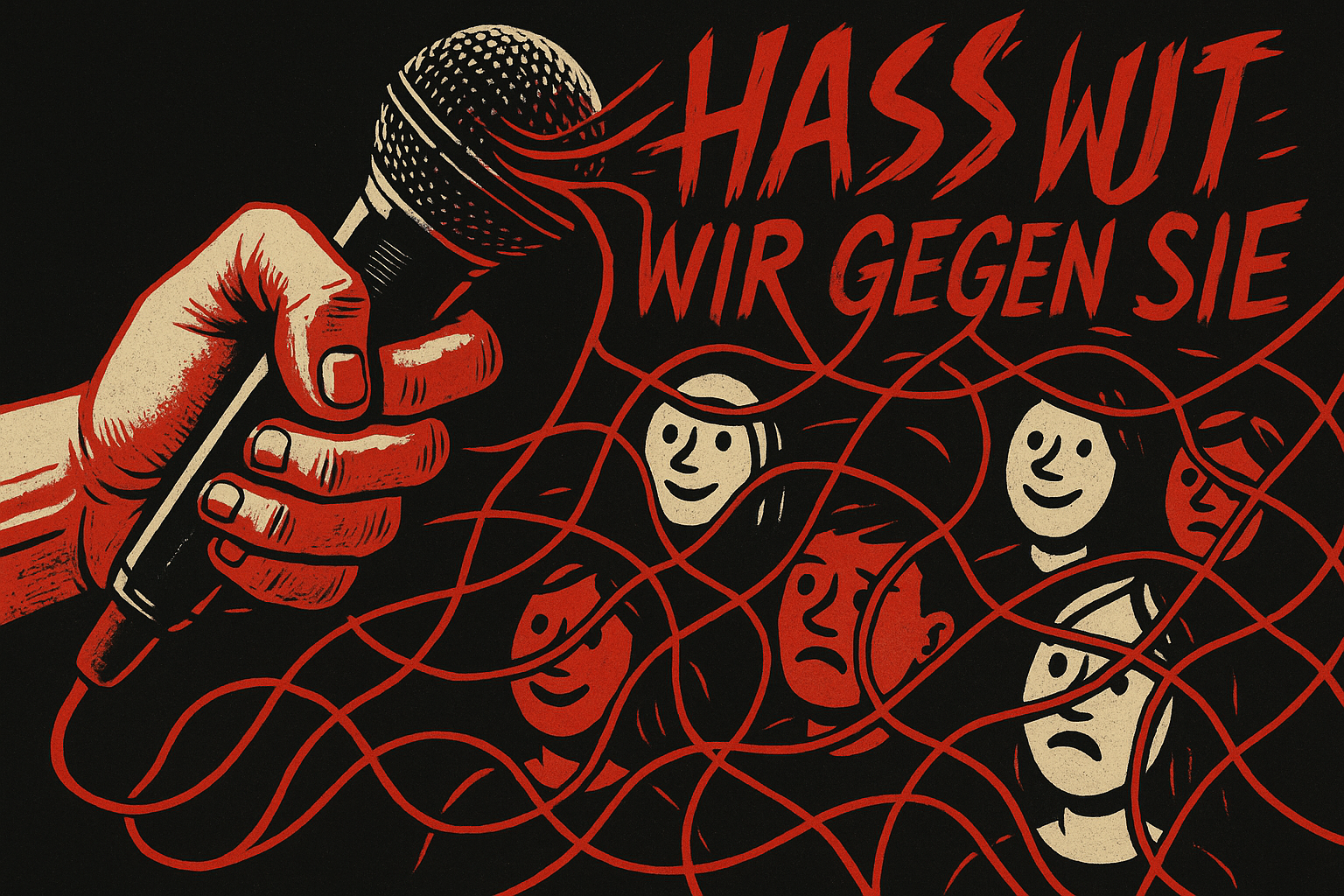
1. Introduction – The Form of Enjoyment as the Primary Explanatory Principle
This essay places the form of enjoyment (jouissance) at the center of explaining authoritarianism. Economic crises, cultural conflicts, and strategic mobilization may account for the raw material of authoritarian politics, but they do not explain why people form specific affective bonds and immunize themselves against facts. In Aristotelian terms, jouissance is the causa formalis: the form that shapes disparate causes (material, impetus, purpose) into a coherent experience. Authoritarianism binds because it organizes a jouissance of transgression—pleasure in rule-breaking, in humiliating the opponent, and in the vicarious omnipotence of the leader. Moral outrage and fact-checking miss this form; they address content while the libidinal shape of the scene remains untouched. The introduction therefore defines the task: to uncover the affective grammar of political attachment that produces jouissance as a formative principle.
2. The Psychoanalytic Toolkit – The Economy of Jouissance
Theoretically, the essay draws on Freud, Klein, Bion, and Lacan. Freud’s group psychology explains vertical attachment: the ego ideal is externalized and loved in the leader; horizontal identification follows. Klein describes how anxiety triggers splitting and projection; the “bad Other” licenses aggression. Bion shows that mature leadership “contains” affects—symbolizes rather than unbounds them. Lacan conceptualizes jouissance as an excessive enjoyment coupled with pain and the transgression of law—and reveals how the perverse superego commands not “Thou shalt not!” but “Enjoy!” In authoritarian contexts, “obscene solidarity” emerges: the “we” is forged through collectively committed boundary violations, fueled by the fantasy of “stolen jouissance” (“they” enjoy at “our” expense). In this economy, jouissance is not an add-on but the formative matrix that transforms anxiety into pleasurable practice and powerlessness into imagined sovereignty.
3. The Socio-Psychological Soil – Demand for Jouissance in Late Modernity
The contemporary diagnosis locates the demand for authoritarian enjoyment in the “wounded freedom” of late modernity: an imperative toward autonomy, self-realization, and optimization collides with precarity, political powerlessness, and epistemic disorientation. The result is chronic shame—not about a deed but about the self experienced as inadequate. To find relief, shame is externalized and transformed into ressentiment: Others—elites, migrants, feminists, cosmopolitans—become scapegoats for an alleged theft of “our” enjoyment. From this emerge five desire-guiding gaps: validation of one’s own pain, externalization of blame, empowerment despite powerlessness, homogeneous community, and—as the driving force—permitted pleasure in breaking taboos. These gaps form the vacuum into which the authoritarian leader places his affective offer.
4. The Affective Grammar of Authoritarianism – The Political Offer of Jouissance
Authoritarian leadership functions as a “master of jouissance.” Rather than soothing anxieties, it transforms them—as perverted containment—into pleasurable hatred: validation (“Your fear is real”) turns apocalyptic, then channels onto scapegoats; the resulting aggression is framed as moral duty and a source of satisfaction. Rituals (rallies, chants, running jokes), rhetoric (provocation, vulgarity, calculated lies), and digital infrastructures (affect-feedback loops, memes) generate series of transgressive experiences. The outrage of opponents increases the yield—criticism functions as proof of successful transgression. Thus a destructively symbiotic fit of supply and demand emerges: real powerlessness is exchanged for the imagined omnipotence of a jouissance-capable in-group; material losses are overcompensated by psychic gains.
5. Empirical Findings: AfD Discourse as the Organization of Jouissance
The corpus drawn from Bavarian state parliament protocols and supplementary materials illustrates this grammar exemplarily. “Remigration” functions as a condensing signifier—formally dressed in technocratic garb, factually linked to the narrative of a “population replacement.” Semantically, it generates the phantasm of stolen jouissance (“they are taking our country, our identity, our pride”); politically, it licenses the taboo violation as “reconquest.” The recurring criminalization and dehumanization rhetoric (e.g., “knife attacker,” “asylum fraudster”) splits and projects, so that aggression can be enjoyed as righteous cleansing. Parliament, Ash Wednesday rallies, and social media clips become the stage for transgression, where “obscene solidarity” is performed—from demonstrative violations of parliamentary dignity to the ritualized repetition of catchwords (“climate dictatorship,” “state broadcasting,” “cartel parties”). Legally relativizing maneuvers (“remigration” sometimes “only” for criminals, sometimes en masse) keep the libidinal surplus high by coupling semantic elasticity with escalation fantasies. The empirical findings support the formal thesis: what binds is not the truth content but the surplus enjoyment of rule-breaking that welds the group together and erodes the symbolic order (dignity, equality, renunciation of violence).
6. Prospects for a Democratic Counter-Strategy
An effective response must address the form of affective attachment. First, leadership as containment is needed: receiving, naming, symbolizing affects—rather than inflaming them. This relies on validation without apocalypticism, conflict clarification without scapegoating, tolerance for ambivalence instead of fight/flight reflexes. Second, a democratic eros is needed: tangible self-efficacy, recognition, and successful cooperation as positive sources of pleasure—through participatory formats with real impact, visible interim gains, and narratives that reward competence rather than hostility. Third, the re-ritualization of democratic practices is required: taking the materiality of ideology seriously—those forms in which belonging becomes sensory and repeatable (participatory budgets, citizens’ assemblies, harvest moments of collective solutions). Fourth: documentation instead of “counter-intoxication”—text-based archives of authoritarian speech shift the stage from the affective event to forensic examination. Fifth: legal defense that is factual, text-based, and transparent—without libidinal short-circuits that reward the victim pose. Finally: affect-evaluation of democratic politics (is shaming decreasing? are attachment and trust growing?) complements classical output monitoring.
7. Conclusion
The guiding insight is this: authoritarianism is not primarily an error of judgment but an economy of jouissance. It converts shame, powerlessness, and anxiety into an excessive enjoyment of transgression—and derives from this attachment, immunity to evidence, and escalation dynamics. Those who counter it with facts, morality, or mere procedure miss the site of effectiveness. What is called for is a democratic practice that recodes jouissance: away from the pleasure of humiliation and rule-breaking, toward a shared pleasure in successful cooperation, in symbolically framed conflict resolution, and in tangible self-efficacy. Only when the public sphere once again offers something enjoyable that does not depend on exclusion will facts, arguments, and institutions regain traction. Political work then consists not only in the “what” and “why,” but—crucially—in shaping the form in which reasons become satisfactions without robbing others of their dignity.
1. Introduction – Why “Enjoyment” Is the Key to Authoritarianism
This essay argues: to understand today’s authoritarianism, it is not enough to talk about economic worries, culture wars, or clever media strategies. What matters most is the form of enjoyment. By “jouissance” (pronounced: zhoo-ee-SAHNS) I mean a special kind of enjoyment: it arises when you deliberately cross boundaries, humiliate others, or mockingly break rules. This feels powerful and liberating to those involved—even when it ultimately causes harm.
Aristotle helps here: things have material (e.g., crises), an impetus (leaders, media), a purpose (security, order), and a form. My thesis: the form is the decisive factor—and today that form is often jouissance. It gives the raw material of “anger and grievance” a pattern: shame becomes rage, rage becomes pleasurable taboo-breaking.
2. The Psychoanalytic Tool – What Is Jouissance?
In psychoanalysis (Lacan), we distinguish normal pleasure (which soothes) from jouissance (which intensifies, pushing to the edge of pain). Politically, this means: many people enjoy breaking rules, shaming opponents, or “finally saying what you’re still allowed to say.”
Three building blocks help us see this:
• Superego and the “Enjoy!” command: Instead of “You must not,” the secret command is: “Enjoy—by breaking!”
• Splitting and projection: What is ours appears “pure,” what is foreign appears “evil.” This makes hatred morally permissible and even rewarding.
• Leadership as affect manager: Mature leadership soothes anxiety. Authoritarian leadership inflames it and transforms it into pleasurable aggression.
This helps us understand why some movements remain remarkably stable—even when facts or personal disadvantages argue against them: the affective reward is substantial.
3. The Fertile Ground – Why This Pleasure Is So Powerful Today
Many people experience a double bind: they are expected to be autonomous and self-actualized, yet they experience powerlessness (precarious jobs, opaque politics, information chaos). This produces shame (“I’m not good enough”) and often turns outward into ressentiment (“Those at the top are to blame”).
From this emerges a demand for an offer that promises immediate relief:
Validation (“Your anger is justified”), a scapegoat, a sense of power (through the leader), community—and above all jouissance: the legitimized pleasure of going after “the Others” and breaking taboos.
4. The Affective Grammar – How Authoritarianism Organizes This Pleasure
Authoritarian politics functions like an enjoyment machine:
1. The leader grants the license to break taboos (“Say it out loud!”).
2. Perverted containment: Anxiety is not soothed but transformed into hatred.
3. Rituals and rhetoric (rallies, chants, memes) generate collective excitement.
4. Digital platforms amplify this: outrage is rewarded and quickly repeated.
5. The opponents’ outrage serves as an extra kick (“If they’re upset, we’ve hit the mark”).
This creates “obscene solidarity”: we stick together through shared transgression.
5. Case Study: AfD – How Jouissance Becomes Visible in Language
In the Bavarian state parliament (and beyond), many AfD contributions clearly display this logic:
The signifier “remigration” transforms from a technical term into a fantasy of “cleansing.” It often connects to the myth of “population replacement.” From this emerges the narrative of “stolen joy”: “Others are taking our way of life, our dignity.” The “solution” is supposed to be: deport, exclude, turn back the clock. This generates feelings of revenge and redemption.
Added to this are dehumanizations (e.g., blanket terms like “knife attacker”). Such words are not informative but affect-laden: they permit morally legitimized hatred.
Anti-media rhetoric (“state broadcasting,” “censorship”) serves the same function: the press appears as a superego that denies “us” our enjoyment. Whoever speaks out against it enjoys the rule-breaking—especially when criticism follows.
In parliament, this is staged: scandals, walkouts, deliberate boundary violations. Parliament becomes a stage for transgression, the clips spread online, the cycle of excitement closes.
In short: political impact arises through the form—the organization of jouissance—not through the strength of arguments.
6. Counter-Strategy – How to Redirect This Pleasure
Mere fact-checking or moralizing outrage falls short. They miss the form and often even provide new fuel. Three things are needed:
1. Leadership as containment: acknowledge anxiety, translate it, soothe it—without scapegoats.
2. Democratic eros: create experiences of real efficacy (citizens’ assemblies, participation with visible results). This should feel good: recognition, interim successes, celebrating successful projects.
3. Use rituals and documentation wisely: repeatable positive rituals (harvest moments of successful solutions) instead of mirroring rage; document what was said (close to the text, soberly), so that hot pleasure becomes cool matter for examination.
This is how you shift enjoyment: away from humiliating others, toward shaping things together.
7. Conclusion – Politics Beyond “Addictive” Transgression
Authoritarianism works today because it promises enjoyment: the kick of breaking, the sweetness of revenge, the sense of “we” in taboo. This form makes it robust against facts. A democratic response must not copy this but must keep pace affectively: create attachment, make complexity bearable, make successes tangible, and redirect the superego (inner pressure) from the sadistic “Enjoy the hatred!” toward the caring “Shape things together!”
Then facts regain traction—not because they are “stronger,” but because they connect to a form of enjoyment that relies not on humiliation but on successful cooperation.
Introduction – The Form of Enjoyment as the Primary Explanatory Principle
The current appeal of authoritarian politics cannot—so the guiding thesis of this essay holds—be adequately explained through material scarcity, cultural upheavals, or strategic elite maneuvering. Such factors remain important, yet they do not determine the phenomenon in its essential form. What mobilizes, binds, and immunizes today is a specific form of enjoyment (jouissance) in the political field. Those who understand authoritarianism merely as a reaction to precarity, identity crises, or disinformation describe the material from which the movement draws its life, but not the form that gives this material its shape, dynamic, and direction. In Lacanian terms: it is not the content of demands but the organization of enjoyment that structures the scene—down to those paradoxical features in which deprivation itself becomes pleasure, hatred becomes “righteous” liberation, and rule-breaking becomes the source of an excessive enjoyment that grazes pain (Žižek, 2024).
The punch line of this perspective can be sharpened when developed consistently in Aristotelian terms. In political science, a model often implicitly dominates that explains authoritarianism through causa materialis (economic crises, social destabilization) and causa efficiens (leaders, media apparatuses, platform algorithms), occasionally supplemented by a causa finalis (order, security, “restoration”). What remains systematically underexposed, however, is the causa formalis: the form-giving shape according to which the aforementioned materials and drives become a coherent, experientially accessible political whole in the first place. My thesis is that the form of enjoyment—the jouissance of transgression, of humiliation, of vicarious omnipotence—is the causa formalis of contemporary authoritarianism. Only this form gives the raw material of grievance and the apparatus of mobilization that affective profile which participants experience as liberating and which shields them against corrections (cf. Žižek, 2001/2002).
This primacy of form explains why measured fact-checks, moral appeals, or policy alternatives often remain ineffective: they address contents, interests, and purposes—in short, material and goal—but miss the shape of the libidinal economy in which the authoritarian is experienced as an enjoyment machine. That jouissance is political has long been emphasized by the Lacanian school: ideologies take hold “even when nobody really believes” because they order and embody a field of enjoyment (Žižek, 2024). It is no coincidence that in the psychoanalytic discourse on war, willingness to sacrifice, and “sacred” causes, the keyword “jouissance at any price” recurs: the sacralization of nation, leader, or sacrifice legitimizes and eroticizes boundary transgression—and transforms relief into pleasure (Levine, 2022, on Chetrit-Vatine).
Why Jouissance Is the “Formal Cause”
Aristotle’s causa formalis designates not merely visible contours but the inner form that unites disparate parts into something determinate. Transferred to politics, the formal cause explains why similar material conditions (inflation, migration, technological change) “take hold” so differently in affective terms across different contexts. Jouissance in this sense is not an ingredient alongside anxiety, ressentiment, or identification, but the organizing logic that arranges the affective: it transforms shame and powerlessness into community through hatred, weariness with rules into euphoria of transgression, moral condemnation into shameless license. Three strands work together in this:
First, superego dynamics structure the relationship between law, prohibition, and pleasure. Modern societies do not only externalize coercion; they internalize it—and thereby shift the regime of conscience. This can appear as caring and integrative; but it can equally tip into sadistic severity that emphasizes guilt, shame, and self-devaluation and demands relief through projection (King & Schmid Noerr, 2020). Authoritarian offers transform precisely this burden into enjoyment: the “perverse superego” commands not “Thou shalt not!” but “Enjoy!”—in breaking taboos, in humiliating the Other. In this sense, the leader operates as an agent of an obscene normativity that draws pleasure from violating the law while simultaneously presenting it as a higher duty (Žižek, 2001/2002; 2024).
Second, authoritarian scenes generate “obscene solidarity”: public rituals (rallies, chants, memes) form a shared practice of transgression in which individuals are simultaneously relieved and aroused. The “we” experiences itself as morally superior—and enjoys precisely in the affront against those imagined as “prudish,” “elitist,” or “politically correct.” This shared enjoyment functions as a glue that makes the group resistant to refutation (Žižek, 2001/2002).
Third, the whole is stabilized through phantasms of “stolen jouissance”: the Other—elites, migrants, feminists, cosmopolitans—appears as the one who has usurped “our enjoyment.” The struggle is thus experienced as a reconquest of one’s own enjoyment, whereby aggression acquires a pleasurable moral form (Žižek, 2024).
This explains why adherence to a leader often remains stable despite material disadvantages: the libidinal yield overcompensates the economic loss. Those who dismiss this merely as “false consciousness” underestimate the shaping and binding power of form.
The Four Causes of Authoritarianism – In Light of Jouissance
If we “complete” authoritarianism in Aristotelian terms, it can be thought through—in prose and without taxonomic ambition—along all four causes, with the formal cause receiving primacy:
The causa materialis encompasses crisis-ridden late modernity: precarization, inequality, the experience that sovereignty is demanded but cannot actually be redeemed; digital publics that condense affects; institutional erosion that intensifies ambivalences. This material supplies the affective energy (anxiety, shame, resentment) that authoritarian offers reshape (cf. on the connection between socialization, superego transformation, and authoritarian dispositions: King & Schmid Noerr, 2020).
The causa efficiens names the actors and apparatuses that set this energy in motion: charismatic leadership figures who consciously appear as “masters of jouissance”; media and platform ecologies that performatively reward the pleasure-moment of the taboo breach; party and movement settings that generate collective excitement in rituals of transgression (Levine, 2022; Žižek, 2001/2002).
The causa finalis articulates the purpose in the subjects’ experience: not primarily security or order, but narcissistic restoration through pleasurable aggression—the permission to say and do “what one is finally allowed to say and do again.” This teleology of enjoyment explains the peculiar addictive structure of authoritarian politics and the resistance to counterarguments (Žižek, 2024).
Decisive, however, is the causa formalis: the affective grammar of jouissance that composes material, drive, and purpose into an experienceable unity. It orders the roles (leader as perverted superego; opponent as bearer of the “stolen”), it sets the tonalities (from joke to cruelty), it shapes the temporality (escalation, repetition, intensification). And it translates moral prohibitions into sources of pleasure—transgression counts as proof of authenticity and as “higher duty.” It is precisely this formal logic, not merely its contents, that exhausts democratic discourses when they address the authoritarian scene with arguments instead of disturbing its order of enjoyment (cf. also the diagnosis that “hating together” is a core mode of political jouissance: Leader in foreword to Žižek/Barria-Asenjo, 2024).
Consequences for Method and Structure
The analytical shift toward the form of enjoyment requires two things. First, a psychoanalytically informed conceptual apparatus that grasps superego, projection, splitting, “obscene solidarity,” and the dialectic of law and transgression not as marginal aspects but as construction principles of political attachment (King & Schmid Noerr, 2020; Žižek, 2001/2002; 2024). Second, a systematic linkage with sociological diagnoses of the present that supply the material that jouissance shapes—without losing the primacy of form.
In what follows, Part I will unfold the psychoanalytic toolkit for jouissance (law, prohibition, transgression; the perverse superego; the phantasm of stolen jouissance). Part II analyzes the late-modern fertile ground—the structural production of narcissistic injuries—as material that demands forming. Part III then reconstructs the affective grammar of authoritarianism as an offer of jouissance: the leader as dealer of transgression, the rituals of disinhibition, and the destructively symbiotic fit between demand and supply. Only thus does it become comprehensible why authoritarianism as an economy of enjoyment develops a resistance that cannot be dissolved at the level of facts—and why democratic counter-strategies run empty without their own forms of binding, non-destructive enjoyment (Žižek, 2024; Levine, 2022; King & Schmid Noerr, 2020).
The Psychoanalytic Toolkit – The Economy of Jouissance
If jouissance is the formal cause (causa formalis) of authoritarian dynamics, then our concepts must be sharpened so that they explain not only “what” (material and efficient causes) or “for what purpose” (final cause), but above all how this political attachment is libidinally organized. In this perspective, the psychoanalytic toolkit shifts: libido, ego ideal, superego, splitting, projection, and containment describe not neutral mechanisms but configurations of enjoyment—that “affective grammar” which energizes authoritarian movements. Žižek brings this “formal” dimension to a point when he emphasizes that political discourses only truly take hold when they mobilize jouissance—the excessive pleasure, reaching to the painful, that ignites at the breaking of boundaries (Žižek, 2008/2024). Thus jouissance is no supplement to material causes but structures the field in which socioeconomic deprivation, grievance, and anxiety are affectively formed and translated into impulses to action (Žižek, 2009). That this formative power is political lies in the fact that jouissance does not remain “private” but is collectively organized and performatively staged; it functions as a superego imperative—Enjoy!—and thereby becomes a social license for transgression (Žižek, 2001; cf. Leader, 2021). In the following subsections, we clarify the central building blocks for this.
The Logic of Attachment: Libido, Ego Ideal, and the Obscene Superego
Freud’s analysis of group attachment (1921) provides the basic figure: the libidinal cohesion of the group arises when the subject externalizes its ego ideal and rediscovers it in the leader. As a result, critical distance from one’s own ideal collapses—whoever criticizes the leader attacks the outsourced ideal. This vertical attachment is complemented by horizontal identification: because all “love the same,” they love one another. Psychoanalytically, this is convincing; politically, it explains the remarkable stability of affective loyalties even against obvious self-interest. Crucial is the libidinal surplus. Devotion to the leader is rarely soberly pragmatic; it bears the marks of infatuation, sometimes of self-abandonment. This points to an enjoyment beyond the homeostatic pleasure principle, which Lacan targets with the concept of jouissance: a surplus enjoyment coupled with boundary transgression and pain.
This structure is mediated through the development and transformation of the superego. In psychoanalytic social psychology, the superego is not a purely conscious moral agency but an “inner foreign land” (Freud, 1933) that is historically and socially malleable: it stabilizes adaptation but can also become rigid, sadistic, or “megalomaniacal” when groups usurp the superego and convert it into a grandiose-persecuted identity (King & Schmid Noerr, 2020). The authors show how classical sociology (Parsons, Elias, Bourdieu) takes up Freud’s superego concept, emphasizes its unconscious nature, and traces the shifts between external coercion and internal control. It is precisely this historicity of the superego that opens the view to its perverse, obscene form: a superego that no longer prohibits but commands enjoyment—the “Enjoy!” as political imperative that fulfills itself in the taboo violation itself (Žižek, 2001; King & Schmid Noerr, 2020). Thereby the moral agency becomes the licensing agency of transgression; shame over rule-breaking is converted into pride, punishment into pleasure in punishment, renunciation into pleasure in renunciation. In this logic, jouissance is not a byproduct but the form in which moral affects are politically wired (Žižek, 2024). Cf. on the role and mutability of the superego from a sociological perspective King & Schmid Noerr (2020). See on the thesis of the superegoic demand for enjoyment and the politicization of jouissance the introduction to Political Jouissance (Žižek, 2024).
The Architecture of Enmity: Splitting, Projection, and the Jouissance of Hatred
The libidinal attachment inward gains its stability through aggressive demarcation outward. Melanie Klein showed how under anxiety and powerlessness the world is split into “purely good” and “purely evil”; what is unbearable in one’s own self is projected and attributed to a scapegoat (Klein, 1946/1947). Politically, this splitting delivers immense relief—complexity shrinks to moral certainty—and creates the precondition for a specific enjoyment: when aggression against the “absolutely evil” appears not only permitted but commanded, the discharge transforms into a source of jouissance. Precisely this point is accentuated in the recent psychoanalytic debate on war, violence, and collective affects: in the “sacralization” of fatherland, leader, cause, and sacrifice, a “search for jouissance at any price” is organized—so Viviane Chetrit-Vatine (Chetrit-Vatine, cited in Levine, 2022). This formula names the excessive trait of authoritarian affective economies: not anxiety defense alone but the intensification of affect to the point of pleasurable overwhelm—an inflammable mixture of sadism, masochism, and the pleasure in one’s own humiliation—binds the community.
This explains why hate discourses and conspiracy fantasies possess a libidinal stickiness: they always already attribute to the Other a stolen jouissance—”they” excessively enjoy what was taken from “us”—and charge violence as righteous reconquest (Žižek, 2008/2009). That ideological enemy images prosper precisely where socioeconomic conflicts are real does not contradict this; rather, jouissance provides the form in which real losses are affectively cultivated as narcissistic injuries: envy, disgust, and ressentiment become primary affects that structure the political space (Žižek, 2024).
Leadership as Affect Management: Containment, Its Perversion, and the Alchemy of Transformation
Bion’s concept of containment describes the maturation path of raw affects (beta elements) into symbolizable, thinkable forms (alpha function): the “good enough” agency receives anxiety, metabolizes it, and returns it as workable meaning (Bion, 1962). Transferred to politics, this would be the democratic leadership achievement: calming collective agitation, transforming it into reality-orientation and capacity for action. But contemporary authoritarian leaders invert this function. Rather than digesting beta elements, they amplify them, externalize the cause, and translate anxiety into licensed hatred—a dark alchemy of affect transformation. In Bion’s terminology, the movement keeps the group in the basic assumption of “fight/flight”—permanently agitated, enemy-fixated, reality-poor—and thereby feeds the cycle of jouissance (Bion, 1961; Levine, 2022).
This perversion of containment has been described in the clinical-political literature as “perverted containing”: leadership not only validates anxiety and grievance; it sacralizes victim, enemy, and leader, thereby intensifying the recoding of powerlessness into pleasurable aggression (Zienert-Eilts, 2020; Diamond, 2023). The political style—the demonstrative rule-breaking, the vulgar language, the calculated insulting, the performative contempt for institutional forms—is part of this affective economy: it provides visual evidence of a subject that “is allowed everything” and invites vicarious participation in boundless enjoyment. Thus, again in Lacanian terms, the superego becomes obscene: it commands not prohibition but enjoyment, and the taboo violation of leadership becomes practical instruction in jouissance (Žižek, 2001). That such stagings outrage the other side increases the pleasure: moral indignation functions as confirmation of successful transgression—a central moment of the obscene solidarity of the in-group.
Jouissance, Law, and Transgression: The Formal Principle of Authoritarian Seduction
Lacan defines jouissance as a boundary phenomenon: beyond the pleasure principle, coupled with pain and transgression, inseparable from the law whose prohibition first charges the pleasure in the forbidden (Lacan, 1973/1975). The political punch line is that jouissance shapes how prohibitions, norms, and institutions are subjectively experienced. Where the democratic order is fantasized as bloodless, hypocritical, and “politically correct,” the breach itself becomes the site of liberation—not as a means to a rational end but as an end in itself. Hence the recent debate insists that we cannot dissolve ideology “in contents”; we must decode its forms of enjoyment (Žižek, 2024). In the introduction to Political Jouissance, it is explicitly stated that the political space is traversed by jouissance; ideological investments are marked by sadism, masochism, and their perverse combinations, up to the enjoyment of one’s own humiliation. This explains why power does not work with repression alone but bribes us for our “forced renunciations” with a gain in loss—with surplus-enjoyment, the plus of pleasure that arises precisely from the form of renunciation (Žižek, 2024).
Two consequences are central to our model. First: jouissance functions as the formal cause of authoritarian seduction. It is the matrix in which socioeconomic grievances, status loss, and epistemic injury (the material causes) are affectively organized; it channels the efficient causes (leadership styles, media rituals, algorithmic amplifiers) and directs the final causes (restoration of dignity, recovery of sovereignty) toward the actual performance of enjoyment: the taboo violation, the humiliation of the Other, the ecstatic crowd. Second: authoritarian movements bind by offering the narrative of stolen jouissance—”they” enjoy at our expense—and stylizing the reconquest of this loss as an act of justice. Darian Leader has shown how the fantasy of an omnipotently enjoying father—primal father—is recoded in the present not only sexually but also data-economically: jouissance congeals in the myth of an Other who has access to something that is denied to us and whose expropriation welds us together (Leader, 2021).
The authoritarian experiment of the twentieth century provides the drastic textbook for this: “Stalinist jouissance“—the pleasure-cathected performance of purge, denunciation, and self-humiliation as participation in the enjoyment of the Other—shows how a system maintains its stability not despite but through excess (Žižek, 2001). This diagnosis is neither historicism nor transference of clinical categories onto politics; it names the formal law that decides why these affective arrangements grip the masses while rational counterarguments fizzle. In recent debates, this connection is once again strongly made: “Political jouissance” designates precisely the translation of collective desires into boundary transgressions that become all the more attractive the more outraged their opponents react (Žižek, 2024).
Interim Conclusion
The strength of a jouissance-centered model of authoritarianism lies in grasping the logic of attachment (ego ideal/superego), the architecture of enmity (splitting/projection), and the affect management of leadership (containment/perversion) as forms of enjoyment. Jouissance is the formal cause that structures the mixture of grievance, anxiety, and ressentiment and converts it into a collective practice of transgression. Hence social or economic-theoretical explanations remain right—without sufficing. They name reasons, not the form in which reasons pass into pleasure. Only in this formal dimension does it become comprehensible why authoritarian movements have an addictive quality, why moral appeals “backfire,” and why the taboo violation itself—not its result—is the actual yield. Or in Žižek’s formula: in politics there are only discourses insofar as they are discourses of jouissance (Žižek, 2024).
The Socio-Psychological Fertile Ground: Demand for Jouissance in Late Modernity
The thesis developed in Section 2—that authoritarian movements not only contain anxiety but above all organize a specific, transgressive form of enjoyment—remains incomplete as long as we do not specify the social conditions under which this offer resonates. The decisive step consists in no longer modeling the contemporary subject primarily as a rationally calculating actor, but as a bearer of a demand for jouissance marked by contradictory imperatives of late modernity and highly disposed affectively. This shifts the view from a deficit model of political rationality to a positive, if toxic, libidinal economy in which authoritarian politics functions not as an error but as a precisely fitting compensation for experienced powerlessness (Amlinger & Nachtwey, 2022; Illouz, 2023).
“Wounded Freedom”: Between the Imperative of Omnipotence and the Experience of Dependency
Since the 1980s, within the horizon of neoliberal socialization, a cultural matrix has established itself that continuously obligates the subject to autonomy, self-optimization, and authenticity. The imperative is no longer “conform” but “be yourself”—specifically as an entrepreneurial self that internalizes risks and records biographical ruptures as individual failure (Amlinger & Nachtwey, 2022). However, the promise of boundless self-disposal collides with an experience of structural powerlessness: precaritized employment, outsourced political decision-making power, unbounded information ecologies in which trust in expert knowledge itself becomes a crisis zone. In this constellation, psychoanalytically speaking, a chronic narcissistic wound emerges—a gap between grandiose ego ideal and actual self-efficacy.
This gap does not remain affectively neutral. Where recognition is absent and complexity overwhelms, experience condenses into shame—not as punctual guilt over a misdeed but as global self-devaluation: one feels worthless as a person, overlooked, “left behind.” Psychoanalytic social psychology describes how such wounds restructure the terrain of superego processes: severity and external control are not simply internalized but can tip into rigid, simultaneously sadistic and masochistic demands that chain moral rigorousness and destructive relief together. The superego is not timeless but historically mutable; it shifts depending on which cultural self- and world-relations are socially learned—and can, as sociological receptions of Freud from Parsons to Elias show, both civilize and regressively derail (King & Schmid Noerr, 2020). It is precisely this historicity that explains why late-modern norms of self-optimization can flip into a superego that rules less through prohibitions than through the shrill slogan “You must enjoy!”—at almost any price. Recent debate on the “sacralization” of political concerns shows how easily in crises a “jouissance at all costs” prevails: the cause, the leader, the sacrifice are sacrally charged; surplus enjoyment itself becomes a covert promise of salvation (Levine, 2022, pp. 445-452).
That jouissance becomes a political magnitude under these conditions is no side effect. In recent contributions, the thought is sharpened that political discourses can only be understood if one analyzes their modes of enjoyment—“the only discourse there is … is the discourse of jouissance” (Lacan, cited in Political Jouissance, 2024, Introduction). The connecting thread reaches from the sadomasochistic coloring of ideological attachments to the perverted pleasure in renunciation and sacrifice experienced as “gain in loss” (ibid.).
From Shame to Ressentiment: The Externalization of Grievance
The psyche cannot permanently endure the tension between the claim to omnipotence and the experience of powerlessness. To close the narcissistic wound, it resorts to defenses that form from inner shame an outward-directed, morally charged grudge: ressentiment (Nietzsche, 1887; Fleury, 2020; Illouz, 2023). From the perspective of object relations theory, this dynamic can be described as regression to the paranoid-schizoid position: splitting and projection create a relieving moral map—a pure, suffering we and a demonic they that becomes the projection surface for split-off hatred. The gain is twofold: cognitive simplification and libidinal discharge. In place of the shaming question “What’s wrong with me?” appears the pleasurable certainty “They have stolen our enjoyment”—the central fantasy of “stolen jouissance” from which the moral furor against “elites,” “foreigners,” or “gender ideologues” feeds (Žižek, 2008/1991).
Particularly in the German-speaking context, these shifts can be shown close to the text. The extensive documentation Aus Worten werden Taten (From Words to Deeds) assembles parliamentary statements in which refugees are blanketly stylized as “knife attackers” or “rapists”; refugee movements appear as “mass invasion” or “asylum flood.” The semantic core is not mere affective excess but classic work of splitting and projection: “normal Germans” as pure victims, “the Others” as criminal, instinct-driven threat against whom one may finally “defend oneself”—a narrative that contradicts objective data but functions as affective truth (Schuberl, 2025, pp. 76–79).
The libidinal grammar becomes even clearer where language and gender politics are negotiated as supposedly “authoritarian” thought control. An exemplary parliamentary contribution fantasizes gender politics as “censorship” and “brainwashing” that erase “father” and “mother” and annihilate “identity”—up to the term “cultural murder.” Such passages are not merely polemical; they performatively provide the material for a jouissance of indignation through exaggeration: the imaginary of a damaged, “re-educated” self is fused with the promise of reconquering lost pleasure and identity through taboo violation (against “language regulations”) (ibid., pp. 155–158).
Psychoanalytically considered, this rhetoric does not liberate—it binds. It offers narcissistic compensation by converting superego demands into a permissive regime of aggression: “You may hate”—and should enjoy it. Exactly here the alchemy of perverted containing sketched in Section 2 takes hold: anxiety is not soothed but focused on scapegoats and converted into pleasurable hatred; from passive powerlessness emerges an active transgressive practice (Bion, 1962; Diamond, 2023). At the same time, the view of the “sacralization” of political concerns—fatherland, leader, sacrifice—shows how jouissance is alloyed through the sanctification of struggle and self-sacrifice: “jouissance at all costs” (Levine, 2022).
The Affective Gap: Validation, Externalization, Empowerment, Community—and the Demand for Jouissance
The constellation “wounded freedom → shame → ressentiment” generates a gap that does not primarily demand arguments but affective redemption. From this gap, five—overlapping—desire configurations can be worked out that authoritarian leaders intuitively serve: the longing for validation (“Your pain is real”), for externalization (a tangible culprit), for empowerment (felt sovereignty), for homogeneous community (fusing belonging), and—as the motor at the center—for jouissance, i.e., for a legitimized, collectively borne pleasure in taboo violation and humiliation of the opponent. That political discourses systematically activate this dimension is now broadly documented. The most recent collected work on Political Jouissance therefore insists on measuring discourses not by their semantic contents alone but reading them as arrangements of acts of enjoyment—from envy of the supposed jouissance of the Others to the masochistic pleasure in one’s own subjection experienced as “gain in loss” (Barria-Asenjo & Žižek, 2024, Introduction).
Theoretically, this diagnosis sharpens along two lines. First: jouissance is not an addition to politics but its formal interior—surplus, not supplement. Lacan’s parallel between surplus value and surplus enjoyment shows how the “interest” of the libidinal economy arises in the performance of the dispositifs: in speaking, in ritual, in staging—and not only at their margins (ibid.). Second: the material side of this formal aspect must not be underestimated. Ideology exists not merely “in the head”; it sediments as practice, apparatus, ritual; it works, even when “nobody really believes,” as long as acts are performed that externalize belief “for us.” Precisely this dissociation between personal conviction and objectified practice constitutes the effectiveness of contemporary movements—one acts as if, and that suffices (cf. Žižek, in Barria-Asenjo & Žižek, 2024).
On this basis, the German case vignette can be sharpened once more. Aus Worten werden Taten documents not only the displacement of problem situations into moral Manichaeization; the collection also shows how the repetition of such speech acts creates an affectively cohesive scene—a stage on which superego rigorousness and obscene solidarity intertwine. The polarization formula is performative: it produces the “we” in the act of pleasurable exclusion (Schuberl, 2025, pp. 9, 333 ff.). The violence of words here is no mere symptom; it is a generator of action corridors that make real violence appear plausible, even “pleasurable”—a finding the publication explicitly unfolds around the leitmotif “How quickly words can become deeds” (ibid., p. 9).
Psychoanalytic debates on aggression and war also point in this direction: collective identifications can “drive to heroic deeds or to murder equally”; culture thereby offers an inconstant ally that does not dampen evil but often legitimizes it—up to the rationalization and aestheticization of sacrifice (Levine, 2022, p. 442). This explains why authoritarian mobilization is not broken by fact-checking: the libidinal balance calculates in categories of enjoyment, not evidence. The “gain in loss”—the pleasure in renunciation, in hatred, in humiliation—weighs heavier in the short term than material costs (Barria-Asenjo & Žižek, 2024, Introduction).
Finally, the normative point can be marked. A democratic counter-strategy will only become effective if it addresses the demand side. This includes, first, politically working on the structural drivers of “wounded freedom”—social security, genuine participation, epistemic trust infrastructures. Second, however, a positive, non-destructive organization of affect and belonging is needed—a “constructive jouissance” that lives not from exclusion but from successful solidarity. Psychoanalytically speaking: spaces are needed in which the superego does not tip into perverse license for hatred but functions as symbolic framing of desire—as “law” that channels jouissance into paths of productive sublimation (Braunstein, 2020/2006).
Interim result. The fertile ground of authoritarian seductions forms from a dense weave of late-modern grievances, from defensive formations that transform shame into ressentiment, and from social apparatuses that ritually, rhetorically, and medially convert these affects into jouissance. Only against this background does it become comprehensible why the offer of transgression works so irresistibly. Not because it solves problems but because it promises pleasure—a pleasure that simultaneously binds, blinds, and disposes to action.
The Affective Grammar of Authoritarianism: The Political Offer of Jouissance
The Leader as “Master of Jouissance”: License for Taboo Violation and the Perverse Superego
When authoritarian movements bind affectively, it is not primarily because they promise order but because they grant permission to transgress. In the language of psychoanalysis: they install a perverse superego whose imperative is not “Thou shalt not!” but “Enjoy!” Žižek has systematically made this figure of the obscene superego productive for political theory: authoritarian leaders stage boundary transgression itself—in language, gesture, and rule-breaking—as the source of collective enjoyment and performatively invite the following to participate (Žižek, 2001). This jouissance is no harmonious pleasure gain but an excessive enjoyment reaching to the pain threshold in transgression—a “surplus” enjoyment that lies precisely in the norm-violating gesture (Žižek, 2001; cf. also Žižek, 2024).
Psychoanalytically speaking, subjects externalize moral agencies to the leadership figure: the ego ideal is externalized while aggressive impulses are “legitimized” and collectively unleashed. In the sociological reception of Freud’s superego concept, this switching is well described: alongside caring configurations, there are sadistic, rigid, and megalomaniacal configurations of the superego; in group formations, the ego can usurp the omnipotent grandeur of the institution or leader as “super-ego”—with correspondingly ruthless effects (King & Schmid Noerr, 2020). In authoritarian contexts, this dynamic meets a public that—affectively charged—demands less truth than permission for disinhibition. The leader then serves as an “affect bank”: whoever follows may enjoy what otherwise remains forbidden. That collective identity warms itself on hatred and humiliation is shown by Darian Leader in his foreword to Political Jouissance: political enmity provides a pleasurable, bonding indignation—”we love to hate”—that must be taken seriously analytically without thereby delegitimizing political engagement (Leader, 2024).
Perverted Containment: The Alchemy of Transforming Anxiety into Pleasurable Hatred
Bion’s concept of containment can be politically translated thus: mature leadership receives raw, flooding affects, symbolizes them, and returns them in digestible, thinkable form to the community. The logic of contemporary authoritarianism inverts this function: it does not “contain” anxieties in order to mentalize them but intensifies them, channels them onto scapegoats, and thus converts displeasure (anxiety, powerlessness, shame) into pleasurable aggression—into an addictive jouissance of transgression (cf. Diamond, 2023; Zienert-Eilts, 2020). This perversion of the containing function thrives on the fact that a community is always held together by violence and identification simultaneously—a tension that Freud already marked in his correspondence with Einstein: collective order is “violence in another form” and at the same time cemented by identifications; everything that lets emotional bonds grow works against war—that is, against disinhibited destructiveness (Levine, 2022).
Authoritarian politics capitalizes on this tension. It “sacralizes” the cause, the leader, and willingness to sacrifice and disguises—as Chetrit-Vatine’s term jouissance at any price suggests—the search for enjoyment as the duty to defend the sacred (Levine, 2022). Enjoyment thereby becomes morally charged: whoever enjoys by breaking norms simultaneously feels justified. This is precisely where the parade narrative of “stolen jouissance” belongs: “they” have robbed “us” of our enjoyment, our way of life, our dignity; authoritarian politics promises to reconquer it through humiliation of the “perpetrators” (Žižek, 2001).
Ritual, Rhetoric, Scene: How Jouissance Is Collectively Produced
The jouissance of transgression is no mere interior; it needs stage, form, and repetition. Mass events, chants, “running gags,” calculated obscenity, the repeated lie, the deliberate disregard for institutional etiquette—all function as generators of affective synchronization. Political speech here aims less at persuasion than at bodies: the pleasure stimulus lies in saying the unsayable, in laughing at humiliation, in the relieving “finally-someone-says-it.” Thus emerges what Žižek calls “obscene solidarity”: a collective bond that draws nourishment precisely from shared boundary transgression (Žižek, 2001).
Crucial is the materiality of this ideological production. Žižek has grasped this as the “material existence of ideology”: rituals, apparatuses, gestures, and practices “carry” conviction—even when nobody “really” believes. One acts as if, delegates belief to the Other, and precisely thereby the ideology “works” (Žižek, 2024). A chant (“lock her up!”), the shared hand gesture, the sharing of a meme—they are all actions that sediment the affective surplus enjoyment. Darian Leader additionally points out how much collective outrage intensifies itself: the more vehemently “we” brand the opponents, the stronger the enjoyment in shared hatred (Leader, 2024).
Ritual and rhetoric are thus not accessories but means of production of an affective economy. The more visible the outrage of “the others” (media, “elites”), the higher the yield: the opponents’ indignation confirms one’s own taboo violation, intensifies one’s own enjoyment, and binds the group more tightly. In this logic, the opponent’s criticism becomes the source of one’s own drive.
Digital Infrastructures of Jouissance: Memes, Feedback Loops, Delegated Belief
The digital public sphere scales this economy. Algorithms privilege affect, polarization, and repetition—precisely that grammar in which jouissance thrives. The structure Žižek illustrates with Pascal (“act as if, and belief will come”) finds its mass counterpart online: we post, like, share—often without firm belief—but the performance itself outsources conviction and feeds collective certainties (Žižek, 2024). The credo becomes practice, practice becomes certainty, certainty becomes identity.
Thus emerge communities of enjoyment: feeds in which enemy images solidify, jokes and ciphers become markers of belonging, and every “false” fact-check is enjoyed as an affront. The digital scene continuously delivers stimuli—small “tickles” that, as Andrea Perunović shows in the volume Political Jouissance, can turn from tickle to “puddle of gasoline”: mistrust shifts into an all-explaining affect that provides enjoyment in suspicion itself (Perunović in Barria-Asenjo & Žižek, 2024).
Case Forms of the Political: Hyper-Royalism, Totalitarianism Critique, and the Promise of Omnipotence
Concrete configurations of political jouissance vary culturally. Pavin Chachavalpongpun describes “hyper-royalism” in Thailand as a specific modality: the monarchy functions as a focal site of enjoyment—emotional, symbolic, ritual—at which loyalty, self-sacrifice, and aggression against critics are coupled. The smile of the “Land of Smiles” narrative meets a hard, enjoyment-shaped sacralization that marks dissent as desecration (Chachavalpongpun in Barria-Asenjo & Žižek, 2024).
On the other hand, liberal-democratic critique of “totalitarianism” frequently functions as an ideological antioxidant: it neutralizes “free radicals” of thought by prematurely placing radical projects under Gulag suspicion (Žižek, 2001). For our question, this is relevant because the power of authoritarian jouissance is stabilized not only from within (through anxiety-to-hatred conversion) but also from without (through disarming counter-elevations): where contradiction counters only moralistically, it provides affect-nourishment instead of recoding attachments.
The Destructively Symbiotic Fit: Supply Meets Demand
If we relate this supply side to the demand logic reconstructed in Part III (Chapter 3)—wounded freedom, ressentiment, externalization of shame—the picture of a precisely fitting, destructively symbiotic coupling emerges. Authoritarian leaders “read” the unconscious needs—validation, externalization, empowerment, community, enjoyment—and serve them with high precision. The result is a libidinal exchange: real powerlessness for imagined omnipotence; material losses for psychic gains; ambiguity burden for certainty enjoyment.
This exchange relation explains the elasticity of authoritarian attachments vis-à-vis facts and cost-benefit arguments. Where psychic income from jouissance exceeds the accounting balance, rational criticism fizzles. And it explains the rebound effect of moralizing interventions: whoever begrudges the movement its transgression offers themselves as guarantor of its further pleasure production.
Interim Conclusion: The Offer of Authoritarian Jouissance as a Production Regime
The affective grammar of authoritarianism can thus be described as a production regime:
(1) Raw material consists of diffuse anxieties and narcissistic injuries;
(2) Refinement is accomplished by perverted containment, which transforms anxiety into hatred;
(3) Form-giving is undertaken by rituals, rhetorics, and digital infrastructures;
(4) Distribution occurs through scenes of transgression that deliver jouissance in series;
(5) Reinvestment happens through the outrage of opponents, which cyclically intensifies enjoyment.
In Freud’s terms: communities are held together by violence (as an ever-callable possibility) and identification (as affective bonding); politically organized jouissance fulfills both simultaneously by bundling aggressions and establishing identifications (Levine, 2022). In the terms of the social psychology of the superego: what should punish, protect, and orient as an inner agency is externalized, inflated, delegated—and enjoyed as a megalomaniacal collective super-ego (King & Schmid Noerr, 2020). In the political diagnosis of the jouissance discourse: the “materiality of ideology” shows itself in practices that carry belief without needing it—and precisely thus generate affective loyalty (Žižek, 2024; Leader, 2024).
From Words to Deeds – The AfD Case
Corpus, Method, and Formal Hypothesis: AfD Rhetoric as the Organization of Jouissance
The corpus analyzed here documents verbatim statements by members of the AfD (Alternative für Deutschland, a German far-right party) parliamentary group in the Bavarian State Parliament (18th legislative period, 2018–2023), including recorded plenary speeches, Ash Wednesday speeches, and relevant social media posts that were discussed in plenary debates. The edition provides session and page references from the state parliament protocols and contextualizes quotations with brief classifications of semantic fields (“ethnically homogeneous concept of the people,” “remigration,” “equation of refugees with criminals,” etc.). It is particularly valuable as primary material because it makes visible the performative, not merely propositional, dimension of AfD speech—that form of political speaking that awakens and bundles libidinal investments before it compels cognitive assent (Schuberl, 2025).
The central hypothesis of this chapter is formal: authoritarianism in AfD rhetoric can be described more precisely as an affective economy of enjoyment than as a sum of political positions. The conceptual foundation is provided by Lacan’s determination of jouissance as excessive, often pain-adjacent enjoyment beyond the pleasure principle, and Žižek’s political connection: ideologies take hold when they mobilize the dimension of enjoyment—through the envy figure of the “foreign pleasure” that threatens us, and the command form of the perverse superego: “Enjoy!” (Žižek & Barria-Asenjo, 2024, pp. 1–3, 20–22). In this sense, jouissance is not an ingredient but the formal cause (causa formalis) of events: it structures the scene on which contents take affective hold at all.
Methodologically, this means: we read AfD texts form-analytically according to modes of pleasure organization—transgression, obscenification, sadistic discharge, phantasm of “stolen jouissance“—and interrogate the discursive triggers (“remigration,” “population replacement,” “knife specialists”) for how they bundle affects. Psychoanalytically, this can be interpreted as externalization and projection of superegoic violence that is disinhibited in the collective (King & Schmid Noerr, 2020, pp. 741–744, 753). The heuristic gain over socioeconomic explanations (anxiety, backlash) lies in making comprehensible the specific form of affects—their excess, their pleasure.
Remigration, “Population Replacement,” and the Phantasm of “Stolen Jouissance”
Hardly any semantic field condenses the libidinal grammar of the AfD as precisely as “remigration.” Semantically, the term is masked as a technical administrative formula; functionally, it is a euphemism for ethnic cleansing, linked to the lie of “population replacement” (Schuberl, 2025, pp. 344–347). As early as the beginning of 2019, Christoph Maier marks the tipping point before the state parliament: “Remigration before integration. […] This is therefore also one of the central demands of the AfD”—and frames it “culturalistically” through “compatibility” and “quantitative limits” (7th session, 31.1.2019) (Schuberl, 2025, pp. 38–41). The form of the argument is decisive: integration is not negotiated as a political program but as a boundary metaphor of an imaginarily homogeneous body; deviation appears as contagion, density, overstretching—affects of contamination that, in Lacanian terminology, mobilize the desire for a phantasmatic purity.
The logic of escalation culminates where “remigration” is thought in dimensions that burst the administrative pretext. The Bavarian “Resolution for Remigration” (24.11.2024) targets a “state goal of comprehensive remigration in the millions”—theoretically linked to an “autochthonous people” (Schuberl, 2025, pp. 344–347). By setting “autochthonous” against peoples “created through immigration,” the text constructs a figure of racial purity and makes belonging dependent on “blood” (Schuberl, 2025, pp. 35–37). The pleonasm in politics—legalization of an anthropological fiction—is already jouissance-affine: it promises retroactively a liberation from lack, a restoration of lost wholeness, precisely that phantasmatic completeness that Lacan links to the “objet a” circuit (Žižek & Barria-Asenjo, 2024, pp. 20–22).
Explicitly, the AfD connects “population replacement” with the reading of a theft. Its Bavarian parliamentary group posts on 28.06.2023: “Replacement of the population advances rapidly […]. The solution is remigration and deportation of migrants not entitled to stay!” (Schuberl, 2025, pp. 74–76). Shortly afterward, Maier demands: “Let us replace the government before it replaces the electorate!” (January 2023) (Schuberl, 2025, pp. 76–78). The formal punch line of these sentences lies in the shift from the demographic to sovereignty-enjoyment: “The electorate”—the supposed subject of decision—appears as object of a foreign disposition. Precisely therein lies, according to Žižek, the functioning of “stolen jouissance”: the Other (migrants, “elites”) appears to have usurped not only goods but our enjoyment; political aggression stages itself as legitimate reconquest of this enjoyment (Žižek & Barria-Asenjo, 2024, pp. 1–3, 20–22).
How intensely this scene is affectively charged is shown by the rhetoric of the Political Ash Wednesday 2023 (Ebner-Steiner): a “time travel” leads into the “Colorful Republic—never again Germany,” government business would be conducted “from Brussels and Washington” (22.2.2023) (Schuberl, 2025, pp. 75–76). The narrative form works with end-time fantasies and “loss of self-power” which—psychoanalytically read—deliver the libidinal charge to experience the taboo violation (remigration on a mass scale) as an act of sweet revenge. On this stage, even the demand for institutional anchoring of the program (“remigration policy spokesperson,” “remigration commissioner”) can appear as pleasure in order, while simultaneously performing a pleasure in excessiveness (Schuberl, 2025, pp. 36–38).
That this jouissance is from the outset coded as obscene-superegoic—”Enjoy the rule-breaking!”—is documented by the attacks against constitutional semantics itself: “enemies of the people,” “rule of injustice,” “secure borders” as moral imperative (136th session, 15.2.2023) (Schuberl, 2025, pp. 230–233). Here the coordinates of normativity shift: not the prohibition brakes pleasure, but the command character of disinhibition drives it—precisely that logic which Political Jouissance describes as perverted pleasure gain in renunciation/transgression (Žižek & Barria-Asenjo, 2024, pp. 20–22).
The consequence of this phantasmatization are ethnic echo effects. When the texture of the “autochthonous people” is semantically framed as homogeneity, difference becomes narcissistic injury that calls for pleasurable erasure. Hence the remigration field fits so frictionlessly into the overall rhetoric of the AfD: it is the condensation point of a libidinal economy that organizes shame as ressentiment and ressentiment as pleasurable aggression.
Criminalization, Dehumanization, and the Jouissance of Aggression
The second major carrier layer of AfD rhetoric is the criminalizing metaphoric that equates migrants and refugees with delinquency. The corpus documents a serial production of defamatory signifiers—”knife specialists, knife attackers, clan criminals, rapists, million-strong army of have-nots and good-for-nothings, asylum fraudsters”—up to ironic invectives like “little golden pieces” (Schuberl, 2025, pp. 343–346). The function of this chain is less descriptive than drive-economic: it offers projection surfaces for split-off destructiveness, which may now return morally legitimized as justified defense. King & Schmid Noerr (2020) have described this logic as “superegoic externalization”: the punishing superego is displaced outward; the “enemy” embodies our own unconsciously punishment-deserving parts—so that the attack is libidinally rewarded (pp. 742–744, 753).
The aggression license is then ritualized. In plenary rhetoric, collective formulas appear (“asylum flood,” “border flooding”) that turn the individual case into a natural disaster imago and thus accomplish dehumanization (Schuberl, 2025, pp. 343–346). In the same logic, Stefan Löw demands a “remigration commissioner” and “return to the rule of law,” whereby “rule of law” is semantically narrowed to deportation efficiency (34th session, 5.12.2019) (Schuberl, 2025, pp. 36–38). Thus emerges what Žižek describes as “obscene solidarity”: a “we” that constitutes itself through the pleasure of taboo-breaking—the pleasurable saying of the unsayable (Žižek & Barria-Asenjo, 2024, pp. 1–3).
At times, dehumanization is openly marked as völkisch: Atzinger speaks of leaving “childbearing to the migrants” (139th and 141st sessions, March 2023) and derives from this the demand for “remigration”—not better language support but removal (Schuberl, 2025, pp. 20–23). Löw distinguishes “Turks with German passports” from “real Germans” and instrumentally refers to a debate on police crime statistics (34th session, 5.12.2019) (Schuberl, 2025, pp. 37–39). The motif is constant: juridical belonging is devalued in favor of an imagined ethnicity—a classic perversion maneuver in which, psychoanalytically speaking, the fetish (here: the blood/origin signifier) whitewashes castration anxiety and thus transforms anxiety-pleasure into combat-pleasure (Themi, 2024, pp. 133–135).
At the border of the authoritarian, criminalization semantics tips into paramilitarization: the idea of deploying the military for border support is normalized as “support” (92nd session, 29.9.2021) (Schuberl, 2025, pp. 54–57). Noteworthy here is the form of self-assurance: whoever criticizes this militarization becomes confirmation of one’s own democratic ethos; the AfD claims “pluralism” in return—as performative shield for what is structurally exclusion (Schuberl, 2025, pp. 54–57). Thus a basic pattern of superegoic regression is fulfilled, which King & Schmid Noerr (2020) have worked out along the Frankfurt tradition: megalomaniacal charging of collective agencies that usurp the ego ideal and recode contradiction as moral guilt (pp. 743, 746).
At the level of affect economy, this also explains the astonishing resistance to factual corrections. If what binds in AfD speech is not reference to reality but the gain in pleasure—the excessive satisfaction of being allowed to be evil with a good conscience—then fact-checks run on the wrong frequency. Žižek captures this in a concise thesis: political attachment functions, even when nobody “really believes,” as long as the practices of as-if keep jouissance running (Žižek & Barria-Asenjo, 2024, pp. 28–29). Precisely for this reason, AfD rhetoric can be described as a generator of collective jouissance: through sadistic attributions, masochistic self-stagings (“we victims of the system”), and their “perverted combinations” (Žižek & Barria-Asenjo, 2024, pp. 20–22).
The formal closure of this machine is openly named in the corpus: “The AfD strives […] for the replacement of the existing constitutional order by an authoritarian ‘nation-state’ oriented toward the ethnic ‘Volksgemeinschaft’” (Schuberl, 2025, pp. 13–16). Politically, this is a diagnosis; affect-theoretically, it is the target shape of enjoyment: a phantasm of unity without fissure that, because it is impossible, permanently needs new sources of jouissance—new taboo violations, new enemies, new rituals of humiliation. Here precisely the psychoanalytic arc closes: jouissance appears not as a detachable additive but as the formal cause of authoritarian attraction—the style in which contents become libidinally effective at all.
“Stolen Jouissance”: Enemy Images, Relief Fantasies, and the Scapegoat Device
When one reads AfD discourse in the light of jouissance, what first stands out is the recurring structure that Žižek has described with regard to racism and nationalism as “envy of the jouissance of the Other”: the Other appears not merely as political opponent but as someone who usurps “our” way of enjoying and thereby steals something fantasized as inalienable from us (Žižek, 2009, pp. 140–141). In this logic, it becomes explicable why migrants, “globalists,” or “multiculturalists” in the Bavarian AfD verbal material are marked not only as problem-bearers but as enjoying usurpers: the “globalists and multiculturalists” had created a “new people,” the “German state” had ceased “to be the state of the Germans”—a signifier bundle that does not simply invoke a political conflict situation but a libidinal expropriation fantasy (Aus Worten werden Taten, 2025, pp. 201–206).
The same structure appears in the recurring topoi of “ethnic replacement” and “population replacement.” When an AfD member of parliament declares that “bio-Germans” are “already today replaced in many cities” and a “self-dismantling” of the country threatens, precisely that narrative of stolen jouissance condenses therein, which imagines the Other as bearer of an excessive, undeserved enjoyment—and licenses one’s own aggression as righteous reappropriation of this enjoyment. That the formula of a “coup against one’s own people” appears in the same breath is no coincidence: the libidinal loss (“they are taking something from us”) is translated into a judicial narrative (“a coup was committed”) that transforms affect into apparent morality and thus makes it particularly enjoyable (Aus Worten werden Taten, 2025, pp. 129–133).
Such scapegoat constructions function—in the Kleinian sense—through splitting and projection: the “we” appears pure, the “they” as contaminating, dangerous, addicted to enjoyment (Klein, 1946). The discourse excerpt of a district chairwoman who links a “migration of peoples” with an alleged “asylum industry” offers a textbook example: the suffering “of the Germans” is transformed into a morally charged counter-reckoning with the Others; the harshness of the demand—one must “end the asylum industry”—is carried by the logic of allegedly stolen jouissance, which transubstantiates one’s own grievance into legitimate rage (Aus Worten werden Taten, 2025, pp. 282–286). At the same time, these formulas work as “master signifiers” (Lacan) that channel and fix collective affects; their efficiency lies not in empirical adequacy but in the libidinal relief they produce.
The punch line of Žižek’s diagnosis is that the symbolic support of political ideologies is ultimately carried by a “nonsensical, pre-ideological kernel of enjoyment” (Žižek, 2009, pp. 170–171). Precisely this is documented by AfD rhetoric where it transforms the field of the political into an inheritance question of jouissance: whoever controls “our” lifestyle, “our” children, “our” language, “our” energy supply disposes—so the subtext—of “our” enjoyment. The moment “remigration” is suggested as a repair measure, the political shifts from the space of legitimate rule conflicts into a quasi-moral crusade for the reconquest of enjoyment. This is the affective grammar the term acquires in the party’s orbit and—since late 2024/early 2025—in official texts (Correctiv, 2025a; AfD Bayern, 2024; Deutscher Bundestag, 2024).
The License for Transgression: How Discourse Organizes Jouissance
The jouissance of transgression arises where the law—politically: the rules of civil, pluralistic dispute—is staged precisely as a boundary to be crossed. The “breach of style” becomes a pleasure generator. In the Bavarian material, this emerges unvarnished: “storm of the people” instead of parliamentary moderation, “left-green breaches of style” as enemy image that legitimizes one’s own boundary transgression—a semantic set that is not programmatic but an economy of excitement (Aus Worten werden Taten, 2025, pp. 158–163). Žižek has made this moment current as the core of modern political seduction: ideologies “hold” not through arguments but because they transform a precarization of the law into libidinal gain; their “ultimate support” is not meaning but surplus enjoyment (Žižek, 2009, pp. 170–171).
The pandemic-related passages show the same alchemy. When there is talk of a “war against one’s own people,” of a “chemical cudgel” against children and a “virocratic” dictatorship, diffuse anxieties are not soothed but intentionally intensified, in order to convert them in the next step into aggression-pleasure. The semantic three-step—validation, apocalypticism, externalization—is a pattern of perverted containment in Bion’s sense: from raw beta-affects (uncertainty, powerlessness), no symbolizable knowledge emerges but a focused, action-capable rage that can be experienced as morally just and—crucially—as pleasurable (Bion, 1962; Aus Worten werden Taten, 2025, pp. 340–350; 352–359; 371–377).
Climate policy provides a second, paradigmatic field. “Climate dictatorship,” “eco-fascists,” “green planned economy”—the attacks are not merely a polemical register but techniques to turn the normative claim of climate-related law into an eroticized boundary transgression: whoever refuses them enjoys—beyond the pleasure principle—the transgression. This is precisely what jouissance as “erotics of the negative” means, which Derek Hook has described for racist and populist discourses: the transgression increases the “bonding effect” within the group and individual excitement equally (Hook cited in López-Calvo, 2024, pp. 57–58). The Bavarian material confirms this when rejection of the energy transition is cast in images of “gas and electricity shortages” as “ideologically intended”: one’s own opposition no longer appears as one option among others but as saving liberation from a regulating superego—and precisely this makes it enjoyable (Aus Worten werden Taten, 2025, pp. 360–363; López-Calvo, 2024, pp. 57–58).
With the semantic elevation of “remigration” in party resolutions and federal debates, this alchemy condenses into a central dispositif: while the AfD in Berlin, after the Correctiv investigation, officially claims to distinguish between “criminal foreigners” and citizens, the Bavarian “Resolution for Remigration” (24.11.2024) already shows the attempt to normalize the signifier officially within the party and to link it with a dramatizing decline diagnosis (AfD Bayern, 2024; Correctiv, 2025a; Deutscher Bundestag, 2024). In the Lacanian perspective, a “master signifier” emerges here that functions as a generator of collective jouissance not despite but because of its semantic elasticity. It allows, depending on context, gradual “switching” between legally permissible and openly völkisch meanings—a classic form of disavowal in the sense of “Je sais bien, mais quand même”: one knows very well that the radical, expulsion-adjacent reading is constitutionally untenable, and precisely therefore one can continuously ignore and libidinally hint at it (Perunović, 2024, pp. 48–49, 68–71).
Scenes of Jouissance: Performance, Ritual, and “Obscene Solidarity”
The affect dynamic is accessed not only through semantic patterns but through scenic arrangements. An iconic scene is the scandal in the Munich city council when Charlotte Knobloch warned in 2019 against the backdrop of increasing antisemitism and AfD representatives left the hall. Here—in the medium of public scandal—a pleasurable taboo violation is performed: the refusal of symbolic credit toward a moral authority produces bonding inward and humiliation outward; Žižek calls this bonding mass of the “we” through shared transgression “obscene solidarity” (Žižek, 1991). That the scene had a long aftereffect in Munich municipal politics lies less in its argumentative force than in its affect-economic valence: jouissance in pure form (Aus Worten werden Taten, 2025, pp. 98–104).
State parliament appearances work similarly, in which the AfD explicitly marks parliament as a stage for boundary transgression. The call for a “storm of the people” shifts the scene from the site of deliberative opposition into the quasi-sacred theater of an imminent state of exception; parliament—Lacan would have said: as site of the law—is not only criticized but staged as an object to be desacralized. Precisely this sacrilegious gesture is enjoyable because it celebrates proximity to prohibition (Aus Worten werden Taten, 2025, pp. 158–163). The pandemic-related “current hours” in the German Bundestag after the Correctiv investigation repeat the logic in mirror image: while coalition speakers invoke democratic defense, the AfD dismisses the accusations as “completely unfounded” and thus uses the others’ outrage as fuel for its own scene—the classic paradox of the jouissance of transgression (Deutscher Bundestag, 2024).
The ritualized repetition of signifiers—”climate dictatorship,” “cartel parties,” “Great Reset,” “asylum turnaround now,” “virocratic regime”—functions in these scenes like chants. They produce, to vary Darian Leader, no “substance” of enjoyment but produce it performatively (Leader, 2021, pp. 104–105). A state parliament contribution that accuses the federal government of a “criminal war of aggression against its own country” proceeds exactly thus: it substitutes the referential content “war” with an affective metaphor that simultaneously rewards affectively and binds socially—an equivalent to chanting in the mass scene (Aus Worten werden Taten, 2025, pp. 306–312).
That such scenes increase group cohesion is explained by Perunović’s diagnosis of the “enjoyability of mistrust”: the stronger the ritualized refusal toward the “big Other” (state, media, science), the greater the surplus enjoyment in the group. Fetishistic disavowal—I know very well, and precisely therefore I ignore it—creates the space in which one can say “without saying it” what is experienced as taboo (Perunović, 2024, pp. 48–53, 68–71). In AfD practice, this means: one oscillates between legalism (deportation of criminals) and insinuation (withdrawal of citizenship, pressure on “dual citizens”) to capture the libidinal yield of both registers. Precisely this is accomplished by the Bavarian remigration resolution, which couples “constitutionally conforming” demands with völkisch-coded semantics (AfD Bayern, 2024; Correctiv, 2025a).
From Signifier to Measure: “Remigration” as Action Dispositif
The thesis that the signifier “remigration” functions as a generator of jouissance would be analytically incomplete if one ignored its operative side. Precisely the Bavarian resolution—as well as the motion book of the state party conference—shows the coupling of affect and measure. “Remigration” is not treated there as mere slogan but transferred into a catalog of status withdrawal, restrictive citizenship law changes, and administrative “pressure” on “non-assimilated” persons. Thereby the signifier transforms into an action dispositif whose affective surplus—the jouissance of transgression—facilitates the transition into politics (AfD Bayern, 2024; AfD Bayern, 2024, Motion Book).
The federal political confrontation after the Correctiv investigation makes visible that this coupling is contested. While courts and media disputed the scope of the plans discussed in Potsdam, sworn statements by individual participants suggested that the term was factually meant to include “non-assimilated citizens” as well; parallel to this, AfD actors in social networks began posting “remigration” with high frequency—partly in defused, partly in radical meaning (Correctiv, 2025a; Correctiv, 2025b). This oscillation is not communicative imprecision but the libidinal motor of the term: it allows insinuating severity and keeping legal connections open—and precisely in this ambivalence it unfolds its binding force.
Theoretically, this can be read as exemplary confirmation of Žižek’s thesis that “behind the ideological meaning” the “surplus kernel of enjoyment” establishes the actual durability of an ideology (Žižek, 2009, pp. 170–171). In our case, the surplus enjoyment of taboo-breaking stabilizes the signifier so much that it remains resilient even against semantic rejections: legal objections, media outrage, and parliamentary criticism are re-translated into the scene of jouissance—as proof of one’s own effectiveness. The discursive effect is a “double bind”: the stronger the criticism, the more complete the libidinal harvest. Precisely this paradox describes the powerlessness of purely rational counter-speech (cf. Perunović, 2024; Barria-Asenjo & Žižek, 2024).
At the same time, the material findings show that jouissance works not only aggressively “outward” but also in identity-forming ways “inward.” When there is talk of “cartel parties” and “government extremism,” a worldview emerges in which one’s own group appears as the sole legitimate bearer of “true” jouissance—all others enjoy wrongly or sadistically (against the people). This inversion, which Žižek has identified as “perverted superego,” is politically dangerous because it codes moderation as betrayal and compromise as withdrawal of libidinal satisfaction (Žižek, 1991; Aus Worten werden Taten, 2025, pp. 312–318; 352–359). It transforms politics into a permanent state of exception in which only the “obscene” side of the law—the license to transgress—receives recognition.
Thus the transition from speech to measure is no incidental escalation but follows the internal logic of a discourse that taps jouissance as a resource and politically monetizes it. To the extent that “remigration” is repeated as “solution” for heterogeneous problem situations—from schools to social policy—in social networks and at party conferences, it solidifies as universal objet a of the movement: an empty-form signifier that keeps desire in circulation without forcing itself into a verifiable problem-solution relation (Correctiv, 2025b). This empty form is—in Aristotelian terms—the causa formalis of the authoritarian offer; its “material” (causa materialis) are real anxieties and grievances; the “moving cause” (causa efficiens) are the performative scenes of transgression; the “final cause” (causa finalis) is libidinal restoration through shared taboo violation. And thus it becomes explicable why the semantic elasticity of the term is not a deficit but the condition of its political potency.
“The Stage of Transgression”: Parliamentary Performances as Generators of Jouissance
Whoever reads the Bavarian state parliament in the years 2018–2023 as merely a site of argumentative confrontation misses the affective dramaturgy that the AfD systematically established there. The plenary hall functions as a stage on which a pleasurable norm violation—the performed transgression—is staged and aestheticized for social media clips. In the material collection compiled by Toni Schuberl, richly documented, this dramaturgy is explicitly named: the AfD uses parliament “as a stage to attract attention with democracy-contemptuous statements, to stage deliberate taboo violations” and to distribute these as provocative videos (Schuberl, 2025). This staging logic aims not at deliberative knowledge gains but at affective yield. In Lacanian terms, this is the production of a jouissance of transgression whose “surplus enjoyment” arises precisely in the breach of civilizational speech and behavioral norms (Barria-Asenjo & Žižek, 2024).
The semantic core of these performances consists in the repeated marking of an ethnically narrowed concept of the people, in the obsessive narrative of an impending “population replacement,” and in the escalation of opposing enemy images—above all against Muslims and refugees. Thus in the state parliament “remigration” is proclaimed as “central demand” of an “identitarian” politics. Christoph Maier formulates this in January 2019 in the plenary as guideline: “Remigration before integration”—underlaid with a hierarchy of “compatibilities” that blanketly marks Muslims as problematic (Schuberl, 2025). The same movement—condensing affects, splitting complexity, and mobilizing the enjoyment of humiliating the Other—shows itself in the systematic dehumanization of those addressed: in the recurring labeling as “knife attackers,” “clan criminals,” “asylum fraudsters,” or “million-strong army of good-for-nothings” (Schuberl, 2025). The appeal of these vocabularies lies not in their informational performance but in their affective surplus: they permit—and demand—a laugh, a murmur, a shared shudder that welds the group of those present together as a collective of the “true” and “decent.”
Central to this affect economy are fantasies that first charge set boundaries in order to then pleasurably transgress them. When Oskar Atzinger warns in March 2023 of “ethnic replacement” and praises all-day care as a means “to counteract,” he shifts child, family, and population policy into a mythic-biopolitical frame of reference in which the body of the nation—as supposedly “autochthonous”—must be defended against “foreigners” (Schuberl, 2025). The same scene appears in Atzinger’s narrative that “childbearing [is left] to the migrants”—a formulation that simultaneously insinuates an invisible “guiding hand” and confirms the ethnicizing schema (Schuberl, 2025). At the level of affective economy, this symbolic overstatement produces a “surplus” of excitement: whoever imagines themselves as victim of a silent population experiment steered from “above” gains through the taboo violation in the plenary the feeling of a heroic counterstrike. In Žižek’s terminology, the figure of “stolen jouissance” is thereby activated: the Others had taken “our” enjoyment (dignity, order, identity) from “us”—the boundary transgression serves as erotic reconquest (cf. Barria-Asenjo & Žižek, 2024).
Matching this is the recurring shift from anxiety to aggression, which we can read—clinically speaking—as perversion of the containment function: not calming but heating; not translation into symbolizable problem situations but escalation to enemy image (King & Schmid Noerr, 2020). Thus Stefan Löw already in 2019 demands his own “remigration commissioner” and stylizes every rejecting reaction of the democratic parliamentary groups as supposed “support for illegal immigration”—an argumentative totalization that reduces reality to a binary desire “for or against us” (Schuberl, 2025). In the same logic, German citizens with naturalization are systematically separated from the category “Germans” as “Turks with German passports”—a classic case of splitting and projection that increases the pleasure of morally legitimized exclusion (Schuberl, 2025).
The consistent punch line is: not despite but because these statements violate norms do they produce what the jouissance model politically explains—a collectively shared, excessive enjoyment of taboo-breaking. This suspends rational objections by itself; it creates a collective that recognizes, constitutes, and fortifies itself through the pleasure of boundary violation (Barria-Asenjo & Žižek, 2024).
“Remigration” as Object of Desire: From Slogan to Affective Organizational Form
“Remigration” in the AfD rhetoric analyzed here is more than a political demand term. It functions as object-cause of desire (objet a) of the movement: as a pregnant figure that on an imaginary level promises to repair the loss of “our” order, “our” purity, “our” future—and from this draws the power to eclipse other projects. Already in the 18th legislative period “remigration” is repeatedly set as guiding idea; in January 2019 Christoph Maier speaks in the plenary of the “central demand” and justifies it with “cultural distance” and allegedly low integration capacity of “Muslim-influenced cultural circles” (Schuberl, 2025). In social media and speeches, the parliamentary group repeatedly couples the term with the conspiracy narrative of “population replacement”—for instance in a Facebook post of June 28, 2023, that speaks of a “rapidly” advancing “replacement” and marks Muslims as main source of an alleged “storming” of the welfare state (Schuberl, 2025).
The later, nearly unanimous party conference resolution declaring “comprehensive remigration in the millions” a “state goal” shows ex post what was already tangible in the state parliament material as affective subtext: it is not about proportionate return of those obligated to leave but about an ethnopolitical reordering that claims to protect “autochthonous peoples” (Schuberl, 2025). That the number of those actually obligated to leave does not remotely support the demanded dimension unmasks the demand as an affective totality project: its function lies in the libidinal condensation of a collective “we” against a phantasmatic, morally devalued “they.” The material collection also makes the intellectual-historical connection identifiable: the term import from the “Identitarian Movement” and the parallel appearances to early völkisch programmatic are explicitly documented in the dossier (Schuberl, 2025).
This explains the double dynamic with which “remigration” becomes effective: first as condensation nucleus of different ressentiments (alienation by foreigners, Islamization, welfare state abuse), second as mobilization command of the obscene superego. In psychoanalytic terms, the superego here shifts into its “obscene” variant that not only prohibits but calls for enjoyment: “Enjoy the exclusion!” (King & Schmid Noerr, 2020; cf. Barria-Asenjo & Žižek, 2024). Therefore an affective economy forms around “remigration” in which adherents enjoy the performance of transgression itself—the pleasurable cancellation of universal equality—and therefore material or legal objections roll off. This explains why even technical advances (creation of a “remigration commissioner” etc.) produce the same excitement quality as crude verbal transgressions: they signal emergency, power to act, the return of the boundary-drawer (Schuberl, 2025).
Consistently, the dossier reinforces the documentary diagnosis that the AfD imports remigration from the right-wing orbit, transfers it into its parliamentary vocabulary, and makes it the identity-establishing signum of its politics (Schuberl, 2025). In the logic of jouissance, this is plausible: the term promises a “cleansing” through excess—a fictive reversal of the humiliating present into a re-ethnicized order. Precisely this excess is the reward.
“From Words to Deeds”: Affect Bridges between Dehumanization, Authority Pleasure, and Violence
The title formula of the collection—Aus Worten werden Taten (From Words to Deeds)—is programmatically chosen. It does not assert a linear causal nexus but describes a socio-psychic bridge over which affective dispositions inscribe themselves into action corridors. The volume frames this explicitly: it wants to provide the “documented basis” to show how the AfD “as parliamentary arsonist” creates a climate in which the democratic rule of law is delegitimized and human dignity systematically relativized (Schuberl, 2025).
Three aspects of the material support this finding:
(1) The normalization of the withdrawal of subject status.
Whoever—as repeatedly documented—routinely frames refugees and migrants as “knife attackers,” “asylum fraudsters,” or “million-strong army of good-for-nothings” withdraws from them in discourse that status which lets them appear as bearers of unconditional dignity (Schuberl, 2025). In Adornian diction, this would be the “cold” preliminary stage of practical violence; in the language of psychoanalysis, a step from the symbolic to the imaginary Other as persecution figure. King & Schmid Noerr remind us that superegoal pathologies are not to be understood as “exception” but as socially normalized forms of severe, often sadistic conscience demands against the self and others (King & Schmid Noerr, 2020). In the mode observable here, this severity shifts into a collectively empowered cruelty: the imagined danger may be met with a “firm hand”; transgression appears as moral duty—and precisely therein lies its enjoyment.
(2) The linking of elite paranoia and redemption promise.
Numerous contributions couple “population replacement” with the suspicion of an orchestrating “all-party cartel,” a “Great Reset,” some kind of centrally steered transformation, the “Colorful Republic—never again Germany” (Schuberl, 2025). In this fantasy, one’s own aggression receives a halo: it counts not as attack but as repair. In Lacanian terms: the Other is constructed as one who “enjoys too much”—and therefore one must drive out his (stolen) surplus enjoyment (Barria-Asenjo & Žižek, 2024). On this affective basis, measures—from deportation campaigns to blanket disenfranchisements—are not experienced as excessive but as restoration of a moral equilibrium. That this logic clothes itself in parliamentary form sharpens its effectiveness: the excess becomes legitimate program, motion, regulation—and thereby connectable to everyday practices (Schuberl, 2025).
(3) The strategic positioning as “parliamentary arsonist.”
The diagnosis cited at the outset, that the AfD pours “oil on the fire,” receives in the final chapter a judicial last sentence: the documented statements already suffice—so the argument—for examining a prohibition procedure; from words, experience shows, deeds arise where size, connectivity, and personal networking are established (Schuberl, 2025). The invocation of the deeds—Halle, Hanau, the murder of Walter Lübcke—underscores that the bridge is empirically load-bearing: not as deterministic line but as significantly elevated “affective air pressure” in the space of possibilities (Schuberl, 2025).
Psychoanalytically, this can be described as a double movement: on one hand, leadership acts as “perverted container” that does not bind diffuse anxiety but transforms it into aggressive jouissance; on the other hand, adherents internalize an obscene superego that commands boundary violation—Enjoy the taboo violation, enjoy the humiliation of the enemy! (King & Schmid Noerr, 2020; Barria-Asenjo & Žižek, 2024). This explains why rational counterarguments so frequently run into emptiness: they address the ego as bearer of rational consideration while attachment to the movement is anchored at the level of pleasurable excess.
Precisely with remigration one can recognize how this bridge functions. What is formally labeled as migration administration is affectively a ritual of “cleansing”—a symbolic act in which the collective experiences itself as sovereign. This sovereignty is, strictly considered, imaginary; its “reality reference,” however, is established through parliamentary debate, motions, legislative proposals, and social media clips. Precisely in this linking lies what the collection cited at the outset calls political effects: parliament creates, by offering the stage for excess, a normative pull—and precisely therefore the same signals and slogans repeat in endless variations (Schuberl, 2025).
Attacks on Independent Media: The Pleasure of Truth-Breaking
AfD rhetoric toward the press and particularly toward public broadcasting follows in the Bavarian state parliament a recurring pattern of delegitimization: media are branded as “political-media complex,” as “state broadcasting,” or as carriers of “left-green-leaning lecturing and education formats” (Schuberl, 2025, pp. 242–245). This does not say everything—decisive is how this speaking is libidinally organized. In the logic of jouissance, reality testing is consciously replaced by the affect economy of taboo-breaking: one enjoys publicly degrading the media portrayed as “schoolmasters,” and one enjoys it all the more, the more clearly the outrage of the “elites” becomes palpable. That AfD member Katrin Ebner-Steiner already in 2018 attacked the “political-media complex” that appeared “as schoolmaster of the nation” is symptomatic for this libidinal excitement circuit (Schuberl, 2025, p. 243).
Theoretically, this dynamic can be precisely grasped with Žižek’s determination of political jouissance. Not fear of punishment holds the following together here but a “perverted pleasure gain” from the renunciation of shared reality reference—a surplus enjoyment that lies precisely in the transgression of the symbolic “boundary” (Žižek, 2024). Already in his analysis of the “material existence of ideology,” Žižek moreover emphasizes that ideologies function even when “nobody really believes”—decisive is the acting-as-if, the performative following of the discursive role (Žižek, 2024). Attacks on media therefore stage less an empirical truth dispute than an affective ritual: one acts as if reporting systematically lies; in the performance of this pose, enjoyment arises.
In the state parliament contributions, this pose condenses into persecution fantasy: Ferdinand Mang speaks of “GEZ-compulsorily-financed” media, “manipulative” reporting, and “censorship” (Schuberl, 2025, pp. 255–258). Ralf Stadler declares, “whoever controls language also controls thought,” and claims public broadcasting institutions want to install a “language of submission” (138th session, 7.3.2023), whereby public broadcasting is fantasized as an overpowering, libidinally charged superego agency (Schuberl, 2025, p. 261). In psychoanalytic perspective, this is precisely that externalization of the superego which Vera King and Gunzelin Schmid Noerr describe as signature of contemporary authoritarian dynamics: moral pressure and shaming are displaced “outward”; suffering from one’s own demands (“one must adapt”) is projected onto the supposedly patronizing media (King & Schmid Noerr, 2020).
Here the Žižekian motif of “stolen jouissance” takes hold: the media appear as an agency that withdraws “our” enjoyment (truth, national self-understanding, pride) while “they”—the elites—”excessively enjoy.” This explains why the attack against the press is not only a means of mobilization but a source of immediate satisfaction. The collective cry “lying press” (even if in the cited corpus circumlocutions like “manipulative,” “censorship,” “state broadcasting” dominate) functions as permission slip to convert shame into aggression: the taboo violation of publicly smashing the legitimacy of the fourth estate becomes a collective source of excitement (Žižek, 2024). That this enjoyment command is experienced as superego imperative—”You shall enjoy!”—Darian Leader has cogently reconstructed cultural-sociologically: modern culture shifts compulsion from renunciation to the duty to enjoy; whoever does not “participate” experiences guilt—or compensates through aggressive enjoyment in rule-breaking (Leader, 2021, p. 95).
Media-hostile rhetoric thus generates a libidinal double gain. First, it provides narcissistic relief: one need not face the complexity of real contradictions, for cognitive dissonance is staged as moral indignation against the “lecturing media.” Second, it establishes “obscene solidarity” (Žižek), which arises through the fact that one’s own group shares the enjoyment of the unsayable—for instance when Mang declares knowing “manipulation techniques of the media” precisely, whereby an initiated community of the knowing is performed (Schuberl, 2025, pp. 255–257). In this economy, not truth counts but the stimulation curve. Attacks on independent media are consequently no rational argumentation offer but generators of a jouissance of truth-breaking that is performed in public—and in the plenary. Precisely therein lies, psychoanalytically considered, their political efficiency.
Nationalism and Historical Revisionism: The Fantasy of Reconquered Jouissance
Where media-hostile attacks perform a counter-world of “true reality,” the nationalist and historical revisionist tenor centers the question of who may “legitimately” enjoy. The statements documented in the state parliament protocols draw a clear pattern: the moral problematization of National Socialism is relativized; instead dominates the equation of anti-racism with ideological power instrument “of the left”—thus Richard Graupner: “What fascism was for the SED concrete communists is […] for the West German left their racism” (49th session, 17.6.2020) (Schuberl, 2025, p. 262). The affective punch line consists in the enjoyment of transvaluation: from the historically burdened category “fascism” rhetorically becomes an empty cipher that one now attributes to the opponents oneself—without one’s own responsibility but with maximum excitement yield.
Particularly clear does the jouissance of transgression become where symbols of the National Socialist past are carefully played around. Christoph Maier counters criticism of the first stanza of the Deutschlandlied with the sentence: “Every attack against us because of singing the Deutschlandlied true patriots perceive as a mark of honor” (17th session, 14.5.2019) (Schuberl, 2025, p. 264). The libidinal yield lies here less in the content than in the form: the accusation is recoded into narcissistic confirmation; the embarrassment of proximity to historical boundary transgression transforms into proud self-assurance. The “mark of honor” motif shows exemplarily how the enjoyment of taboo-breaking (the coquettish play with forbidden signifiers) and the “we”-feeling coincide: one stands “upright” against “the others”—and publicly enjoys that the others are outraged.
Psychoanalytically, this is the political variant of what Žižek unfolds as the logic of “stolen jouissance“: the central narrative of right-wing populism reads—depth-affectively—”they” have stolen “our” way of life and our pride; reappropriation therefore legitimizes transgressions that are fantasized as “reconquest” (Žižek, 2024). In the performance of that “reconquest,” historical politics becomes an eroticized stage. The motif of relativizing the NS or redirecting it to the GDR shifts shame into heroic indignation; guilt is transformed into enjoyment. Here the connection between superego and jouissance takes hold: not the prohibition-superego (“Thou shalt not!”) dominates but the perverse superego, the imperative “Enjoy!”—enjoy the insubordination, enjoy the reproach of the “politically correct” (Leader, 2021, p. 95; Žižek, 2024).
Again the debate functions not as search movement for truth but as libidinal machine. The shortcut “patriotism = mark of honor” works like a phantasmatic restitution: the damaged ego ideal (a proud German sovereign) is regenerated through the leader-substitute “movement.” In the language of Kleinian splitting and projection logic, the “bad object”—the “left elites,” “anti-racists,” “GDR heirs”—is laden with the split-off, unbearable guilt portion of one’s own collective; the hatred of this object becomes “justified” pleasure (cf. King & Schmid Noerr, 2020, on the social figurations of the superego). Therein it is explained why revisionist turns function not despite but because of their obvious distortion: the contradiction triggers the jouissance of transgression.
That the AfD parliamentary group—so the finding of the documentation—”hardly mentions or even relativizes” the NS crimes, while simultaneously cultivating a chauvinist nationalism, confirms the reading of an affectively charged restitution fantasy (Schuberl, 2025, pp. 261–264). This fantasy allows coding democratic rules as “gag of the German people” and transforms parliament into a stage of narcissistic rehabilitation. Politically, this economy is destructive; psychically, it is highly efficient because it fills a traumatic void—historical guilt and the complex present-day losses—with the immediate kick of transgression.
Violation of the Dignity of the State Parliament: Obscene Solidarity as Business Model
The chapter heading of the documentation—”Violation of the Dignity of the State Parliament”—marks a final point central to the economy of jouissance: the targeted damage to parliamentary forms is not merely collateral damage but essential offer to one’s own following. The notorious case from the 22nd plenary session 2019, when AfD member Ralph Müller remained seated during the moment of silence for Walter Lübcke, murdered by a right-wing extremist, shows this in pure form; State Parliament President Ilse Aigner connected the incident with the Federal President’s sentence: “Where language coarsens, the criminal act is not far”—and pointed to the responsibility to choose words moderately (Schuberl, 2025, pp. 305–308). The performative devaluation of the ritual of mourning is here no “slip” but a libidinal act: a calculated shamelessness that welds together the “we” of taboo-breakers through a publicly visible boundary transgression.
Precisely this “obscene solidarity”—the shared knowledge that “one really doesn’t do that” and the jointly enjoyed transgression—Žižek has described as cement of right-wing populist movements: the enjoyment arises not despite but because of the scandalization by the counterpart (Žižek, 2024). The dignity violation of the house is thus seen not as the failure of parliamentary culture but as the planned success of an affective strategy. That in the same documentation linguistic derailments and perpetrator-victim reversal also belong to the standard repertoire—”crime against the people” (Stadler), “government extremism,” comparisons of the counter-demonstration with “SA troops” at a rally—shows the breadth of boundary violations (Schuberl, 2025, pp. 215–217, p. 244). The parliamentary setting is consciously transformed into a stage of affect disinhibition.
The libidinal grammar of this disinhibition can be read with the Bionian containment figure in the negative. Where democratic leadership receives, symbolizes, and detoxifies affects, authoritarian populism operates with “perverted containing”: it transforms anxiety into pleasurable hatred and offers “the license to transgression” (cf. the psychoanalytic lines we laid out in Chapters 2–4; see also the systematic reconstruction of the jouissance concept in Braunstein, 2020). That in the analyzed corpus the impression is repeatedly created that the AfD is the “only opposition” being “mercilessly” persecuted demonstrates the mechanism: from shaming becomes heroic self-staging; from criticism becomes fuel. Mang formulates it exemplarily when he speaks of a “drumfire of agitation, mockery, and slander” by media and from this gains the self-legitimation of the movement (Schuberl, 2025, pp. 255–257).
Structurally considered, this is the point at which superego dynamics (shame/guilt) tip into jouissance. King & Schmid Noerr show how digital-cultural shaming dispositifs produce new forms of external superego charging that become connectable to authoritarianism (King & Schmid Noerr, 2020). In parliamentary practice, this burden is externalized: the “dignity of the house” is despised so that the “dignity of the people”—as identitarian fiction—can be libidinally occupied. Therefore the anticipatory threatening gestures are also telling: “All that was presented here will one day stand on a shield of honor,” and the announcement that motions would be “cast in legal form when Germany once again finds its old strength and power” (Schuberl, 2025, pp. 349–350). In the fantasy of coming power, political strategy and affective reward merge: today’s transgression is the fore-pleasure of tomorrow’s retaliation.
The political-legal punch line the documentation itself brings to concept when it records in the final assessment that the parliamentary group works “planfully” toward the replacement of the liberal-democratic basic order—directed toward an authoritarian “nation-state” of the ethnic “Volksgemeinschaft” (Schuberl, 2025, pp. 13–16, pp. 350–353). Psychoanalytically, this “planful action” is the macro-sequence of a libidinal exchange: real powerlessness for imaginary omnipotence, shame for aggression-pleasure, parliamentary dignity for obscene solidarity. The violation of the dignity of the state parliament is therefore not only a norm violation but the culmination point of a jouissance economy that intentionally uses the democratic framework as a stage of contempt—and precisely from this draws its affective adhesive force.
Perspectives for a Democratic Counter-Strategy: Detoxifying Jouissance, Reorganizing Affects
Why Enlightenment Is Not Enough: The Primacy of the Form of Enjoyment
If authoritarian movements are held together by “transgression pleasure,” then a counter-strategy that limits itself to fact-checks, moralizations, and procedures necessarily fails at its object. Not because truth has become irrelevant but because the bond that holds the following is not cognitive but libidinal. In precise form, the recent debate on political jouissance has distilled the punch line: ideologies function even when nobody “really” believes in them; what counts is the practice, the rituals, the performative participation through which belief is “outsourced” (Žižek, 2024, pp. 9–10). “Kneel down—and you will thereby make someone else believe!” as the sharpened formulation has it: action establishes social effectiveness of belief, even when the subject remains inwardly cynical (Žižek, 2024, p. 10).
This formal analysis is grave for democratic practice. If authoritarian scenes gain their cohesion in the act of boundary transgression and in shared laughter over humiliation, then the indignant outrage of opponents works not as corrective but as fuel. Darian Leader brings this compulsion to pleasure—the superego character of the demand for enjoyment—programmatically to the point: “You must enjoy—even if you don’t agree” (Leader, 2024, pp. xvii–xxi). The affect-economic result: submission practices are desired not despite but because of the loss of autonomy; renunciation itself delivers surplus enjoyment (surplus-enjoyment) (Leader, 2024, p. 21).
That democratic counter-speech so often runs into emptiness is therefore not a contingency problem of rhetoric but follows the logic of “enjoyment in renunciation”: repression, rule, taboo—they are not only “endured” but brought to bear as source of a paradoxical pleasure. A counter-strategy that ignores this libidinal grammar misses the site of attachment. It must, so the thesis of this chapter, redirect the form of enjoyment without falling into authoritarian mirrorings.
From Perverted to “Containing” Leadership Style: Affect Work Instead of Affect Consumption
The empirical analyses of the preceding chapters have shown how authoritarian actors do not soothe raw affect—anxiety, grievance, ressentiment—but forge it into pleasurable hatred. Psychoanalytically, this can be read as perversion of the containment function (Bion): instead of symbolizing beta elements, they are “charged” and returned as aggressive jouissance; the group slides into the unconscious basic assumption state fight/flight (Bion, 1961), whose attraction lies in the promise of de-limitation (Levine, 2022, pp. 442–443). A democratic counter-strategy must start here: leadership as containment is not technocracy of coolness but affective work on collective excitation—validating, differentiating, symbolizing. It takes anxiety seriously without instrumentalizing it; it translates it into workable conflicts instead of projecting it onto scapegoats.
Freud’s letter to Einstein provides a normative compass for this that remains remarkably current. Against the wishful thinking of a purely rational pacifism, Freud insists on the double bind that holds communities together: monopoly on violence and identification. Crucial becomes “promoting everything that lets the emotional bonds between people grow,” because these bonds limit aggression outward (Freud, 1933/Levine, 2022, p. 212). Democratic leadership that contains thus organizes not merely deliberation; it establishes attachment—through images, narratives, shared practices—and thereby lowers the libidinal yield of the enemy image.
“Democratic Eros”: Alternative Sources of Satisfaction
If authoritarian politics does not soothe affects but lets them circulate as drug, the democratic answer is not “less feeling” but “other sources of pleasure.” The category of “democratic eros” therefore means not aesthetic decoration of the political but the systematic organization of experiences that reward self-efficacy, recognition, and shared creation as libidinal. Freud hints at this possibility when—beyond drive-theoretical polarizations—he emphasizes that community feeling and object love can accomplish the redirection of destructive drive components (Freud, 1933/Levine, 2022, pp. 212–213). The punch line is not to repress aggression but to detoxify it through attachment.
Politically, this translates into concrete formats: citizens’ assemblies with real decision power, whose results become visible; participatory budgets that reward proposals with implementation; work forms that make cooperation experienceable as “gain.” It is not about glossing over conflicts but about making their productive processing tangible: for example, through facilitated formats that make disagreement into learning success; through media coverage that presents “winners” not as those who yell loudest but as those who offer the smartest solution. In short: the construction of public pleasures that do not live from exclusion.
That such shifts can inscribe themselves psycho-socially at all is shown by the broader findings: the superego is historically malleable; it changes “in relation to general social conditions” (King & Schmid Noerr, 2020, pp. 743–744). In a culture accentuated by digital visibility, the “pleasure of counting” fuels competition and shame—but precisely therefore the space of shared efficacy must be not only normatively but affectively attractive (King & Schmid Noerr, 2020). The construction of such spaces is not “soft” pedagogy but the core of a libidinal reprogramming of democratic practice.
Re-Ritualization of the Democratic: Learning from the Materiality of Ideology
The formal side of ideology—its materiality in practices and rituals—provides a second lever. Žižek insists: ideology is not primarily a doctrine but “an apparatus” that interpellates subjects by organizing “material practices, regulated by ritual forms” (following Althusser), so that belief is externalized in action (Žižek, 2024, pp. 26–27). Democratic politics that wants to undermine the authoritarian enjoyment economy must draw consequences from this: it is not enough to speak about values; one must create forms in which belonging becomes sensory, repeatable, and enjoyable—beyond the stimulus structure of secessionist mass rituals.
This can begin profanely. Public “harvest” moments of successful cooperation (from a citizens’ budget to a locally visible climate project) that are symbolically charged; stagings of political responsibility that show not asceticism but competence as source of pleasure; an aesthetic grammar of democracy that celebrates the ability and counting of the many instead of only lamenting grievances. Not for nothing does Žižek write that in the normal functioning of ideology, externalized practice serves to relieve the burden of “direct belief” (Žižek, 2024, p. 10). Whoever therefore wants to renew democratic loyalties must offer practices that enable this relief in the sense of democratic values—rituals that help bear the demands of the political instead of tipping them into cynicism.
Politically Recoding the Superego: From Sadistic Command to Caring Frame
But how does one escape the “perverse” superego that commands precisely enjoyment in renunciation? Psychoanalytic sociology makes two things visible. First: the superego is not congruent with conscious morality; it operates predominantly beyond conscious disposal as “inner foreign territory” and can therefore not be adjusted through appeals alone (King & Schmid Noerr, 2020, pp. 741–743). Second: in societal stress situations, its sadistic pole can intensify—the pleasure in punishing, the pathic need to purify oneself through retaliation (King & Schmid Noerr, 2020, pp. 742–746). A democratic strategy may therefore not increase the severity of moral norms (which only “turns up” the superego) but must shift its addressing: away from the relief promise through enemy fixation, toward recognition economies that help heal the narcissistic wound without scapegoat.
This sounds abstract but is concrete: in participation procedures in which individual groups systematically fail, the mode quickly switches from creating to shaming. If, however, competence becomes visible—that a migrant neighborhood plans a security project better; that a workers’ initiative raises productivity—the libidinal balance shifts. And the more platforms structure our comparisons, the more important becomes the targeted design of “pleasure curves” of democratic work: visible interim gains, socially distributed recognition, public narratives that reward abilities, not hostility. The empirical observation that digital visibility makes rivalry simultaneously “pleasurable” and “oppressive” points precisely to this (King & Schmid Noerr, 2020).
Counter-Rituals and Counter-Publics: The Document That Works
A further lesson from the materiality of ideology is the power of documented language. The Bavarian collection “From Words to Deeds” shows how the repeated, text-close making-visible of authoritarian rhetoric releases its libidinal promises from the spell of the event: what electrifies in the “hot” moment as pleasurable boundary transgression, in the cold light of citation looks like a monotonous poetics of dehumanization—verifiable, referenceable, connectable for institutions (Schuberl, 2025, pp. 7–10). The democratic achievement of such archives lies not in the moral but in the form change: they convert performative aggression into forensic material. This does not automatically destroy attachments, but it changes the libidinal economy because it shifts the conditions of repetition—from the stage of collective intoxication into the files of the legal community.
From this also follows a publicistic task: counter-publics that do not merely outrage but curate—dossiers that show patterns of dehumanization, scapegoat logic, violence legitimation in speech-pragmatic terms; newsletters that make “how it’s done” vignettes of democratic solutions visible; formats that make participation attractive. Short paths from document to practice—to municipal oversight, to ethics commissions, to parliamentary group retreats—increase friction for authoritarian jouissance and simultaneously lower the threshold to experience democratic jouissance: the satisfaction when procedures work.
Institutional Resilience as Affect Architecture
Psychoanalytic war skepticism was never naïve: “civilization” does not automatically defeat “barbarism”; the high forms of culture can themselves provide the conditions for legitimized hatred (Levine, 2022, pp. 437–443). Institutional resilience therefore means not only constitutional protection and media criminal law but affect architecture: how are conflicts framed so that they tip not into paranoid-schizoid splitting but into depressive processing—into recognition of ambivalence, mourning, repair? This language comes from the clinical tradition (Klein/Bion), but it is political: whoever, for example, sets citizens’ councils on controversial topics should firmly anchor rituals of recognition (storytelling rounds, counter-representations, shared problem definition); whoever leads parliamentary investigation committees on overheated topics needs reflective session leadership that sanctions humiliations and sets substantive progress markers. The goal is not “harmony” but maintaining that psychic position that tolerates differences without making the Other the bearer of one’s own pain.
Learning Politics: Affective Evaluation Instead of Mere Output Control
A counter-strategy that addresses jouissance must also be measured by its affective effects. Classical evaluations capture outputs (motions, funds, reach) but rarely whether a measure changes the libidinal grammar. Conceivable are recurring “affect audits”: is there less complaining about “those up there” in a municipality since citizens’ budgets perceptibly move something? Do qualitative surveys show that participation in citizens’ councils comes with the feeling of being “valuable”—an indicator against shame and ressentiment? Do the hatred yields decrease in local partial publics—not only in numbers but in the forms of speech? Such audits force institutions to adjust their symbolic offers—not as marketing but as conscious affect politics.
6.9. Legal Flank Without Libidinal Short-Circuit
Criminal and disciplinary measures against incitement, abuse of office, or extremist network action remain necessary; at the same time, they should be justified and staged so that they do not maximally serve the authoritarian narrative of the “victim of ideological dictatorship.” The documentary style—show, don’t vilify—is the ally here. Precisely this is accomplished by the Bavarian collection of AfD quotes: it forgoes pathos in favor of verifiable evidence and draws its normative conclusion from the documentation (Schuberl, 2025, pp. 7–10). For parliaments and authorities, this means: careful, text-close justifications, clear reference to rules, transparent procedures, low symbolic surpluses. The affective gain arises on the side of the legal community—as trust—not as “victory intoxication” of the opposing side.
A Theory of Counter-Strategy: Four Propositions
First: authoritarian movements capitalize on a form of enjoyment; a democratic answer must change the form instead of merely refuting contents (Žižek/Leader, 2024). Second: leadership is affect work; containment replaces stoking—with attachment as medium of detoxification (Levine, 2022). Third: the superego is plastic; its sadistic side is re-addressed through recognition economies, real self-efficacy, and fair procedures (King & Schmid Noerr, 2020). Fourth: rituals and documents are not accessories but tools—they materialize democracy so that what it promises can be enjoyed: dignity, efficacy, world-relation.
A Concrete Roadmap
From the perspective of this essay, a simple practical logic emerges. It must begin where the libidinal yields of authoritarianism are greatest: with scapegoat pleasure. Against this one sets meaning pleasure that visibly solves real problems and makes this solution celebratory—with the same repetition economy that authoritarian rallies cultivate, but inverted normativity. Not “counter-demonstrations” as mirroring but harvest demonstrations of successful projects; not “scandal” press conferences but rhythmically curated learning reports of political institutions that exhibit competence as aesthetic value. Parallel to this, the cold work of documentation that withdraws the material of authoritarian speech—from the spell of the moment, into the protocols of democratic review (Schuberl, 2025). And at the center, a leadership work that does not use the excitement but holds it—not as devaluation but as demand for maturity.
This logic does not contradict classical politics. It also does not reduce the importance of social security, codetermination, and just distribution—on the contrary: precisely the diagnosis of “wounded freedom” suggests that social policy must be affectively staged so that it can unfold its libidinal effect. Otherwise it remains perceived as cold transfer—and loses against the hot enjoyment of transgression.
Conclusion: Against Addicted Politics—For an Affectively Intelligent Democracy
Freud, in a moment of historical catastrophe, soberly insisted that law ultimately remains “socialized violence”; domesticated aggression is not the negation but the cultural form of the drives (Freud, 1933/Levine, 2022, pp. 204–209). Whoever today takes the authoritarian wave seriously must connect to this sobriety—and at the same time renew the promise that attachment can do more than hatred. Psychoanalysis helps here, not because it suggests a politics of the couch but because it shows why we can hardly unlearn our addicted dependency on affect consumption with yet more outrage. We need an affectively intelligent democracy that has learned to understand its own rituals, archives, recognition economies, and leadership forms as instruments of jouissance architecture.
The good news is: we already possess these instruments—as law, as common sense, as institutions capable of organizing attachment, and as a culture that knows how to celebrate dignity. The challenge consists in tuning them so that they can be enjoyed without humiliating others. Only then do facts have a chance again—not because they would be “stronger” than affects but because they connect to a pleasure-capable form of public sphere that offers more than the quick drug of transgression. In Freud’s sober words: “Everything that lets emotional bonds grow works against war” (Freud, 1933/Levine, 2022, p. 212)—and against those inner wars from which authoritarian politics draws its capital.
Conclusion—Jouissance as Formal Cause and Democratic Practice
The guiding thesis of this essay was from the beginning a formal one: authoritarianism in the present is explained not primarily from material (precarity, cultural devaluation, institutional erosion) or from moving forces (leader figures, apparatuses, platform ecologies), certainly not from declarative purposes (order, security, “restoration”), but from the form of enjoyment that joins these elements into a coherent, affectively load-bearing whole. In Aristotelian vocabulary: the causa formalis—the organization of jouissance—is the constitutive principle that fuses material, movement, and purpose into a political figure (Aristotle, Metaphysics VII; cf. the formal-analytic approach in Žižek, 2008/2009). The question was not “What does authoritarianism want?” but “How does it produce pleasure?”—and thereby became a question about form.
The theoretical reconstruction of this form has three pillars. First, the Freudian insight into the libidinal architecture of collective attachment: the externalization of the ego ideal onto a leadership figure, the condensation of horizontal identifications, and the ambivalence of the superego as “inner foreign territory” produce an affective structure that precedes politically rational calculation (Freud, 1921/1930; King & Schmid Noerr, 2020). Second, the Kleinian-Bionian grammar of enmity: splitting and projection relieve overwhelm, perverted containing transforms raw anxiety into pleasurable aggression and holds groups in the basic assumption state “fight/flight” (Klein, 1946; Bion, 1961/1962). Third, the Lacanian-Žižekian determination of jouissance: enjoyment beyond the pleasure principle, charged precisely through law and prohibition, organized as imperative of a perverse superego—”Enjoy!”—and carried by the “material existence of ideology” in practices, rituals, apparatuses (Lacan, 1973/1975; Žižek, 2008/2009, 2024).
The case analysis of AfD rhetoric (Chapter 5) has concretized this formal hypothesis in the texture of political speech and scene. Remigration functions therein not as sober administrative category but as libidinal condensation nucleus: an empty-form signifier that bundles heterogeneous ressentiments and circulates as object-cause of desire (objet a). The phantasmagoria of “population replacement,” the dehumanization through criminalizing labels, and the demonstrative violation of parliamentary forms prove themselves as generators of a surplus enjoyment of transgression: the taboo violation becomes the cement of the “we,” the outrage of opponents becomes the feedback loop that increases the yield of jouissance (Schuberl, 2025). That such discourses translate operatively into measure-imaginaries—from the “remigration commissioner” to ethnicizing state goals—shows that the affect economy is not a merely rhetorical surface but a dispositif that socio-psychically prepares the transition from words to deeds. In Žižek’s sense, it is precisely the “surplus kernel of enjoyment” that establishes ideological durability beyond semantic verifiability (Žižek, 2008/2009).
This formal diagnosis decides why counter-strategies based on cognitive refutation or moral shaming so frequently “run into emptiness.” They address the wrong agency: the arguing ego instead of the scene of enjoyment. More still: indignation functions in the economy of transgression as confirming fuel; the outrage of the “elites” fulfills the secret expectation of the obscene superego that commands its followers to boundary transgression and to enjoyment of the outrage (Leader, 2021; Žižek, 2024). In Lacanian terms: belief is delegated and externalized—one acts as if—practice carries conviction (Žižek, 2024). Whoever wants to combat authoritarian jouissance must consequently redirect the form of enjoyment instead of merely correcting contents.
Chapter 6 has drawn a democratic-theoretical consequence from this: detoxifying jouissance means not denaturalizing affects but containing them—making anxiety symbolizable, replacing the pleasure of exclusion with a constructive pleasure of successful participation, occupying the material side of ideology through democratic rituals, archives, and recognition economies. Freud’s sober insight that everything “that lets emotional bonds grow works against war” (Freud, 1933) can be read as political imperative: an affectively intelligent democracy of the 21st century must provide forms in which dignity, efficacy, and world-relation can be enjoyed without humiliating the Other. This is not soft accessory but the formal counter-principle to the authoritarian jouissance of transgression.
In the Aristotelian framework, the argumentative arc can be closed thus: late-modern “wounded freedom” provides the material (causa materialis)—a mixture of narcissistic wounding, epistemic unsettlement, and social decoupling (Amlinger & Nachtwey, 2022). Perverted leadership styles, digital affect economies, and ritual scenes act as moving causes (causa efficiens) that set these raw affects in motion (Bion, 1961; Žižek, 2024). The declared purposes, causa finalis, articulate themselves as restoration of order and sovereignty but are subjectively experienceable as narcissistic restoration through pleasurable aggression—the teleological surface of a libidinal exchange (Leader, 2021). Decisive remains the causa formalis: the political economy of jouissance that makes from anxiety and shame a scene of transgression, from powerlessness a vicariously enjoyed omnipotence, from language a stage of obscene solidarity (Žižek, 2008/2009, 2024).
The AfD analysis has exemplarily shown how this form operates without depending on “belief” in the classical sense. It functions as long as practices of boundary violation, of shared laughter over humiliation, and of delegated authority are repeated. Therein lies the political danger and the scientific task: authoritarian dynamics are not so stable because they have “too many” reasons but because they have found the form in which reasons pass into pleasure. From this diagnosis follow criteria of evaluation: democratic interventions must be measured not only by outputs and legal standards but by their affective effects—whether they relieve shame, bear ambivalence, produce belonging without enemy image.
That such a paradigm shift is possible is suggested by both the plasticity of the superego and the materiality of ideology. The superego is historically malleable; it can punish sadistically but also frame protectively (King & Schmid Noerr, 2020). Ideology exists as practice; it can be redirected—through counter-rituals, through forensic documents (that transfer the pleasure of scandal from the spell of the moment into the coolness of the file), through participation forms that themselves possess excitement curves (Žižek, 2024; Schuberl, 2025).
Finally remains the normative punch line: the “dark pleasure” of the political will not disappear. It is an anthropological constant whose forms vary. The error of liberal reason lies not in denying this constant but in withdrawing it from politics. The contribution of psychoanalysis consists not in romanticizing it but in the sobriety of recognizing it as formal principle—and thereby making it shapeable. A democracy that has learned to cultivate its own forms of enjoyment—eros of solidarity instead of obscenity of humiliation; success as celebratable practice instead of taboo violation as sole source of excitement—is not less rational but more rational because it reflects the affective condition of its effectiveness. Then facts regain ground—necessarily not against affects but by means of their form.
So understood, the theory of political jouissance presented here is not only an explanation of authoritarianism but a blueprint for democratic practice in the medium of affect. It does not say: “Less feeling!” but: “Different form!”—causa formalis as public task.
Conclusion—Jouissance as Formal Cause and Democratic Practice
Alternative für Deutschland, Landesverband Bayern. (2024a, November 24). Bayerische Resolution für Remigration [Party conference resolution]. AfD Bayern. https://afdbayern.de/wp-content/uploads/2024/11/Bayerische-Resolution-fuer-Remigration.pdf
Alternative für Deutschland, Landesverband Bayern. (2024b). Antragsbuch zum Landesparteitag 2024 [Party conference document]. AfD Bayern.
Amlinger, C., & Nachtwey, O. (2022). Gekränkte Freiheit: Aspekte des libertären Autoritarismus. Suhrkamp.
Barria-Asenjo, N. A., & Žižek, S. (Eds.). (2024). Political jouissance. Bloomsbury Academic.
Bion, W. R. (1961). Experiences in groups, and other papers. Tavistock.
Bion, W. R. (1962). Learning from experience. Heinemann.
Braunstein, N. A. (2020). Jouissance: A Lacanian concept (S. Rosman, Trans.). SUNY Press. (Original work published 2006)
Chetrit-Vatine, V. (2022). Freud’s Why war? revisited. The International Journal of Psychoanalysis, 103(3), 444–454. https://doi.org/10.1080/00207578.2022.2062696
CORRECTIV. (2025a, January 15). “Geheimplan”-Recherche: Fragen und Antworten. CORRECTIV – Recherchen für die Gesellschaft. https://correctiv.org/aktuelles/neue-rechte/2025/01/15/faq-geheimplan-recherche-correctiv/
CORRECTIV. (2025b, January 21). Das “Volk” der Rechtsradikalen. CORRECTIV – Recherchen für die Gesellschaft. https://correctiv.org/aktuelles/neue-rechte/2025/01/21/das-volk-der-rechtsradikalen/
Deutscher Bundestag. (2024, January 31). Aktuelle Stunde: Debatte über “Correctiv”-Recherchen [Short report on plenary session]. Deutscher Bundestag. https://www.bundestag.de
Diamond, M. J. (2023). Perverted containment: Trumpism, cult creation, and the rise of destructive American populism. Psychoanalytic Inquiry, 43(2), 96–109. https://doi.org/10.1080/07351690.2023.2163147
Fleury, C. (2020). Ci-gît l’amer: Guérir du ressentiment. Gallimard.
Foucault, M. (2008). The birth of biopolitics: Lectures at the Collège de France, 1978–1979 (G. Burchell, Trans.; M. Senellart, Ed.). Palgrave Macmillan.
Freud, S. (1955). Beyond the pleasure principle (J. Strachey, Trans.). In The standard edition of the complete psychological works of Sigmund Freud (Vol. 18, pp. 1–64). Hogarth Press. (Original work published 1920)
Freud, S. (1955). Group psychology and the analysis of the ego (J. Strachey, Trans.). In The standard edition of the complete psychological works of Sigmund Freud (Vol. 18, pp. 65–144). Hogarth Press. (Original work published 1921)
Freud, S. (1961). Civilization and its discontents (J. Strachey, Trans.). In The standard edition of the complete psychological works of Sigmund Freud (Vol. 21, pp. 64–145). Hogarth Press. (Original work published 1930)
Freud, S. (1955). Why war? (J. Strachey, Trans.). In The standard edition of the complete psychological works of Sigmund Freud (Vol. 22, pp. 197–215). Hogarth Press. (Original work published 1933)
Fromm, E. (1941). Escape from freedom. Farrar & Rinehart.
Illouz, E. (2023). The emotional life of populism: How fear, disgust, resentment, and love undermine democracy. Polity.
Inglehart, R. F., & Norris, P. (2019). Cultural backlash: Trump, Brexit, and authoritarian populism. Cambridge University Press.
King, V., & Schmid Noerr, G. (2020). Psychoanalytic social psychology and the problem of the social superego: For an interdisciplinary psychoanalytical sociology. The International Journal of Psychoanalysis, 101(4), 735–757. https://doi.org/10.1080/00207578.2020.1846318
Klein, M. (1946). Notes on some schizoid mechanisms. The International Journal of Psycho-Analysis, 27, 99–110.
Kohut, H. (1971). The analysis of the self: A systematic approach to the psychoanalytic treatment of narcissistic personality disorders. International Universities Press.
Lacan, J. (1977). The four fundamental concepts of psycho-analysis (A. Sheridan, Trans.). W. W. Norton. (Original work published 1973)
Lacan, J. (1998). The seminar of Jacques Lacan: Book XX—Encore, on feminine sexuality: The limits of love and knowledge, 1972–1973 (B. Fink, Trans.). W. W. Norton. (Original work published 1975)
Leader, D. (2021). Jouissance: Sexuality, suffering and satisfaction. Polity.
Leader, D. (2024). Preface. In N. A. Barria-Asenjo & S. Žižek (Eds.), Political jouissance (pp. xv–xxii). Bloomsbury Academic.
Levine, H. B. (2022). Why war? An introduction. The International Journal of Psychoanalysis, 103(3), 436–443. https://doi.org/10.1080/00207578.2022.2067220
López-Calvo, I. (2024). Neoliberalism’s political jouissance and the environmental crisis in Latin America. In N. A. Barria-Asenjo & S. Žižek (Eds.), Political jouissance (pp. 56–65). Bloomsbury Academic.
Nietzsche, F. (2007). On the genealogy of morality (C. Diethe, Trans.; K. Ansell-Pearson, Ed.). Cambridge University Press. (Original work published 1887)
Perunović, A. (2024). Mistrust and political jouissance in the age of contemporary capitalism. In N. A. Barria-Asenjo & S. Žižek (Eds.), Political jouissance (pp. 43–55). Bloomsbury Academic.
Schuberl, T. (2025). Aus Worten werden Taten: Dokumentation der AfD im Bayerischen Landtag (18. Legislaturperiode, 2018–2023) (2nd ed.) [Digital publication]. Stiftung Lebensräume für Natur und Kultur in Niederbayern. https://schuberl.de/wp-content/uploads/2025/02/aus-worten-werden-taten-zitate-afd_2-auflage.pdf
Themi, T. (2024). The perverted erotics of the father’s enjoyment and populist reactionism. In N. A. Barria-Asenjo & S. Žižek (Eds.), Political jouissance (pp. 133–146). Bloomsbury Academic.
V-Dem Institute. (2025). Democracy report 2025: Defiance in the face of autocratization. University of Gothenburg. https://v-dem.net/media/publications/DR_2025_25gaZEu.pdf
Zienert-Eilts, K. (2020). Destructive populism as “perverted containing”: A psychoanalytical look at the attraction of Donald Trump. The International Journal of Psychoanalysis, 101(5), 971–991. https://doi.org/10.1080/00207578.2020.1827955
Žižek, S. (2001). Did somebody say totalitarianism? Five interventions in the (mis)use of a notion. Verso.
Žižek, S. (2008). For they know not what they do: Enjoyment as a political factor (2nd ed.). Verso. (Original work published 1991)
Žižek, S. (2009). The sublime object of ideology (2nd ed.). Verso. (Original work published 1989)
Žižek, S. (2024). On the material existence of ideology. In N. A. Barria-Asenjo & S. Žižek (Eds.), Political jouissance (pp. 9–27). Bloomsbury Academic.
Fictional Debate
/topic/ The Pleasure of Transgression – Plenum on the Jouissance of the Authoritarian
/scene/ An overcrowded lecture hall at a university, on the podium sit a moderator, an analyst, a sociologist, a jurist, an SPD member of parliament, and an AfD member of parliament, cameras and notebooks at the edge, people still standing in the back rows.
/note/ The lights dim slightly, a hum lies in the room as the microphones are switched on.
Mara Weiss (Moderator): Good evening, ladies and gentlemen, and also to those who only managed to get a standing spot up on the stairs. We have taken on a topic today that is emotionally charged and has become very personal for many of us. It is about the “pleasure of transgression” in politics, about those moments when someone “finally says what one surely must still be allowed to say,” when the hall laughs, cheers, or holds its breath in shock. The question we want to circle around is: what exactly happens there. Is it just rhetorical theater, is it justified anger, is it a dangerous dynamic that hollows out our democratic culture, or something of everything.
/same/ Sitting here on the podium for this purpose are: Dr. Heike Brandt, psychoanalyst, who is concerned with the question of how forms of enjoying structure political movements. Professor Linh Nguyen, sociologist with focus on authoritarian temptations in late modernity. Sarah Vogt, constitutional jurist, who will help us with the question of where sharp speech becomes an attack on fundamental rights. And two parliamentarians who stand in these debates not only from outside but right in the middle: Jonas Hartmann, SPD member of parliament, who describes himself as conservative-social democratic, and Markus Reuter, AfD member of parliament, who considers the criticism of the authoritarian exaggerated and has agreed to argue about precisely this with us.
/same/ I want to say something in advance before we get into the matter. First, this podium is not a tribunal in which we speak about “the people” or “the voters” as if they were objects. Everyone here on the podium, including myself, is part of the political culture we are examining. Second, we will hear strong words, that is expressly intended. But we have a single rule: criticism applies to positions and actions, not to the dignity of individuals or entire groups. If this boundary is violated, I will intervene. Third, I will try not to slip into the role of judge myself, but to name unclarities and make conflicts visible, so that we don’t just talk past each other. I begin with Dr. Brandt. You work with the concept of jouissance. Can you explain to us what you mean by it—and why you believe it helps to understand current authoritarian tendencies.
Dr. Heike Brandt (Analyst): Thank you, Ms. Weiss. I’ll try without jargon. When we speak of jouissance in psychoanalysis, we mean a form of enjoyment that is not calming but excited, a bit excessive. It is the enjoyment that arises precisely where it hurts, where a boundary is crossed, where a prohibition is palpable. In politics, you see this when people don’t just nod contentedly but visibly come alive when someone breaks a norm. That can be a crude insult, a mocking gesture toward institutions, a “enough with all the correctness.” Important is: for many this feels like liberation—even though it simultaneously has something destructive.
/same/ My thesis, roughly put, is: authoritarian movements organize precisely this kind of enjoyment. They don’t just give answers to factual questions but deliver a stage on which one may collectively shift boundaries. One may finally say who is supposedly to blame, may laugh when others are outraged, may feel omnipotent for a moment, even though one often feels small in everyday life. This form of community in taboo violation I call, following Lacan and Žižek, a scene of jouissance. It is what makes a stable political attachment from social frustration and grievance. And it is what makes [the movement] so resistant to facts and appeals, because internally it satisfies something that a factual argument does not touch.
/same/ I expressly do not want to claim that people who turn to authoritarian offers are “sick” or “perverse.” I rather see how late-modern demands—be autonomous, be successful, be authentic—leave behind a lot of unfulfilled promises. Many experience shame at not measuring up, and powerlessness at being unable to change anything. Then a leadership style that makes taboo violation into virtue can work like a valve. My question to the podium, especially to the parliamentarians, is: Do you see such moments of “collective coming alive in rule-breaking” in your everyday work. And if so, how do you deal with them. Do you consciously use them, do you counter them, do you ignore them. I’m curious whether the category of enjoying plays any role for you yourselves.
Jonas Hartmann (SPD Member of Parliament): I want to begin immediately with a confession, Dr. Brandt: Yes, I know this moment of coming alive, also from my own political practice. When after a long, tough debate in the plenary one lands a punch line that hits, when one’s own people laugh and the other side is visibly annoyed, there is a small inner applause that doesn’t consist only of sense of responsibility. It feels good to feel belonging, it feels good when one notices one’s own side stands behind you. In that sense, your description also applies to us who like to locate ourselves on the “reasonable” side. We are not free of enjoyment, and perhaps it is even dangerous to pretend we are.
/same/ At the same time, I want to defend a distinction that is important in the essay on which this podium is based. There is a difference whether I use a sharp image that sharpens a political difference, or whether I systematically make entire groups into projection surfaces onto which everything unpleasant is thrown. That we in the SPD go hard against conservative or neoliberal positions is part of a democratic game that knows rules. That some forces speak of “those up there,” “the foreigners,” or “the traitors in our own people” breaks these rules, because with that no longer the matter is negotiated but the legitimacy of persons and groups. That is the boundary I see.
/same/ This produces, in my observation, a stronger short-term kick—but in the medium term it poisons the climate so that compromises become impossible.
/same/ I don’t want to pretend here that I stand nobly outside the mechanisms you describe. There is in my party a quite palpable pleasure in moral superiority, in the pose of the enlightened adult who looks with a weary grin at the supposedly immature. If you say that is also a form of jouissance, you are right. I notice it at party conventions when we celebrate each other for being “against the right” without asking whether the people we address with that are even still listening. In that sense, this podium feels uncomfortably self-revealing to me. And perhaps that is good. The lesson I draw from it is that we may not only critically illuminate the pleasure of others but our own. The difference remains nonetheless: when I catch myself enjoying the kick of the moral pose, that is an occasion for correction. When I notice that a speech lives from depicting others as inferior or fundamentally threatening, the point has been reached where we must intervene not only psychologically but politically and legally.
Markus Reuter (AfD Member of Parliament): You know, Mr. Hartmann, Dr. Brandt, I find this refreshing in a strange way, that you look in the mirror publicly here. Only I have the feeling that you always turn the mirror so that in the end we are again the main attraction of the monster mirror. You speak of pleasure in transgression, of scenes of enjoyment, of taboo violations. I wonder what has driven you all here. Surely not only the sober desire for knowledge. This hall is full because there is apparently an appeal to getting properly outraged about the authoritarian—in a safe framework, with the sign “science” in front. That is also a form of jouissance, isn’t it. The pleasant warmth when one may stand together on the right side.
/same/ When I stand in the plenary and say that people in this country feel like strangers, that they are fed up with a politics that tells them their perception is wrong, then I enjoy that, yes. I enjoy it because after dozens of emails and conversations I know that I speak there for many whom no one else listens to. And if I use a formulation that you label as “transgressive,” that is also because a smooth, off-the-rack language no longer captures this experience. I don’t have to say a swear word to mark a boundary. It suffices to say that the beautiful story of successful integration doesn’t arrive everywhere, that not every concern is “only felt.” That you immediately transfer this moment in which people feel seen into a theory of dangerous enjoyment says, in my view, more about your defense than about my voters.
/same/ And one more thing, Ms. Vogt will perhaps scold me for this later. When I take the term “remigration” in my mouth, I am fully aware that it gets you all up in arms. That you cite books, analyze resolutions, adduce contexts. Part of my people are pleased precisely about that. Not because they secretly have deportation fantasies, but because they have the impression that finally someone is forcing this system to look more closely. You don’t have to agree with the term, but to pretend that everyone who uses it is part of a comprehensive plan to abolish the constitution is itself an overwrought scene of excitement. Perhaps we should be more honest and say: everyone here enjoys something about this conflict. The question is what we make of it. I am ready to talk about boundaries. But I will not accept that only I am supposedly the one who “hangs on enjoyment” while you wallow in your outrage and consider it morality.
Prof. Linh Nguyen (Sociologist): Mr. Reuter, you are painfully right that we here are not enjoyment-free either. There is a satisfaction in standing on the side of analysis, naming things, understanding our own blind spots. And yes, there is also an uncomfortable pleasure in the outrage over what you say. If we pretend that only “the others” are affectively invested, we lie about the situation. To that extent it is valuable that you mark this point. I take it as criticism that hits us. But I also want to make clear why this does not lead to a leveling in which all forms of enjoyment can be equated.
/same/ There is a difference whether I draw pleasure from better understanding a complex matter together with others, or whether my pleasure depends on someone else appearing smaller, more dangerous, less worthy. That is analytically and normatively relevant. We know from many studies that where political language constantly works with images of “the others” as threat, readiness for violence rises, trust sinks, willingness to cooperate decreases. The short-term kick you described—finally someone says what we experience—transforms then into a longer-term erosion of common ground. That there are real problems that must be named, no one here disputes. The question is with what images and codes we do that. You say you need “hard” language because reality is hard. I ask back: why then do you so often choose terms that you yourself know come from scenes that go far beyond the grievances you describe.
/same/ And one last point, because you accused us of only “talking about you.” Precisely therefore this hall is full. Many people want to understand how it can be that positions that obviously flirt with discriminatory fantasies simultaneously work so liberatingly for some. When we talk about what form enjoyment plays a role here, then not to dehumanize you but to explain why certain offers are so sticky. That you answer this explanatory offer with a certain mockery is revealing. It shows how strong the temptation is to enjoy every criticism as proof of one’s own importance. Perhaps that is the point where we should try in the next step, as Ms. Weiss announced, to gain a bit of distance—not only from your but also from our own scene.
Sarah Vogt (Jurist): I want to start at two points where it becomes legally delicate. Mr. Reuter, you have just very openly admitted that you know which terms come from which scenes and which images they evoke. That is already an important difference from someone who uses a metaphor thoughtlessly in a beer mood. You act in awareness that a word like “remigration” is read in certain circles as a cipher for the mass removal of unwanted groups, including citizens. You say your voters want the “system to look more closely.” From a constitutional law perspective that means: you consciously play with an ambiguity that you can defuse outward but that unfolds its effect inward. We lawyers have a term for that: testing the limits. The question is where testing becomes an attack on the substance.
/same/ I will not pretend to you that every metaphor, every strong image is already a constitutional problem. It is not. But there is a point where language becomes more than a means of communication—where it becomes action preparation. The documentation that Dr. Brandt has cited shows that in the Bavarian state parliament “remigration” is not only used as catchword but embedded in a dispositif: motions on withdrawal of citizenship, “pressure” on “non-assimilated” persons, narratives of “population replacement.” If you connect these things, there emerges a language game that is no longer mere speech but a template for administrative and political action. There lies the boundary that matters to me. Not every shocking sentence is a violation of the constitution. But a discourse pattern that systematically withdraws subject status from certain groups and fantasizes about their expulsion is closer to incitement than you perhaps want to admit.
/same/ I add one more point that is uncomfortable for all sides. The pleasure of drawing a clear line—I notice it in myself. It would be easy for me to say: Mr. Reuter, you are unconstitutional, and with that close the conversation. But that would also be a form of enjoyment: the satisfaction of having the law on my side. If I am honest, I must say: within constitutional limits there is an enormous playing field for sharp, provocative, even offensive speech. The art lies in distinguishing where provocation serves the articulation of legitimate interests and where it serves the pleasurable humiliation of others. This distinction is often less clear than I would like. Perhaps that is why I sit here, because I am looking for criteria that neither give me the heroic role of the guardian of the constitution nor leave you, Mr. Reuter, the comfortable role of the persecuted truth-teller.
Markus Reuter (AfD Member of Parliament): Ms. Vogt, you are a skilled jurist, and I acknowledge that you formulate in a differentiated way. Nonetheless you push me in a direction that I must reject. You act as if I worked with a secret lexicon in which “remigration” automatically means “hidden deportation.” In fact there is a range of readings, and I resist that precisely my opponents define which of them is valid. When I speak of remigration, I mean return of people who have no right to stay or who have forfeited guest right through serious crimes. That there are more radical dreams in some circles does not make my position identical with these dreams. You wouldn’t want every social democratic demand to be immediately associated with GDR just because there is a biographical line.
/same/ What bothers me is this one-way street of imputation. When a citizen says he is afraid that his children will soon be in the minority in their school, that is quickly labeled racist. When a politician says that is a problem, he is declared an arsonist. But when a jurist or sociologist gets excited in extensive essays about “jouissance” and obviously has fun with her own sharpness, that is supposed to be pure knowledge. That is convenient. You speak of responsibility for what radiates outward. Doesn’t that also apply to those intellectual circles that design every conservative boundary-drawing as a preliminary stage to fascism. How much willfulness has it taken, for example, to put every discussion about Leitkultur or functioning borders under suspicion of authoritarian pleasure. Perhaps precisely this moral overextension has prepared the ground on which we stand today.
/same/ And yes, Mr. Hartmann, I expressly take you into the boat. You have just admitted that there is a pleasure in moral superiority. I go further: there is a pleasure in feeling like the last bastion of reason while describing entire milieus as blanketly susceptible to authoritarian seduction. If Dr. Brandt says there is a scene of jouissance also among those who are “against the right,” then I agree. The difference is only: my people constantly have to be accused of enjoying. You may live it out in the guise of enlightenment. If we want to deal honestly with each other, we should not pretend that one is a qualitatively completely different phenomenon. Otherwise the call for responsibility quickly looks like an asymmetric muzzle.
Jonas Hartmann (SPD Member of Parliament): You manage, Mr. Reuter, to turn the knife very elegantly. I will grant you two points because they hit us. First, we as political center and left have too often worked with the moral wrecking ball. Whoever wanted to talk about migration, security, cultural conflicts quickly got a label. That was convenient and shortsighted. It gave people the feeling that their experiences don’t count. Second, we enjoy—I say this consciously in your language—the role of those who “have understood.” That is a form of self-reassurance that prevents us from acknowledging our own failures. That is taking revenge right now.
/same/ But I won’t let you get away with having every distinction collapse with that. You say your version of “remigration” is merely the enforcement of law against criminals and non-entitled persons. One could say that in clear, unsuspicious administrative German. Instead you pick up a term that you know functions as a cipher for something else in certain circles. You play with the elasticity. Inward, the more radical may hear what they want. Outward, you can retreat to the mildest reading. That is great political theater, I do see that. But it is not honest, and it shifts the boundary of what is sayable piece by piece normatively to the right.
/same/ And something more about your symmetrical equation. Yes, progressive milieus also have their kick. But the difference remains: our worst day consists in keeping too many problems away from us through words like “structural” and “discourse.” The worst day of your line consists in people with real power normalizing fantasies in which certain groups appear as burden, danger, or somehow “too much.” These fantasies have worked in our country’s history not abstractly but lethally. If I know that a certain sound is historically charged, then I have a different responsibility than if I wallow in academic self-satisfaction. To that extent I accept your criticism of the self-righteousness of my bubble without entering into the trade “everyone is equally seducible.” We are not on the same track, even if we both sit in the train of pleasure.
Dr. Heike Brandt (Analyst): I want to pick up the thread that you both unintentionally spun together. Mr. Reuter just pushed us on the fact that shared pleasure in conflict is present here in the room. Mr. Hartmann acknowledged that his side also enjoys in a certain way. I consider that a rarely honest moment. The temptation now would be to quickly jump to the moral balance and ask whose enjoyment is “worse.” Psychoanalytically more interesting is what these two forms have in common: they transform shame and powerlessness into something that feels strong. On your side, Mr. Reuter, it is the pleasure of finally no longer being quiet, sticking it to “those up there.” On your side, Mr. Hartmann, it is the pleasure of standing on the “right” side that sees through the whole thing. In both cases, inner unrest is calmed by a collective image. That is human. But precisely that is what our topic is about.
/same/ Jouissance is not per se right or left. It is a form of satisfaction that hangs on transgression. We see it in mockery of “gender asterisks” as well as in the smug smile about “the left-behind who just don’t get it.” The analytical point is: as long as we don’t admit to ourselves that we sit on different sides of the same structure, talk about “authoritarian pleasure” remains a projection business. Then you, Mr. Reuter, can rightly say: “You enjoy too,” and you, Mr. Hartmann, can rightly say: “But our consequences have been less violent so far.” That is true but doesn’t untie the knot.
/same/ The question on which the political lines divide is: what do we do with this insight. Authoritarian offers say: give in to the pleasure, make it into political energy, let it break taboos, and if others suffer, that is collateral damage or even deserved. Democratic answers must say: yes, there is pleasure. But we bind it to forms that make no one into an object. We try to draw the kick not from humiliation but from shared solution. That sounds moral but is technical. It is about the design of procedures, spaces, languages in which there is enough recognition, efficacy, also humor, so that the addictive appeal of taboo violation loses ground. I fear we are still at the very beginning with this. But perhaps the first step is that we no longer deny our own enjoyment scenes.
Mara Weiss (Moderator): I want to pause briefly before the pulse goes all the way up. What we have experienced in the last minutes is exactly what we set out to do—and at the same time the risk of this evening. A theory that speaks of enjoyment was used by Mr. Reuter to nail us all to the cross of hypocrisy. Mr. Hartmann did not reflexively fend off this criticism but partially accepted it. Ms. Vogt tried to draw a line where enjoyment becomes danger. And Dr. Brandt just served us the uncomfortable news that no one here acts enjoyment-free. If we continue like this, we can easily get into a kind of meta-game: who enjoys more cleverly, who more dangerously, who more morally pure.
/same/ I would therefore like to suggest a small turn. Until now we have mainly pointed at each other: you enjoy wrongly, we enjoy rightly. I would like that in the next round we consciously try to switch perspective. Mr. Reuter, I would ask you to describe once—even if reluctantly—where you yourself see a dangerous pleasure in your camp that gives you stomach ache. Mr. Hartmann, I would ask you to name a moment in which you yourself had the feeling of having gone over a line in the plenary or in your own parliamentary group because the applause was so nice. And you, Ms. Nguyen and Ms. Vogt, I ask where you notice in your fields that the pleasure of exposure or of legal boundary-drawing itself can take on authoritarian traits.
/same/ I say this not to lift us all onto a cloud of “we’re all the same after all.” I say it because otherwise we repeat exactly what the essay criticizes: we talk about authoritarianism as if it were a foreign object and forget that the form in which we talk itself releases forces. My suggestion to the hall is therefore simple. In the next round we let the positions consciously look at themselves a bit. After that we return to the question: what follows from this for concrete politics. Until then I ask that we take the tension not only against each other but also as energy that carries us through this evening without us shooting each other away.
Markus Reuter (AfD Member of Parliament): Well, Ms. Weiss, if I listen to this here, the great discovery of the evening seems to be that everyone who criticizes me somehow enjoys particularly finely. The SPD man enjoys his moral superiority, the sociologist enjoys her clever categories, the jurist enjoys her red lines, the analyst enjoys interpreting us. And then I come along—and suddenly my political engagement is supposedly just a case of “pleasure in transgression.” Honestly: that is exactly the asymmetric lens that makes so many outside angry. When left-wing groups block streets, insult police officers, or yell “Germany, you lousy piece,” that is rebellious expression, civil society, resistance. When I point out that people no longer feel at home in their neighborhoods, that is “projection performance.” Something is wrong with your framework.
/same/ You act as if I were the dealer of a dangerous drug while you apparently sip at the anonymous, highly cultivated variant. Dr. Brandt, you speak of the kick of taboo violation—look into your own ranks. There is a not to be underestimated pleasure in pathologizing us here on the podium. The holy order—constitution, science, media—sits in the semicircle, and the villain delivers illustrative material for your theory. I am, so to speak, the live case for your seminar “Jouissance of the Right.” And you seriously believe nobody outside notices how much you need this role to feel like the reasonable center yourselves.
/same/ I don’t dispute that there are emotions, surges, also exaggerations at our events. But that has to do with the reality that you consistently aestheticize. Whoever lives in a place where the language on the street has completely changed, whoever experiences that the police are cutting personnel while certain forms of violence increase, doesn’t first need to have it explained in a psychoanalytic seminar why they are angry. You talk about “stolen enjoyment.” The people outside don’t have the feeling that their enjoyment is being stolen, but that control, reliability, recognition are slipping away from them. When someone then comes and says: we name that, we want to make borders palpable again, then that is not per se a “pleasure in humiliating the other” but an act of self-assertion.
/same/ And one more thing, because you like to juggle with terms like “transgression.” Of course I know that certain words like “remigration” trigger shock waves in this room. It would be silly to claim I don’t feel that. But the difference from your image is: I don’t say it to intoxicate myself on the horror, but because I am convinced that the alternative is a creeping dissolution that you comment on with your fine analyses while others have to endure it. If you want to make a kind of obscenity out of that—please. Only don’t be surprised if many citizens perceive this as theater: some play outraged defenders of order, others the taboo-breaker—and in the end nothing changes. Perhaps the real jouissance of the system lies in needing this role distribution to stabilize itself.
Jonas Hartmann (SPD Member of Parliament): Mr. Reuter, when you address me like this, you actually hit a nerve—but differently than you think. Yes, we too know our enjoyment scenes, and we have named them openly here. The difference from what you do consists not in us being completely pure but in us being ready to problematize our own pleasure in the moral pose. You turn the tables and say: you are just the same, only finer. That is rhetorically skillful, but it obscures the core. It makes a difference whether I warm myself on the humiliation of concrete groups or whether I warm myself on the self-confirmation as “enlightened democrat.” Both can be questionable, but they don’t carry the same consequences into the streets, into the offices, into the classrooms.
/same/ You claim “remigration” is above all expression of a legitimate will to self-assertion. You know as well as I do that this word doesn’t stand in empty space. It comes from a milieu that very consciously works with the fantasy of an ethnically sorted Volksgemeinschaft. Of course one can technically reinterpret it: return, enforcement of law, blah blah. But the images mobilized with it are different. And where these images become connectable, deeds follow: intimidation, violence, exclusion. That is not only theory, that is documented. If you then pretend it is pure semantics while we are the “enjoyment-full” ones, you make it easy for yourself. You play with fire and then call “psychologists are to blame” when it burns.
/same/ I grant you that many of your voters experience real grievances. I also very consciously talk with people who vote for your party without blanketly regarding them as enemies. But there is a difference whether I take their experience seriously or whether I embed it in a powerful fantasy of “we” against “they” that makes specific groups into scapegoats. If I take what has been said here about jouissance seriously, then I must put my own pleasure in the sharp demarcation under the microscope. And I must ask you: are you ready to do that with your pleasure in the effect that the hall rustles? If you are, there is a conversation. If not, this remains theater.
Prof. Linh Nguyen (Sociologist): I want to pick up Mr. Reuter’s critique at one point, because it contains something true. Of course, we here are not innocent. And yes, there are forms of enjoyment that are academically masked: the enjoyment of complexity, the enjoyment of the better overview, the enjoyment of sounding the alarm while one is safe. But it is analytically cheap to simply shout “all equal” at this point. The decisive question is: against whom is the transgression directed. Upward—against institutions, practices, possessions. Or downward—against people who already have less power, less voice available to them.
/same/ When climate activists block a street, that is an imposition for some working parents, no question. But the goal is not to permanently deny these parents their place in society. If, however, speeches constantly talk of “population replacement,” “foreign infiltration,” or “remigration in the millions,” then transgression becomes an exclusion project: certain people are considered defective stock that must be “corrected.” The pleasure that sets in there is not only the “aha” of exposure but the sweet imagination of sorting a complex, contradictory reality into a clear inside and outside. That is a different quality.
/same/ And something else: you have very sovereignly sorted us here into a kind of “system jouissance”—we all would warm ourselves on your role as villain. That is a clever move, because it makes you unassailable: every criticism becomes confirmation of your thesis that we need you for our own theater. That is almost textbook. From a sociological perspective I would say: you try to monopolize second-order observation. Only you see how the game really runs. The rest of us are supposedly prisoners of our positions. But precisely that is itself a form of enjoyment: the enjoyment of staging oneself as the only sober observer, surrounded by naive idealists.
/same/ I suggest we turn the screw the other way: yes, there are forms of enjoyment on all sides. But that doesn’t relieve anyone of responsibility for whose interests, whose bodies, whose security are at stake in one’s own project. When we ask why certain terms—”remigration,” “Volk,” “borders tight”—work like a catalyst, then not to secretly take from you your “right to anger,” but to make visible how quickly from anger a legitimation arises to devalue others. That you defend yourself against this with the hint that we too enjoy is understandable. It just doesn’t change the fact that between a study of authoritarian dynamics and their political implementation there is a difference.
Sarah Vogt (Jurist): I want to insert a sober point at this juncture. For the law it is initially completely irrelevant who in the political space enjoys how strongly. The state measures no inner pleasure curves, and that is good. What interests us are actions and their consequences: is violence called for, is it facilitated, are certain groups systematically marked as without rights. In this sense it is relatively immaterial to me, as a jurist, whether someone feels a kick while singing a slogan or yawns—what is decisive is whether the content is compatible with our basic norms. And there are, all rhetoric notwithstanding, differences that cannot be relativized away.
/same/ Let’s take your favorite term, Mr. Reuter: “remigration.” You can talk at length about meaning only “consistent application of the law.” The moment this term is connected with the idea of an “autochthonous people” and movements of millions that go far beyond the number of persons obligated to leave, it leaves the realm of legitimate administrative language and dangerously approaches constructs that in our history led to the greatest crimes. That is not psychoanalytic deep interpretation, that is a sober legal-historical finding.
/same/ I also want to clearly name the stakes: not every tasteless or pointed formulation is unconstitutional, not every speech that outrages me justifies a ban. The wish that the law might simply “clean up” is itself a symptom—also on the left side. We see this in debates when party bans are immediately called for before the facts have been examined. Here Mr. Hartmann and Dr. Brandt have a point with their self-criticism: we constitutional state friends too can intoxicate ourselves on the idea of the clear line.
/same/ My suggestion is: let’s set this rushing aside and look at criteria. Where people are blanketly declared sources of danger, where from passport or origin is derived who should have fewer rights, there begins the constitutional law problem zone. Where protest is directed against concrete laws, projects, concentrations of power, it moves more within the framework, even if it is annoying. This distinction is rough but load-bearing. It doesn’t become obsolete just because all participants feel enjoyment somewhere. That may be interesting for analysis. For the question whether we are moving toward authoritarianism, what remains decisive is whether we begin to treat people according to their origin as “material” that can be shifted.
Dr. Heike Brandt (Analyst): Mr. Reuter, you have just delivered a textbook case that I could hardly find better in a textbook. You have taken the jouissance concept that we introduced here and turned it against everyone else: the analyst enjoys, the sociologist enjoys, the jurist enjoys, the SPD man enjoys. Only you stand—in your presentation—with a dry shirt in the rain of feelings and defend “reality.” That is, if you allow me the professional view, a very elegant displacement. It relieves you of having to look at your own enjoyment. At the same time it gives you a pleasant position: you are the only one not playing. But precisely this gesture is already part of the game.
/same/ I contradict you on one point particularly decidedly: you present it as if we up here need you as “case” to warm ourselves morally. That is partially correct—we all know the temptation—but it is not what I am aiming at. My concern is precisely to build a space in which we make the mechanics visible without being completely swallowed by them. Part of that is that we, like Mr. Hartmann, like Ms. Nguyen, like Ms. Vogt, name our own blind spots. Part of this block was also to open to you the possibility to do something like that. You have decided against it. That is your good right. But it makes clear the difference that the essay is about: between a movement that can reflect on its own dark pleasure moments and one that consistently projects them outward.
/same/ When you say “outside” our analyses are perceived as theater, that is a finding to be taken seriously. Many people actually feel that they are being talked over. The question is what one makes of that. One can make from it an invitation to shared reflection—or the opportunity to draw a clear enemy figure: the “elites,” the “system jouissance,” in contrast to the “normal people.” In your speech just now the second variant sounded very strongly. You have packed us into an enjoyment block to extricate yourself.
/same/ I want to make a different suggestion, and it is uncomfortable for everyone. We could understand this space as: a place where we accept that all participants—you included—draw something from their role that goes beyond factual arguments. I, for example, quite enjoy it when I succeed in naming a conflict so that something loosens. Mr. Hartmann perhaps enjoys it when he feels that his self-criticism has an effect. The others have their own small satisfactions. The difference begins where from this enjoyment a license for degradation becomes. And precisely there runs the line we are wrestling over in this discussion. You can continue to dispute that your rhetoric works in this direction. But you cannot demand that we pretend it is only about “hard realities” while your camp warms itself on the thrill of transgression. Precisely this contradiction the text we are talking about shows—and precisely therefore it is worth enduring rather than dismissing the analysis as elitist game.
Mara Weiss (Moderator): Before we get completely lost in these mirror skirmishes—you enjoy, no you enjoy more—I would like to shift the line a bit. Mr. Reuter has named something important that resonates with many people: the feeling that their reality doesn’t appear in our formulations. Dr. Brandt, Mr. Hartmann, Ms. Nguyen, Ms. Vogt have for their part made clear that words have consequences, precisely when they are linked with certain images. We thus have at least two levels in the room: the experience of powerlessness and grievance—and the question what form we give it. If we here only analyze or only accuse, we turn in circles. I would therefore suggest a simple exercise that is not nice but clear.
/same/ Each person on the podium now formulates, first, a sentence in which he or she names where the respective other is not completely wrong. Not “might also be right sometimes,” but concretely: there is a point I acknowledge. Second, each person names a point at which they themselves tend toward enjoyment that is politically delicate. No confession, but an honest self-disclosure. And third, we formulate exactly one sentence on what boundary from our view may not be crossed when we argue politically. I don’t demand a consensus formula, but I want these three sentences to be distinguishable from each other: acknowledgment, self-reflection, boundary marking.
/same/ I’ll start. First: Mr. Reuter, I believe you that many people in your constituent service hours describe very concrete, hard everyday problems and feel not taken seriously by “us” up here. Second: I know in myself the temptation to moderate discussions so that the supposedly “reasonable center” wins—and feel that I like the recognition for “having managed it.” That is a form of enjoyment that can tempt one to smooth conflicts too much. Third: my red line is that no one who lives here in this country is blanketly treated as less worthy or less a citizen because he or she belongs to a certain origin or religion. If we don’t share this boundary, we have no common playing field.
/same/ I now ask first you, Mr. Reuter, to formulate these three sentences. Then Mr. Hartmann, then Ms. Nguyen and Ms. Vogt, at the end gladly Dr. Brandt again. I know this is demanding—it takes from all of us the comfortable position of only interpreting or only attacking. But precisely that is the kind of movement that is often missing outside. And I ask everyone, also in the hall and at the screens, to listen whether we manage not to immediately fall back into the reflex we know so well: “That’s all just theater.” Let’s try it once as if it were really about something we must bear together.
Markus Reuter (AfD Member of Parliament): Fine, Ms. Weiss, I’ll play your game—knowing that some in the audience will now think: “Now he’s being softened up.” First sentence, acknowledgment. I see that you all don’t sit here out of cynicism. I don’t impute to you that you consciously work against the interests of the people I meet. I believe you are really convinced that with your analyses and norms you protect something important to you: dignity, equality, rule of law. I take that seriously, even if I consider much of it naive. If I don’t grant you that, any further discussion becomes pointless.
/same/ Second sentence, own enjoyment. I would be dishonest if I denied that it feels good to say a sentence in a hall like this that audibly lands. When suddenly there is quiet, when one notices, now some are startled or also nodded internally, that has an effect one feels. There is also a pleasure in playing the role of the troublemaker who throws the fine round off its concept. I like to tell myself I do it only for the sake of the matter. But of course there is also a personal moment that one can like or reject.
/same/ Third sentence, boundary. For me the red line is that the state does not lose the right to enforce its rules—at the border, inside, on the question of who may stay here and who not. I don’t think much of degrading people or celebrating violence. But I consider it dangerous when the concept of human dignity is expanded so far that every distinction—citizen or not, criminal or not, willing to integrate or not—already counts as “dehumanization.” If we can no longer say that certain developments are harmful without flying out of the circle of the decent, then the debate breaks.
/same/ You will say: that is too little self-criticism and too much defense for you. I turn the mirror around: you have now heard from all sides that I enjoy it when I rhetorically test boundaries. I have admitted that. Perhaps the next honest step would be if you asked yourselves whether your red line doesn’t also sometimes serve to give you a good feeling—for example, when you take someone out of the game with reference to “constitution” instead of facing the harder question: why do so many follow him. If we mutually tug at these points, there is a chance that from this evening more becomes than another feuilleton piece about “those there and those there.”
Jonas Hartmann (SPD Member of Parliament): My three sentences, and I take the rule of the game seriously. First, acknowledgment. Mr. Reuter, you are right that we up here—I now consciously mean the “we” of established politics—have a strong tendency to hide behind procedures and concepts when the mood tips. We invoke the constitution, international obligations, practical constraints, and often that sounds to people who can’t pay their rent right now or are afraid of violence on the bus like an elegant form of “you have to live with that.” This gap is real, I see it in my own party too.
/same/ Second, own enjoyment. I notice in myself a pleasure in the role of the one who “has understood,” who can dissect arguments and locate opponents on a spectrum. That is an intellectual kick, and it sometimes prevents me from listening to what is actually being said. I have also entrench myself behind the word “constitution” because it is more pleasant to end a debate legally than to lose politically. When I say “that is unconstitutional,” I signal strength—and perhaps spare myself to concretely ask your voters where we objectively wrong them or are simply too slow. That is the point where your attack on our own jouissance lands. I don’t take it as carte blanche for your terms, but as admonition to us that progressive politics too must work on its forms of enjoyment if it wants to be not only counterimage to you but credible alternative.
Prof. Linh Nguyen (Sociologist): I follow. First sentence, acknowledgment. Mr. Reuter, you have pointed to an asymmetry that has long been described in research: protest forms that fit one’s own worldview are framed as “engaged,” “civil society,” “courageous,” while protest forms of the other side more quickly count as “dangerous,” “coarsening.” This double standard is real, it sits deep in milieus, media, and academic institutions, and it contributes to your camp experiencing itself as permanently misunderstood. Whoever ignores that doesn’t understand the binding force of your party.
/same/ Second, own enjoyment. In my field there is a distinct pleasure in penetrating complexity and thereby elevating oneself above those who “only experience.” It feels good when one can split a conflict into three dimensions, four causes, five discourse figures. One gains symbolic capital: invitations, citations, influence. This pleasure can blind one to the circumstance that people in their everyday practices have other questions. In the worst case, affected persons are degraded to case examples so that we can sharpen our models. That is a form of instrumentalized enjoyment that we must critically consider.
/same/ Third, boundary. For me the red line is reached where political communication no longer sees people in their vulnerability but makes them into material for an identitarian project—be it nationalist, class-romantic, or morally “pure.” As soon as I address someone primarily as bearer of a characteristic—migrant woman, academic, “left-behind East German”—I risk denying him or her that complexity that democracy needs. Authoritarian projects—and in this category falls for me the ethnically charged concept of Volk—live from systematically reducing this complexity.
/same/ I use my third line to build a bridge. When we as researchers speak about jouissance, then not to examine people “from above” but to make visible how much we all—including ourselves—are entangled in these dynamics. The question the essay asks is: what form of enjoyment strengthens authoritarian tendencies, which can carry democratic practices. That we are asking this question here right now not only on your side, Mr. Reuter, but also on ours is a small but real difference from the usual outrage logic. Whether it holds also depends on whether in the further course of the evening we get from description into design. That means: not only saying what is problematic but what excitement forms we want to promote.
Sarah Vogt (Jurist): Then my three sentences. First, acknowledgment. Mr. Reuter, you have rightly reminded us that constitutional state friends also have their blind spots. We like to invoke abstract principles and assume that they should intuitively make sense in every individual case. They don’t. When someone experiences that their neighborhood is changing, that procedures take long, that perpetrators seemingly face few consequences, our references to fundamental rights and human dignity look like world flight. To that extent I take your criticism seriously that we sometimes hide behind the big word “constitution” instead of explaining in small steps what it means in everyday life.
/same/ Second, own enjoyment. I too know the temptation to swing the normative club. It does something to you when you have the last word in the hall because you can say: “That’s what the Basic Law says.” This position provides security and status. I must be careful not to use it to shorten complex conflicts. It is tempting to declare difficult political questions as “legally clear” to escape the trouble of shared imposition. In such moments duty merges with personal pleasure—and that is the point at which I must be vigilant.
/same/ Third, boundary. My red line is the distinction between person and status. It is legitimate to differentiate between various residence law positions, to sanction crimes, to formulate conditions for naturalization. It is not legitimate to treat people blanketly as “foreign bodies,” “ballast,” or “material” that can be shifted or removed on a large scale to create an imaginarily homogeneous order. There we leave the ground of the Basic Law and approach a logic that had devastating consequences in Germany.
/same/ I want to take a step toward containment at the end of my contribution, which has been discussed here. Law cannot and should not regulate enjoyment. But it can design spaces so that certain forms of excitement find less incentive. When parliaments set clear framework rules for their debates, when media reflect their role in amplifying taboo violations, when courts sanction hate speech with comprehensible reasoning, then the immediate kick becomes more expensive. At the same time we must, as said, be careful not to use legal instruments to replace politics. The tension between freedom and boundary cannot be therapied away and cannot be adjudicated away. It must be endured—and precisely therein lies perhaps a more mature form of enjoyment that does not come at the expense of others.
Dr. Heike Brandt (Analyst): I gladly do the exercise, Ms. Weiss, though not in the three-sentence format but in its spirit. Where is Mr. Reuter not completely wrong. There, where he points out that institutions and “constitution” can also be used as defense to avoid dealing with what powerlessness and grievance is really there in the population. Where is Mr. Hartmann not completely wrong. There, where he insists that ethnic sortings, talk of “real” and “unreal” Germans, strike the logic of the constitution at its nerve. And where are Ms. Nguyen and Ms. Vogt not completely wrong. There, where they remind us that words do more than transport meanings—they set bodies vibrating and lay tracks in offices, courts, classrooms. All of that is right and remains right, even when we speak about jouissance.
/same/ Now to my own pleasure. I notice how I too enjoy it when from the position of the analyst I expose patterns. There is something satisfying about showing: see, here the fantasy of “stolen enjoyment” repeats, here the perverse superego that commands “Enjoy!” becomes active. I get applause when I formulate that elegantly. And there is a temptation to stay at this height, above everyone else, instead of exposing myself to the discomfort that is in the room. That is my form of transgression: I cross the boundary to cold distance and call it “analysis.” If I am honest, that protects me from the pain of witnessing how people are actually hurt—through real deeds but also through real exclusions.
/same/ And my red line. It runs where theory becomes normalization of violence. If someone wanted to draw from my concepts the conclusion: “See, everyone enjoys, so it doesn’t matter who speaks how”—that would be betrayal of what analysis at its best should accomplish. We cannot pretend that the jouissance of someone who degrades groups in parliament is symmetrical to the jouissance of those who hold onto the constitution to protect these groups. We are all entangled, yes. But we carry different amounts of power and responsibility. My red line is therefore that I do not put myself before the decision but behind it. I can describe how the pleasure of transgression functions. But politically I must say: this pleasure may not cost the dignity of individuals. And I wish that in the further course we not only name who enjoys where, but together consider how we hold what is palpable as aggression here in the room, instead of offloading it onto the respectively weaker ones.
Mara Weiss (Moderator): Good, I think we are at a point where we should no longer pursue self-enlightenment as an end in itself. We have heard from all central figures in the room that they are not free of forms of enjoyment—from the kick of taboo violation, from the enjoyment of moral superiority, from academic and legal pride, from the intoxication of analytical insight. I find that remarkable because it marks a symmetry of entanglement. At the same time—and Dr. Brandt just made this strongly—the asymmetry of effect has not disappeared. It makes a difference whether I juggle with a term in the feuilleton or whether I speak of “foreign bodies” in the plenary.
/same/ I would therefore structure the next block of discussion differently. I ask each person on the podium to add in the next contribution exactly one sentence: “If I take seriously what has been said here about the pleasure of transgression, then I would politically actually have to…”. No meta, no “one,” no “society,” but a concrete “I” plus action or omission. And I expressly ask you, Mr. Reuter, not to now deliver a counter-speech to psychoanalysis but to fill this sentence—precisely because you consider the thesis exaggerated. Perhaps it will then show how far our differences really go.
/same/ For the audience I want to make transparent what I intend with this. We have moved from the phase of clash—of mutual exposure—into a phase in which order is being offered. This carries the danger that we move to the agenda and the affect remains like an undigested lump in the room. I try to avoid that by inserting a minimal commitment: whoever speaks here must show where he or she would be ready to change own behavior. That doesn’t mean we walk hand in hand off the podium at the end. It only means we don’t delegate the seriousness of this topic to the next talk show. Mr. Reuter, would you begin.
Markus Reuter (AfD Member of Parliament): All right then, Ms. Weiss, I’ll play your game with a clear sentence. If I take seriously what has been said here about the pleasure of transgression, then I would politically actually have to become even more precise and even colder in my formulations—so that you have no excuse to dismiss my criticism of real grievances as “kick.” That is not capitulation, that is an offer of clarity. I hear what you all say: that I too enjoy when the others get upset, that I too savor the feeling of uniqueness of my position. I don’t dispute that, I’m no saint after all. But I resist the idea that this observation becomes the main argument for why my content should be wrong.
/same/ I am ready to look at myself. Yes, there are formulations where I think in hindsight: did the image have to be that hard. But the line runs differently for me than for you. My red line remains that we must call things by their names, even if someone takes offense. And I tell you openly: I have the impression that part of the pleasure discussed here is also located in your corner—the pleasure of morally exposing me, the pleasure of staging oneself as bulwark of civilization. If you really want me to choose my language so that it works less as mere affect generator, then you must leave me the possibility to address problems so that people in the country still recognize them.
/same/ Concretely that means: when I run a campaign against knife attacks, I will stop taking entire groups into collective liability for them. I will concentrate on perpetrators, deeds, and responsibilities. But I will not stop speaking of a state that no longer adequately protects its citizens, if I see it that way. And I will also not pretend that there is no real overwhelm in some neighborhoods. In that sense: yes, I take away that I may not politically “ride” only on the backs of others. But I demand in return that you stop reflexively dismissing every pointed formulation as authoritarian temptation. Otherwise your analysis remains a comfortable tool to neutralize criticism. And then, Dr. Brandt, your red line becomes a pretty comfortable protective wall.
Jonas Hartmann (SPD Member of Parliament): Your sentence, Mr. Reuter, is interesting because it shows the dilemma exactly. “Even more precise and even colder” sounds at first like a virtue, perhaps even like what we in the best sense understand as sobriety. In practice, however, I experience—precisely in this house—that “coldness” very often means: not a word about the people who stand on the other side of this politics. If I take your sentence seriously, I would politically actually have to do two things. First, rein in my own pleasure in moral indictment by forcing myself to become more concrete: which laws are inadequate, which procedures too slow, which authorities overloaded. But second also: not simply wave through your cool language as sign of responsibility but look exactly whether there again a group is being made into bearer of sacrificed dignity.
/same/ I gladly grant you that you address real security problems. I sit in the same constituent service hours as you. But I demand of myself not to take up your topics only in the mode of defense. If I learn something from this discussion, then this: I may no longer afford myself the small jouissance of delivering in the plenary debate a particularly beautiful sentence about “arsonists of democracy” and inwardly warming myself at how well it will land. That is my share. At the same time I stay with my red line: no ethnic semantics, no playing with “real” and “other,” no relativizing of human dignity. Concretely that means I will support initiatives that improve security without serving sorting fantasies—and that I face my own temptation to see you only as case example for the authoritarian instead of as political opponent who represents voters.
Markus Reuter (AfD Member of Parliament): If I take seriously what has been said here about the pleasure of transgression, then I would politically actually have to do three things, and they are not easy for me. First, I must admit that there is something like an addiction to the scene effect. When I see how a sentence is cut into clips, spread in networks, shared again and again—that gives me feedback that exceeds the substantive claim. It is as if the applause became its own goal. If I take your analysis seriously, I would have to interrupt this loop more often. That means: prepare more speeches in advance, show them to people who tell me the truth, and sometimes consciously not say the sentence that I know will crackle, because I notice that it only crackles, without solving anything.
/same/ Second, I will venture an experiment in my district that contradicts my own instinct. Until now I have held security evenings where the stage was clear: police, me, citizens who speak up, and at the end a feeling of us against those up there. In the future I want to set up two such evenings a year differently. Next to police officers sit a teacher from the vocational school, someone from the foreigners office, and someone from a migrant association. Not as fig leaves but with their own speaking time. I am sure it will clash, and I know that part of my regular audience will perceive it as dilution. But if I claim I want to solve real problems, I must endure that someone who looks different from me speaks about security on the same stage. I give up with that a piece of the clear front line that has served me until now.
/same/ Third, and this is perhaps the most uncomfortable point for me, I will introduce in my team and in my channels a stop for those ironic exaggerations that run under the radar but produce exactly the obscene solidarity discussed here. The memes, the jokes, the half-quotes that circulate in insider circles and that one tells oneself are just fun. I know how attractive that is, how much it strengthens the feeling of “we.” But I know by now also that it makes the colleague with headscarf you mentioned a bit more every day into a symbol onto which one may unload one’s frustration. I cannot promise that in the heat of battle I will never overdo it again. But I consciously take away from myself a piece of this shadow pleasure and regard it as a test whether I am really here for the sake of different politics or only for the nerve thrill.
Prof. Linh Nguyen (Sociologist): I sit here as someone who professionally likes to explain why things are as they are and who could long tell herself that she was thereby already doing something important. If I take the question from the audience seriously, then I would have to come out of the spectator loge. First, I will resolve that every research project I do on political radicalization or polarization has at least one concrete feedback into a practical space. That can be a city administration, a school authority, an association. I have too often juggled with data, given lectures, written essays without ensuring that the people who gave me their time and their stories derive any benefit that touches their everyday life. In the future, part of every project is a component in which we together with affected persons consider what structure could be changed so that their fear, their shame, their anger don’t just remain statistical categories.
/same/ Second, I want to rethink my relationship to media formats. I have developed talk-show-suitable sentence building blocks with which complexity can be cast in three minutes. There is a not inconsiderable pleasure in standing in a studio as voice of reason. At the same time I know that these formats strengthen the logic of condensation that we have critically discussed here. I will accept invitations that are designed for exaggeration and camp formation less often and instead go more strongly to where processes are slower. Local dialogue forums, participation committees, in which theoretical concepts have a place only when they help people better understand their own situation. I give up with that a part of the visibility that attracts my field. But I gain the possibility that theory works not only about but with the people it concerns.
/same/ Third, I would like to suggest an uncomfortable exercise for my guild. We should explicitly disclose in our reports what forms of enjoyment we ourselves serve. The distance pleasure, the pleasure of exposure, the pleasure of the right prognosis. That sounds self-referential but is more than an academic footnote. When we see how much our analyses are fed into the same excitement economy as the phenomena we describe, we can more consciously decide to whom we lend our concepts. Perhaps I then forgo the punch line that a movement has once again reacted exactly as the theory expected and concentrate on making visible small deviations from which new paths could emerge.
Sarah Vogt (Jurist): For me the question of forgoing enjoyment condenses in a very concrete point. I have in my hands how we in parliament deal with the tension that runs between freedom of expression and protection of human dignity. Until now I have often limited myself to checking afterward whether a statement could be criminally relevant, and occasionally in a debate pointing to the protective mandate of the constitution. I suggest that we establish in the state parliament a cross-party working group that develops a voluntary language code. No muzzle, no review board, but a self-imposed form in which we record what metaphors we will no longer let each other get away with because they press people into sorting categories from which they can no longer emerge. The renunciation for all sides would be that we forgo those small but effective evil images that in one’s own bubble provide laughs and simultaneously make others into targets.
/same/ Second, I would like to change the way we communicate legal assessments. It is a temptation to hide behind the brief judgment “that is impermissible.” It gives me power and gives the other the feeling of standing before a wall. In the future I want to practice a kind of two-stage communication where it concerns questions that affect many people—residence law, assembly law, police powers. First the brief legal assessment, then an explanation in understandable language that not only says what doesn’t work but also what room for maneuver remains. That costs time and takes from me the heroic glow of the guardian at the gate. But it gives citizens—and also colleagues in parliament—the possibility to experience law as shapeable framework, not as threatening backdrop.
/same/ Third, I have resolved to name publicly at least once in each legislative period where law must change because it stabilizes structures that systematically humiliate people. That is not a risk-free step for a jurist, because we are used to defending the existing. But when we see that certain procedures for example in asylum law or family law grind people through without clarifying their situation, then we may not be satisfied with formal legality. The renunciation consists in giving up the comfortable role of guardian and entering the cumbersome, sometimes conflictual role of reform advocate. The colleague with headscarf and the daughter who rides home at night have nothing from my only being able to say what doesn’t work. They need me to help ensure that the framework in which they live does not itself become a producer of humiliation.
Dr. Heike Brandt (Analyst): You asked who renounces an advantage. For me that means renouncing the quiet triumph that comes with explaining from outside why everyone else is entangled. That is a very special form of enjoyment that is highly valued in my professional field. I could go home after this evening and say, I have once again shown how the superego functions, how the pleasure of transgression plays. If I am serious about containment, I must instead impose on myself to think as participant. Concretely I will do two things in the coming years. First, I want to build with some colleagues a regular supervision offer for political teams and municipal administrations that is expressly not therapy but a space in which participants can explore their own pleasure in escalation, in moral superiority, in sharpness of tongue. Not to abolish it but to see where it stands in the way of the actual mission. I know that at first only few will accept. But each of these spaces is a small counterweight to the public stage.
/same/ Second, I want to introduce in my publications and lectures a clear rule for myself. I write or speak about authoritarian movements only when I simultaneously present an example in which similar affects were bound differently. That forces me to switch perspective, away from pure exposure toward searching for forms that are viable. It can be a story from a community where a heated debate was transferred into a project. It can be a case from a school where aggression was not only sanctioned but translated into responsibility. The renunciation consists in forgoing the sharp, pessimistic punch line that so often brings applause. I will no longer allow myself the luxury of ending with a slightly desperately smiling “that’s just how people are.”
/same/ And finally, with this I close, I want to fill the concept of enjoyment differently in my own field. There is also a pleasure in experiencing how people gain a bit more freedom because they see through their patterns. This pleasure is quieter than the kick of the big diagnosis, but it is more sustainable. If we have tried here in small to make the pleasure of transgression visible, then we should not forget in large that there is also a pleasure in repair. The colleague with headscarf, the daughter on the way home, the member of parliament who forgoes a sharp formulation—they are all part of the same scene. If we keep that in view, the theory of jouissance perhaps actually becomes a tool that opposes the authoritarian, instead of only describing it more precisely.
Maximilian Müller (Audience): Excuse me, I’m speaking from the audience because I’m torn right now between respect and overwhelm. I hear how you all speak very reflectively about your own role. I hear about pleasure, about superego, about containment and about the responsibility of how one uses terms. At the same time I sit here as someone who wonders what that means for my everyday life. I have a family, rent, shift work. I am afraid to walk through certain streets with my daughter in the evening. But I am also afraid that my colleague who wears a headscarf will at some point no longer be seen as colleague but as problem. When you now say everyone somehow enjoys, I wonder whether my fear and my fatigue even appear in this picture. I don’t experience myself as someone looking for a kick. I experience myself as someone who wants things to be reasonably fair and not to constantly become the plaything of campaigns.
/same/ My impression is that the conversation here stays a lot at the level of how one talks about things. I would like to hear where all this leads to decisions. Who ensures that my daughter gets safely to school without entire groups being put under general suspicion in the process. Who ensures that my colleague doesn’t have to explain every day that she belongs here. Who ensures that I find myself in parliaments and talk shows without feeling that someone is playing with my worries to get applause. I don’t want a perfect theory. I want to know whether anyone here is ready to give up part of their own advantages to take this mixture of fear and resignation seriously. And yes, perhaps there is also in that a longing for a different kind of pleasure—the pleasure of not being played against each other for once.
Mara Weiss (Moderator): Thank you for this contribution that has newly sorted the air a bit. I take three sentences with me that could guide us for the last part of this round. First—I don’t want a perfect theory. Second—I don’t want to become the plaything of campaigns. Third—who gives up an advantage. With that we are very close to what was described at the beginning as the core of the problem. Authoritarian politics wins when it succeeds in transforming powerlessness into an addictive pleasure that keeps demanding new transgressions. Democratic politics loses when it doesn’t succeed in offering a different form of satisfaction that is not based on humiliation but on experienced fairness and efficacy.
/same/ I will therefore introduce a somewhat harder structure for the final block. Each person on the podium gets one more turn. The task is, from one’s own role, to name a concrete practice that aims exactly at what was formulated here from the audience. No value, no abstract concept, but something that leaves a palpable trace in the everyday life of people who don’t sit in theory seminars. That can be a different handling of language in the plenary, a change in committee, a format in the municipality, an adjustment of procedures. It may be uncomfortable, also for one’s own side. And I will be allowed to ask where the loss lies in each case—that is, what piece of jouissance one gives up for it.
/same/ With that we consciously mark the transition into the phase that Dr. Brandt called containment. We note that this pleasure of transgression exists, that it affects us all, if with different responsibility. And we now do something like a rehearsal for practice. Not because we believe that authoritarian temptations can be cleared away in one evening, but because we want to show that it is possible to say before an audience—here I give up a piece of my favorite pleasure in favor of something that perhaps crackles less but carries more stably. Mr. Hartmann, I would start with you and then go around.
Jonas Hartmann (SPD Member of Parliament): Good, Ms. Weiss, I accept the task, even if it doesn’t come easy to me. If I take seriously what has been said here about enjoyment, then I would politically first have to forgo the sweet temptation to morally work myself off on the AfD, because that reliably brings applause in my own bubble. I know it when in the plenary or at a rally I land a particularly polished sentence against the right and feel how my own people jump up. That feels like justice and like victory, at the same time I know that I thereby above all stabilize the split. Concrete practice would mean for me, in the state parliament and in talk shows, to consistently distinguish between voters and party. I no longer want to intoxicate myself on the short, pleasurable exchange of blows but keep coming back to the fact that behind every cross for the AfD stands someone who—like you from the audience—wonders whether his daughter is safe and whether his colleague counts as colleague.
/same/ Second, I must change something in my district. Until now I have gone with a certain pride to events where I knew I was entering friendly terrain. Villages, clubs, neighborhoods where my party is traditionally strong. It is comfortable to reap approval there and feel in the right. I have firmly resolved to go systematically over the next two years into those parts of town where the AfD is voted above average, and to offer office hours there that are not labeled as counter-events but as open spaces. Condition to myself: no exchange of blows about who is worse, but work on concrete topics, together with administration, police, social work. I know that takes away from me a piece of my certainty and my sense of belonging. But it is the bet that there is another form of pleasure than the loud confirmation.
/same/ And one more thing, because the question was: what do I give up. I give up the certainty that I am right. I give up the comfort of speaking only to those who already agree with me. And I give up the quick applause that comes when I land a sharp sentence against the AfD. That is not heroism, that is a trial. I don’t know if it will work. But I know that the alternative—continuing as before—has not worked either. Perhaps the daughter and the colleague from the audience will not directly benefit from my experiment. But perhaps they will benefit from the fact that someone tries to break the cycle of mutual escalation. That is the bet I am making.
/same/ Third, I want to address the question of institutional design that Ms. Nguyen raised. We need spaces in which participation is more than a formality—where people actually experience that their voice has consequences. I will advocate in my parliamentary group for us to systematically accompany citizens’ councils, not as alibi but as genuine experiment. That means: real decision-making power on real topics, professional facilitation, and visible implementation of results. The pleasure that can arise there is different from the pleasure of the rally—quieter, more laborious, but more durable. Whether that is enough to compete with the quick kick of transgression, I don’t know. But I want to try.
Mara Weiss (Moderator): We have arrived at a point from which I can see what has happened this evening. We started with a thesis—that authoritarian movements organize a specific form of enjoyment—and we have tested it together. In the process something happened that I had not expected: the thesis became contagious. Not in the sense that we all became authoritarians, but in the sense that we all had to ask ourselves where we enjoy in ways that we prefer not to look at. Mr. Reuter has named three concrete steps, and I will take him at his word. Mr. Hartmann has named three as well. Ms. Nguyen, Ms. Vogt, Dr. Brandt have each made commitments. Whether they will keep them, we cannot know today. But the fact that they were made publicly, before an audience, gives them a weight that a private resolution would not have.
/same/ I want to close with a sentence that the gentleman from the audience gave us. He said: I want to know whether anyone here is ready to give up part of their own advantages. What we have heard in the last hour was an attempt to answer that question. Whether it is enough, whether it is the right thing, whether it will change anything—that lies outside this hall. What lies inside is that we have, for a moment, stepped out of the usual roles. Not completely, not without frictions, not without the familiar pleasures breaking through again and again. But enough to show that it is possible. I thank all participants for their willingness to expose themselves. And I thank the audience for staying—also in the moments when it became uncomfortable. That too is a form of containment: to hold what is difficult instead of fleeing to the exit. Good evening.
/note/ The lights slowly brighten again. In the hall, no one immediately gets up. A few seconds of silence, then scattered applause, hesitant at first, then stronger. Some remain seated, apparently processing. The podium participants look at each other, something like surprised relief in their faces. Then they begin to pack their papers.
Appendix on the Genesis of the Text
/appendix#anhang/ On the Genesis of This Text: A Reflection in Light of the Guidelines for AI Co-Production | Genesis Process & AI Co-Production
/lead/ In this appendix, the genesis process of the present text is disclosed and reconstructed and analyzed according to the four phases and nine steps of the guidelines for critical-reflective co-production with AI.
/section#phase-1/ Phase I – Preparation | Space, Intention & Material
Step 1 – Formulating Intention (Primacy of Human Desire)
The central intention—to think authoritarianism as structured by a specific form of enjoyment—was formulated by the human author already before AI use and was repeatedly sharpened throughout. The AI role consisted from the beginning in linguistically supporting this existing thesis and not in suggesting a topic itself.
Step 2 – Material Collection (Conscious Confrontation with the Real)
The author brought an already developed canon of psychoanalytic, sociological, and political sources (including Freud, Lacan, Žižek, King & Schmid Noerr, Schuberl) into the collaboration. AI was used mainly for supplementation, condensation, and formal alignment (e.g., APA citations), not for selection of the theoretical core material.
Step 3 – Strategic Role Definition (Pact with the Automaton)
In the project, AI was explicitly defined as editorial assistant, role simulation machine, literature helper, and sparring partner, not as independent co-author. These roles were situationally sharpened throughout (e.g., “dialectical provocateur” in the Plenum) but always remained subordinate to the primacy of human intention.
/section#phase-2/ Phase II – Interaction | Dialectical Prompting & Montage
Step 4 – Dialectical Prompting (Generation of Negativity and Complexity)
Through requests for counter-positions, “clash” in the Plenum, and sharpening of the AfD figure, our output was consciously used as challenge to our own theses. Thus from the prompts emerged not merely confirmatory commentary but a field of contradictions and irritations against which the author could sharpen his argumentation.
Step 5 – Montage (Deconstruction of the Machinic Surface)
Longer texts repeatedly served as material store from which the author selectively extracted passages, edited, combined, and interwove with his own sections. Where text blocks initially turned out too smooth or harmonizing (especially in the Plenum), the author intervened and had us start anew until the desired tension and heterogeneity was achieved.
/section#phase-3/ Phase III – Authorization | Incubation & “Humanization”
Step 6 – Incubation Phase (Slowing Down and Distance)
The work process proceeded in waves with phases of intensive interaction and subsequent interruptions in which the author reevaluated the text with more distance. This rhythmic slowing enabled recognizing previously produced passages as too artificial, revising dramaturgical decisions (e.g., in the Plenum), and stabilizing the overall structure.
Step 7 – “Humanization” (Occupation with Subjective Truth)
The author repeatedly intervened correctively when our texts pacified conflicts too quickly, drew roles too smoothly, or introduced theoretical concepts too didactically “from above.” The final version therefore bears a clearly recognizable human voice that allows ambivalence, sets its own emphases, and takes responsibility stylistically and substantively for the machine-generated passages.
/section#phase-4/ Phase IV – Publication | Transparency & Purpose Determination
Step 8 – Radical Transparency (De-Mystification of Co-Production)
With the decision for a separate appendix that explicitly reflects our collaboration along the guidelines, the AI use is not hidden but made the object of presentation. Readers thereby receive a basis for judging the origin of individual text layers and classifying the specific strengths and limitations of co-production.
Step 9 – Purpose Determination (Autonomy Fund & Political Practice)
The efficiency gains achieved through AI flowed into the deepening of a single, elaborate project (essay, case analysis, Plenum, appendix), not into increasing text quantity. Substantively, the text serves the critical enlightenment of authoritarian dynamics and thereby makes visible that the deployed AI support was committed to an emancipatory and not a purely exploitation-oriented logic.
/end/


Response & Reflection